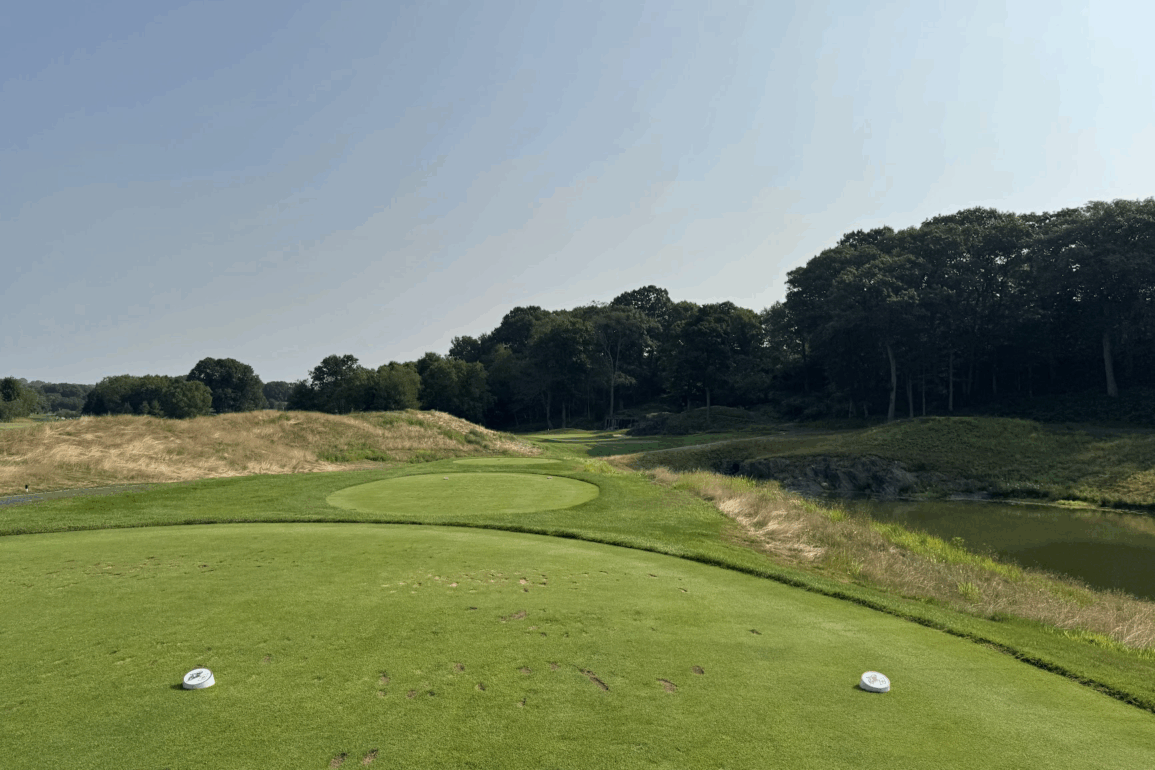
Category: Private

  • Great Neck Country Club

    Great Neck Country Club

    [put_wpgm id=”2″ width=”100%” height=”770px” current_post_only=”true”]

    [letsreview]

    Great Neck Country Club is a private par-71 course measuring approximately 6,460 yards from the tips. The course was originally designed in 1925 by William G. Robinson and is located in Waterford, Connecticut.

    The club originated in 1925 when local golf enthusiasts purchased a parcel of farmland along Lamphere Road, commissioning Charlie Brooks to design and construct the layout. Brooks, who had apprenticed at Royal Lytham and St. Annes in Lancashire, England and served as head professional at Old Lyme Golf Club, crafted the original routing on gently rolling terrain. The course opened for play in 1926 as New London Country Club, operating under that name for nearly nine decades. In 2003, the facility underwent a significant renovation by the architectural firm Cornish, Silva, and Mungeam, led by Ron Forse and Mark Mungeam. This renovation added 200 yards to the overall length and introduced four sets of tees to accommodate players of varying abilities. The Mortimer Family purchased the property in 2012, investing over three million dollars in comprehensive facility improvements and renaming it Great Neck Country Club. The property encompasses approximately 155 acres of rolling Connecticut countryside situated along the shoreline, with ocean breezes providing a distinctive coastal playing environment. The routing maintains a traditional out-and-back configuration with the front nine moving generally away from the clubhouse and the back nine returning. The design philosophy emphasizes strategic shot placement over pure length, with narrow tree-lined fairways and small undulating greens that reward accurate iron play. Players who appreciate strategic course management, precise approach shots, and classic golden-age design principles will find the layout particularly satisfying.

    Strategic Test

    HandicapCourse Strategy
    High Handicap (18+)High handicappers will find the most enjoyment from the White tees at 5,840 yards with a rating of 68.5 and slope of 120. This tee configuration reduces the pressure on driving distance while maintaining strategic interest. The slope rating suggests that double bogey golf remains achievable for players in this range, with the course playing approximately 10-12 strokes over par for an 18-handicapper. The par-3 14th hole at 160 yards from the White tees serves as an excellent example of accessible yet interesting design. This short iron requires nothing more than a smooth 7 or 8-iron for most players, with the primary challenge coming from club selection and committing to the yardage rather than navigating forced carries or extreme hazards. The green accepts a well-struck shot, and missing slightly short presents a manageable recovery rather than a penalty.
    Mid Handicap (8-18)Mid-handicap players will appreciate the Blue tees at 6,140 yards, offering a rating of 70.2 and slope of 123. This configuration presents legitimate scoring opportunities while demanding consistent ball striking and course management. The slightly elevated slope rating indicates the course becomes notably more challenging for players who miss fairways or leave themselves in unfavorable positions. Expect to play 4-6 strokes over par from these tees as a 10-handicapper. The par-4 10th hole at 375 yards from the Blue tees exemplifies strategic design perfectly suited to this skill level. Listed as the signature hole, it demands accuracy off the tee to avoid water left and fairway bunkers right. A well-positioned drive leaves a mid-iron approach to a green that accepts shots from the proper angle. Length alone cannot overcome poor positioning, rewarding players who think their way around rather than simply attempting to overpower the design.
    Low Handicap (0-8)Low handicappers should engage the Black tees at 6,460 yards with a rating of 71.8 and slope of 125. While the overall yardage may appear modest by modern championship standards, the narrow corridors and premium placed on accuracy create a stern examination. The slope rating of 125 suggests the course defends par through precision requirements rather than brute length. Single-digit players can expect to shoot near par, with the course rating indicating a scratch player should average 71.8. The par-4 13th hole at 455 yards from the Black tees ranks as the number one handicap hole and provides the ideal test for accomplished players. This demanding two-shotter requires a bold tee ball to establish position, followed by a long approach that must find the correct portion of the green. The hole rewards skilled players who can execute consecutive quality shots while punishing those who lose focus or attempt to salvage poor drives.

    Nearby Course Alternatives

    Black Hall Club in Old Lyme provides the most compelling private alternative within 20 minutes northwest of Waterford. The Robert Trent Jones Sr. design opened in 1967 and measures 6,659 yards from the tips with a rating of 73.0 and slope of 140, presenting a notably stiffer challenge than Great Neck. The property encompasses approximately 160 acres of pristine Connecticut countryside along the shoreline, with the routing taking full advantage of elevation changes throughout. Jones crafted a layout that emphasizes heroic shot values and strategic decision-making, with the par-5 11th serving as a prime example of risk-reward architecture where proper positioning off the tee determines whether the green can be reached in two. The architectural pedigree runs deep, with Jones and his associate Roger Rulewich returning in 1987 for refinements that enhanced the original design intent. Strategic complexity defines the experience, as Jones incorporated his trademark elevated greens flanked by bunkers, creating approach shots that demand precise distance control. The course has hosted all major Connecticut championships and several USGA qualifiers, reflecting its standing among the state’s premier private facilities. Players who thrive on courses with significant elevation changes, prefer a longer and more demanding test, or appreciate the bold architectural statements characteristic of Robert Trent Jones Sr. will find Black Hall offers a distinct experience from Great Neck’s more intimate, strategic layout. The higher slope rating indicates that while single-digit handicappers may find both courses comparably challenging, mid and high handicappers will face notably more difficulty at Black Hall.

    Stonington Country Club in Stonington offers another private option approximately 25 minutes east of Waterford along the Connecticut coast. The facility opened in 1992 with original design work by Al Zikorus, followed by a 1994 renovation by Ron Forse that refined the strategic elements. The par-72 championship layout stretches 6,510 yards from the back tees with a rating of 71.8 and slope of 131, positioning it between Great Neck and Black Hall in terms of overall difficulty. Spread across 155 acres of rolling hills and meadows, the routing emphasizes variety through a mix of more open and tighter holes, with elevation changes adding dimension to club selection. The course employs minimal water hazards, instead favoring strategic bunkering to define playing corridors and frame greens. The design philosophy creates opportunities for diverse shot-making, with multiple par-4s in the moderate to long range that reward accuracy over pure distance. Four doglegs balanced between left and right turns ensure players cannot rely on a single shot shape throughout the round. Forse’s renovation work enhanced the strategic interest while maintaining accessibility for a range of skill levels, though the slope rating indicates the course presents legitimate challenges when approached from the wrong angles. Players who appreciate architectural variety, prefer a course with both open and tree-lined sections, and desire a slightly more forgiving experience than Black Hall while maintaining more challenge than typical resort courses will find Stonington Country Club particularly appealing. Mid-handicap players seeking a course that tests all aspects of their game without overwhelming them from the championship tees will discover the 131 slope rating provides an engaging but fair examination.

    Final Word

    Great Neck Country Club provides members with comprehensive practice facilities including a full driving range with five practice tees and unlimited balls for members, a practice putting green, and dedicated short-game practice areas for chipping and pitching. The range accommodates both mat and grass hitting stations depending on seasonal conditions. The practice amenities underwent expansion during the 2003-2004 renovation period, ensuring players have proper venues to refine all aspects of their game. The clubhouse features Langley’s Restaurant and Lounge, which uniquely opens to the public for dining while golf remains members-only. The restaurant offers three dining options with indoor seating, lounge service, and an outdoor patio overlooking the course, providing views of multiple holes including the 18th green. The facility has established itself as a premier wedding and special events venue throughout southeastern Connecticut, with the banquet room accommodating approximately 200 guests for weddings and corporate functions. The pro shop carries leading golf brands including TaylorMade, Titleist, and FootJoy for both equipment and apparel. What distinguishes Great Neck is its commitment to the fundamentals that define exceptional private club golf – a thoughtfully designed championship layout that rewards strategic thinking, immaculate course conditioning with fast true greens and tight fairways, comprehensive practice facilities, and a PGA professional staff led by Kevin Shea who has served the membership since his teenage years. The course proves its value not through gimmicks or excessive length, but through the timeless principle that accuracy and course management will always triumph over raw distance when architecture is properly executed.

  • Goose Run Golf Course

    Goose Run Golf Course

    [put_wpgm id=”2″ width=”100%” height=”770px” current_post_only=”true”]

    [letsreview]

    Goose Run Golf Course is a private par-34 course measuring approximately 2,466 yards from the tips. The course was originally designed in 1951 and is located in Groton, Connecticut.

    Goose Run Golf Course has served as a recreational amenity for Naval Submarine Base New London personnel since its establishment in 1951, though some records indicate a formal reopening or expansion in 1985. The course was originally established in 1947 according to some accounts, serving naval personnel and golf aficionados for over seven decades . The facility underwent a significant clubhouse renovation in 2012, which included a complete redesign of the pro shop and food service areas, along with the addition of an outdoor deck overlooking the Thames River . The course operates seasonally from April through November, weather permitting. Throughout its history, the course has maintained its original nine-hole layout while serving as an important recreational facility for military personnel stationed at the submarine base. The course has preserved its bent grass fairways and greens through the decades, incorporating water hazards and strategic bunkering into the compact layout. Recent maintenance practices have focused on maintaining playable conditions while working within the constraints of a military facility that prioritizes base operations over recreational amenities.

    The course occupies a relatively compact footprint on the submarine base property, utilizing undulating terrain that provides views of the Thames River . The routing maximizes the available acreage while navigating around military infrastructure and security requirements inherent to a naval installation. The layout features bent grass fairways and greens, water hazards, and a few strategically placed bunkers . The design philosophy emphasizes playability over length, creating a course that can be completed in under two hours while still demanding accurate shot-making. The terrain rolls gently through the property, with several holes playing along or near the Thames River shoreline. This military course attracts golfers seeking a quick nine holes with reasonable challenges, particularly those affiliated with the military community who appreciate the convenient on-base location and relaxed atmosphere compared to more formal civilian facilities.

    Strategic Test

    The strategic demands at Goose Run center on precision over power, with the short overall yardage placing a premium on accurate approach shots and careful course management. The course features several distinct challenges including the 467-yard par-5 fourth hole as the longest test, the 365-yard par-4 third hole which serves as the number one handicap hole, and the 105-yard par-3 ninth hole providing a short but precise finish . Players must navigate water hazards that come into play on multiple holes, demanding thoughtful club selection off the tee to avoid penalty strokes. The bent grass greens, while not overly contoured, require attention to speed control given the compact nature of the putting surfaces. With a slope rating of 103-109 and a course rating of 31.8, the course presents a relatively accessible challenge for golfers of all abilities . The absence of significant forced carries and the modest overall distance make the course particularly welcoming to beginning players and those with limited driving distance. Strategic decisions primarily revolve around avoiding water hazards and selecting appropriate angles of approach into the small greens.

    HandicapCourse Strategy
    High Handicap (18+)Playing from the forward tees at approximately 2,280 yards reduces the course to very manageable distances. Focus should be on keeping the ball in play and avoiding water hazards rather than attempting aggressive lines. The shorter overall yardage means most greens can be reached with mid-irons or wedges, reducing the impact of limited driving distance. The slope of 109 from these tees suggests minimal adjustment to handicap expectations.
    Mid Handicap (8-18)From the white tees at 2,466 yards, mid-handicappers should focus on course management and target selection. The key is identifying the safest routes to each green while taking calculated risks on scoring opportunities. The modest slope rating indicates that playing to handicap is achievable with smart decisions. Concentrate on approach shot accuracy as the short yardage provides numerous birdie opportunities.
    Low Handicap (0-8)The championship distance of 2,466 yards may seem uninspiring, but the course demands precision to score well. Low handicappers should view this as an opportunity to work on short game and course management skills. The slope of 103 suggests less advantage for better players, requiring exceptional accuracy to separate from the field. Focus on attacking accessible pin positions while respecting the water hazards that can quickly elevate scores.

    The par-3 ninth hole at 105 yards from the white tees represents the signature short-game test at Goose Run . This finishing hole demands precise distance control despite its minimal yardage, as the small green complex leaves little room for error. High handicappers playing from the forward tees face a shot of approximately 95 yards, making club selection crucial between a full swing with a sand wedge or a controlled swing with a pitching wedge. The key for these players is ensuring solid contact to carry any fronting hazards while avoiding the tendency to decelerate through impact on such a short shot. Mid-handicappers from 105 yards should focus on trajectory control, as wind off the Thames River can significantly affect ball flight on this exposed hole. The strategy involves selecting a club that allows for a comfortable three-quarter swing rather than trying to finesse a full wedge. Low handicappers have the opportunity to attack the pin from this distance, but must account for the green’s limited depth and any subtle slopes that affect ball reaction upon landing. The hole rewards players who can control both distance and spin, as the ability to stop the ball quickly near the hole location becomes paramount for birdie opportunities.

    Nearby Course Alternatives

    Shennecossett Golf Course in Groton presents a comprehensive contrast to Goose Run as an 18-hole municipal layout stretching 6,562 yards from the championship tees with a slope of 122-124 and rating of 71.5-71.7. This Donald Ross design dates to 1898 with significant Ross redesigns in 1916 and 1919 . The course underwent modifications in 1997 when the town performed a land swap with Pfizer, losing three holes but gaining three new holes along the Thames River and Long Island Sound . Located less than five minutes west of Goose Run, Shennecossett occupies substantially more acreage and features dramatic elevation changes, particularly on its oceanside holes. The Ross-designed green complexes showcase the architect’s signature contouring and strategic bunkering, creating a far more demanding test than Goose Run. The par-3 fourth hole has been rated the top par-3 in Connecticut by state club professionals . Players seeking a regulation-length test with classic architecture and superior conditioning would find Shennecossett appealing, particularly those who appreciate the strategic demands of Donald Ross designs and desire a walking-friendly layout with scenic water views.

    Norwich Golf Course in Norwich extends 6,228 yards from the back tees with a slope of 131 and rating of 70.0, providing another full-length alternative to Goose Run. Designed by Tull & Tull and opened in 1926, this municipal course features undulating terrain constructed over varied topography playing to a par of 71 . Located approximately 24 minutes north of Goose Run, Norwich Golf Course offers a more substantial test across its rye grass fairways and greens. Recent improvements have focused on course conditioning, with golfers noting the true and fast greens along with well-groomed fairways and tee boxes . The layout demands various shot shapes and club selections across its elevation changes, providing strategic interest absent from Goose Run’s flatter terrain. The course features interesting and scenic holes throughout the routing, with particular emphasis on accurate approach shots into well-protected greens . Higher handicap players who prefer tree-lined fairways and enjoy working the ball through elevation changes would appreciate Norwich’s more traditional parkland style compared to Goose Run’s compact military course layout.

    Final Word

    The facility’s practice amenities remain modest, befitting a military recreation facility rather than a full-service golf complex. While specific practice facilities are limited, the course operates on a first-come, first-served basis without requiring tee times, allowing for spontaneous play . The renovated clubhouse houses a pro shop with golf merchandise, along with a full-service food and beverage area featuring both indoor seating and an outdoor deck overlooking the Thames River . The facility also provides catering services for special events, making it a popular venue for military ceremonies and gatherings. Additional amenities include rental clubs and pull carts, though the compact layout makes walking the nine holes easily manageable for most players . The seasonal operation from April through November means the facility maximizes its use during New England’s prime golf months while avoiding the maintenance challenges of year-round operation. The relaxed atmosphere and lack of formal tee time requirements create an environment where military personnel can enjoy quick nine-hole rounds without the formality of traditional country clubs.

    Goose Run Golf Course occupies a unique niche as one of Connecticut’s few military golf facilities, providing accessible recreation for naval personnel and authorized guests within the secure confines of Naval Submarine Base New London. The course’s modest length and relatively gentle slope rating create an environment where beginning golfers can develop their skills while experienced players can work on their short game and course management. The breathtaking views of the Thames River distinguish the course from other short layouts, providing a scenic backdrop that enhances the playing experience beyond what the modest yardage might suggest . The recent clubhouse improvements demonstrate the military’s commitment to maintaining quality recreational facilities for service members, even as the course itself retains its original character. For military personnel seeking convenient golf without leaving base, Goose Run provides an invaluable amenity that balances playability with enough strategic interest to remain engaging over repeated rounds. The course succeeds in its mission to provide accessible golf recreation for the military community while maintaining conditions and facilities that honor the service of those who defend our nation.

  • Grassmere Country Club

    Grassmere Country Club

    [put_wpgm id=”2″ width=”100%” height=”770px” current_post_only=”true”]

    [letsreview]

    Grassmere Country Club is a public par-35 course measuring approximately 3,065 yards from the tips. The course was originally designed in 1976 and is located in Enfield, Connecticut.

    The Kamerer family established Grassmere Country Club on former Connecticut River Valley farmland, transforming rolling agricultural acreage into a regulation nine-hole layout that has maintained its character for nearly five decades. The property encompasses approximately 65 acres of gently undulating terrain that transitions between open meadow and mature tree corridors. The routing follows natural topographical features, with several holes ascending modest slopes while others descend toward low-lying areas where a meandering brook becomes a strategic element. The design philosophy emphasizes width over penal narrowness, presenting fairway corridors that reward thoughtful positioning rather than demanding surgical precision. Four holes feature right-bending doglegs, creating a bias toward fade-friendly tee shots that can work the ball around corner hazards. The course particularly suits players who appreciate strategic variety within a compact footprint, offering enough challenge through green complexes and elevation changes to engage low-handicap golfers while maintaining accessibility for developing players through generous landing areas and recoverable misses. The overall aesthetic balances pastoral tranquility with functional golf design, providing an environment where course management decisions matter more than raw distance.

    Strategic Test

    HandicapCourse Strategy
    High Handicap (18+)Players in this range will find appropriate challenge from the forward tees at 2,673 yards, where the 113 slope adds approximately 13 strokes to par for an expected score around 48 for double-digit rounds. The seventh hole, a par-4 measuring 301 yards from the championship tees, exemplifies ideal strategic opportunities for this category. The modest distance removes driver anxiety while maintaining design interest through the dogleg-right configuration and uphill approach to a raised green fronted by substantial bunkering. Higher-handicap players can comfortably navigate this hole with fairway wood or long iron positioning, leaving a manageable mid-iron approach that rewards accuracy over power. The slope impact means course management becomes critical, as penalty strokes from hazards or aggressive lines multiply quickly against the rating.
    Mid Handicap (8-18)From the white tees measuring approximately 2,850 yards, mid-handicap players face a balanced examination that emphasizes precision over distance. The slope of 113 translates to roughly 8-10 additional strokes beyond the scratch golfer’s expected score, producing target scores in the low-to-mid 40s for this bracket. The fourth hole, Grassmere’s number one handicap at 404 yards as a par-4, provides the definitive test for this skill level. The tee shot demands a controlled fade around substantial tree mass along the right corridor, with pull tendencies finding dense rough and potential tree interference on the left. The approach plays strongly uphill to a blind green surface protected by an extensive right-side bunker complex, requiring accurate distance control and proper club selection accounting for both elevation and visual deception. This hole rewards strategic thinkers who accept conservative positioning over heroic attempts, as the slope rating amplifies mistakes made through overaggression.
    Low Handicap (0-8)Accomplished players navigating the 3,065-yard championship routing will find Grassmere’s 35.5 rating creates genuine scoring challenges despite modest yardage. The slope of 113 indicates relatively proportional difficulty between scratch and bogey golfers, suggesting design features that test all skill levels equitably. The sixth hole, a par-5 ranging from 446 to 475 yards depending on tee placement, exemplifies strategic risk-reward architecture that engages single-digit players. The sweeping dogleg-right presents genuine green-in-two opportunities for players capable of controlled power, but a brook positioned approximately 180 yards from the green creates a legitimate hazard for overly aggressive drives. Low-handicap golfers must decide between laying back to a comfortable full-wedge distance or challenging the dogleg apex with a drawing tee shot that optimizes the angle for a mid-iron approach to the slightly elevated, tree-framed green. The narrow opening to the putting surface punishes imprecise second shots regardless of power, emphasizing that course rating derives from strategic complexity and green defense rather than pure length.

    Nearby Course Alternatives

    Rolling Meadows Country Club in Ellington sits approximately 10 minutes east of Grassmere and represents the area’s premier public eighteen-hole experience. Architect Al Zikorus opened this 6,818-yard par-72 layout in 1997 on approximately 150 acres that blend parkland styling with dramatic elevation throughout the property. The course rating of 72.3 paired with a slope of 125 indicates significantly greater challenge than Grassmere, particularly for mid-to-high handicap players who will find the slope differential adding 4-6 strokes to expected scores. Rolling Meadows distinguishes itself through substantial topographical variation, with the back nine carved into wooded hillsides that create severely sloping lies and demanding positional requirements off the tee. The front nine adopts a more open, links-influenced character with generous fairway widths that mirror Grassmere’s approach but extend across greater yardage and more undulating terrain. Zikorus integrated both brutality and aesthetics, routing holes through corridors where wayward shots encounter thick rough and challenging recovery positions while providing panoramic views of the Connecticut River Valley and distant Berkshire foothills. The green complexes feature more severe internal contouring than Grassmere’s table surfaces, demanding superior touch around the greens. Rolling Meadows appeals most to low-handicap players seeking a comprehensive strategic examination and mid-handicap golfers willing to accept a fuller test of ball-striking across varied terrain and longer forced carries, particularly those who value modern course conditioning standards and prefer eighteen-hole variety over nine-hole efficiency.

    Airways Golf Course in West Suffield provides an accessible alternative approximately 12 minutes west of Grassmere, offering an eighteen-hole Geoffrey Cornish design from 1973 that measures 5,845 yards from the championship tees with a par of 71. The course rating of 66.0 and slope of 106 create a significantly softer examination than either Grassmere or Rolling Meadows, positioning Airways as ideal for high-handicap players and beginners seeking confidence-building rounds without sacrificing design integrity. Cornish, a master of budget-conscious architecture, maximized the relatively flat former farmland through strategic bunker placement, selective water hazards affecting five holes, and tree-lined corridors that frame approaches without creating penal narrowness. The property spans approximately 100 acres of ex-agricultural land with minimal elevation change, contrasting sharply with Grassmere’s rolling topography and emphasizing accuracy over power throughout the routing. Airways features thoughtful par-3 variety through five short holes and balances scoring opportunities with defensive design elements, though the modest slope rating indicates high-handicap players face proportionally less difficulty than at courses with steeper slope gradients. The conditioning maintains public-course standards focused on playability rather than country-club presentation, with firm fairways and consistent rough cuts that promote pace of play. Airways particularly suits high-handicap players seeking full-length rounds without intimidation, seniors prioritizing walkability across gentle terrain, and developing golfers who benefit from Cornish’s strategic clarity where proper shot execution receives appropriate reward without excessive penalty for minor misses.

    Final Word

    Grassmere’s practice facilities encompass a dedicated putting green and separate chipping area that provide adequate warm-up opportunities, though the property does not include a driving range for full-swing preparation. The putting surface replicates the firm, quick conditions found on the course itself, with sufficient undulation to practice breaking putts that mirror the challenges awaiting on the layout’s pitched greens. The chipping area features multiple landing zones and allows players to rehearse the delicate touch required around Grassmere’s raised green complexes, where short-game proficiency often determines scoring success. The essential character of Grassmere Country Club emerges through its commitment to strategic golf architecture within an efficient nine-hole format, prioritizing thoughtful routing and green defense over length-based intimidation. The course proves its value by maintaining country-club conditioning standards at public-access rates, with fairway presentation, rough consistency, and green speeds that rival higher-priced facilities throughout the Hartford region. The Kamerer family’s stewardship has preserved the original design intent while elevating maintenance practices to contemporary expectations, creating an environment where course conditions enhance rather than compromise the strategic examination. The layout’s genius lies in its varied hole lengths and strategic requirements compressed into nine distinct tests, with no weak designs among the routing and multiple holes worthy of discussion in any evaluation of Connecticut’s best short layouts. Players seeking authentic golf architecture divorced from modern excess will find Grassmere delivers substance over spectacle, rewarding course management and precision while maintaining accessibility for developing players through generous fairway corridors. The combination of rolling farmland aesthetics, strategic variety, exemplary conditioning, and family-operated hospitality positions Grassmere as an essential destination for golfers who understand that superior design transcends pure yardage and that nine exceptional holes provide more satisfaction than eighteen mediocre ones.

  • Golf Club of Avon – White/Blue

    Golf Club of Avon – White/Blue

    [put_wpgm id=”2″ width=”100%” height=”770px” current_post_only=”true”]

    [letsreview]

    Golf Club of Avon is a private par-70 course measuring approximately 6,700 yards from the tips. The course was originally designed in 1929 by Robert J. Ross and is located in Avon, Connecticut.

    The Golf Club of Avon traces its origins to 1925, when Samuel Graham of Unionville and Dr. Ralph Cox of Collinsville envisioned creating a golf facility in the Farmington Valley. The original property consisted of the 60-acre Stillwell Farm in Avon, which was purchased and developed into an initial nine-hole layout with professional Charles Henderson overseeing play. By 1927, construction began on the clubhouse using lumber harvested from nearby woods and water drawn from springs discovered on the property. Ross created the Red nine in 1926 as the inaugural layout, then returned in 1929 to design the White nine, completing two-thirds of what would become a 27-hole facility. The course received significant architectural attention in 1937 when A.W. Tillinghast visited to modify the Red and White nines, refining the strategic elements and bunkering schemes that define much of the layout today. The original routing was reorganized in 1963 so that the first nine holes concluded at the clubhouse. The third nine, known as the Blue course, opened for play in 1967, designed by Geoffrey Cornish and Bill Robinson to provide additional playing capacity and create three distinct 18-hole combinations. This expansion gave the club considerable versatility while maintaining the architectural integrity of the original Ross-Tillinghast nines.

    The White/Blue combination occupies an estimated 150 acres of gently rolling terrain characteristic of the Farmington Valley region. The routing juxtaposes two distinct design eras, with the White nine reflecting Ross’s golden age principles refined by Tillinghast’s 1937 modifications, while the Blue nine exhibits the more contemporary design sensibilities of Cornish and Robinson from the 1960s. The property features modest elevation changes that create natural amphitheater settings around several greens, though the course never presents severe uphill or downhill lies. Mature tree canopies frame most fairways on the White nine, establishing defined playing corridors, while the Blue nine incorporates more open sightlines and strategic bunkering patterns characteristic of mid-century American design. The White nine begins the routing with Ross’s thoughtful placement of hazards and green complexes that reward specific approach angles, while the Blue nine concludes play with a different aesthetic that emphasizes broader strategic options and more visible defensive features. Players who appreciate architectural diversity will find the combination engaging, as the contrast between classic golden age design and 1960s modernism creates varied strategic challenges. The White/Blue configuration particularly appeals to members seeking a thorough test of adaptability, as the shifting design philosophies between the two nines demand different shot-making priorities and course management approaches throughout the round.

    Strategic Test

    The White/Blue combination presents strategic decision-making through the interplay between two distinct architectural philosophies separated by nearly four decades. The White nine opens play with Ross’s signature placement strategies refined by Tillinghast, where optimal driving lines frequently conflict with preferred green angles, creating legitimate choices about risk and reward. The par-4s on the White nine range significantly in length, with some holes offering drivable opportunities for longer hitters while others demand careful positioning over pure distance. The strategic complexity on the White nine derives primarily from green contouring and hazard placement that rewards specific approach trajectories, requiring players to think several shots ahead when selecting tee shot positions. The Blue nine transitions into Cornish and Robinson’s mid-century design approach, which tends toward more visible strategic elements with broader fairway corridors and larger, more receptive greens that accommodate various approach styles. The architectural contrast creates an interesting strategic dynamic where players must adjust their decision-making frameworks between the two nines, with the White rewarding precision and positioning while the Blue generally offers more recovery options for wayward shots. The combination works effectively because neither nine overwhelms the other stylistically, instead creating a balanced 18-hole examination that tests different aspects of strategic thinking.

    Understanding slope and rating proves essential for strategic planning and handicap calculation. The course rating represents the expected score for a scratch golfer playing from a particular set of tees under normal conditions, while slope rating measures the relative difficulty for bogey golfers compared to scratch golfers on a scale from 55 to 155, with 113 representing a course of standard difficulty. A higher slope indicates that the course becomes disproportionately more difficult for higher handicap players, typically due to forced carries, severe hazards, narrow fairways, or heavily contoured greens. The White nine carries a rating of 71.0 with a slope of 125, while the Blue nine features a rating of 70.4 with a slope of 129, suggesting the Blue plays slightly easier for scratch golfers but presents more challenges for higher handicappers. The combined White/Blue routing averages these metrics, creating a layout that defends par effectively across skill levels through varied architectural approaches. These slope and rating variations directly impact course handicap calculations, with higher slopes resulting in more strokes received for a given handicap index, thereby ensuring equitable competition regardless of which 18-hole combination members choose to play.

    HandicapCourse Strategy
    High Handicap (18+)From the forward tees with reduced yardage and lower slope ratings, the White/Blue combination becomes accessible while maintaining architectural interest. Strategic priorities shift toward course management rather than aggressive scoring, with emphasis on finding fairways and avoiding penalty situations. The shorter yardages reduce forced carries over hazards and allow higher handicappers to reach most par-4s in regulation with two solid strikes. The Blue nine generally proves more forgiving from forward tees due to its mid-century design philosophy favoring broader landing areas and more receptive greens. Focus should remain on steady execution rather than attempting heroic recovery shots, as both nines reward consistent ball-striking over occasional brilliance. The moderate combined slope indicates course difficulty increases somewhat for bogey golfers but remains manageable with sound strategy and club selection appropriate to ability level.
    Mid Handicap (8-18)From the middle tees with moderate length and balanced slope ratings, the White/Blue combination provides optimal challenge through its architectural diversity. Strategic decisions become more meaningful as players possess sufficient length to reach most holes in regulation while still needing to navigate the contrasting design features thoughtfully. The White nine demands more precise positioning due to Ross’s routing principles and Tillinghast’s bunkering refinements, while the Blue nine offers slightly more latitude for recovery due to Cornish and Robinson’s broader playing corridors. Key strategic considerations include recognizing which holes reward aggressive positioning versus those favoring conservative play, identifying the optimal approach angles into Ross-designed greens on the White nine, and understanding when the more visible hazards on the Blue nine genuinely threaten versus when they create optical intimidation without substantial penalty. The architectural contrast provides an educational experience as players learn to adjust strategy based on design era and philosophy.
    Low Handicap (0-8)Championship play from the back tees at approximately 6,700 yards with an average slope around 127 demands both precise execution and strategic adaptability across design philosophies. Low handicappers must carefully evaluate the architectural principles underlying each nine and adjust their decision-making accordingly, as the White nine rewards Ross’s emphasis on positioning and angle creation while the Blue nine responds better to aggressive, contemporary scoring strategies. The White nine generally presents more sophisticated green contouring that complicates approach work and requires precise distance control, while the Blue nine features bolder, more readable defensive elements that allow for calculated risk-taking. Green reading becomes critical on the Ross-designed holes where subtle contours deflect approaches, while the Cornish-Robinson greens demand more focus on lag putting from distance due to their larger footprints. The combination reveals its full strategic depth only through repeated play, as understanding the optimal lines and landing areas requires familiarity with how the two distinct design philosophies defend par differently.

    The finishing 9th hole on the Blue nine serves as the concluding examination and reflects the mid-century design principles of Cornish and Robinson. This hole presents players with strategic options that differ from the Ross-Tillinghast aesthetic dominating the White nine. The hole exemplifies the broader, more visible strategic features characteristic of 1960s design, with its defensive elements clearly presented rather than subtly concealed. Players completing the White/Blue routing appreciate how the architectural journey transitions from Ross’s golden age positioning strategies through Tillinghast’s refinements into Cornish and Robinson’s more contemporary approach. The finishing hole rewards course management throughout, as players who maintain strategic discipline through the contrasting design philosophies can conclude their round positively regardless of skill level. From the championship tees, the hole demands thoughtful club selection and route planning, while mid-handicappers from the middle tees find the strategic options clearly presented and accessible. High handicappers from the forward tees can navigate the hole successfully with steady execution, making par an achievable goal that provides satisfying closure to the round.

    Nearby Course Alternatives

    Tumble Brook Country Club in Bloomfield offers 27 holes of contrasting architectural pedigree approximately 10 minutes northeast of Avon. The facility features three distinct nines designed by different architects across nearly five decades, creating an eclectic but engaging experience. The Red nine, designed by Willie Park Jr. in 1924 and measuring 3,327 yards at par-36, predates the Ross work at Avon by two years and exhibits classic golden age principles with understated bunkering and strategic green placements. Orrin E. Smith contributed the Blue nine in 1949, measuring 3,455 yards at par-36, with a more parkland aesthetic featuring tree-lined corridors and moderate elevation changes. George Fazio completed the triumvirate with the Green nine in 1971, bringing a more modern sensibility at 3,305 yards and par-35 with bolder contouring and aggressive green complexes. Mark McCumber renovated all 27 holes in 2005, modernizing playing surfaces and bunker styles while respecting the original design intent. The Smith/Fazio combination measures approximately 6,760 yards with slope ratings in the mid-130s, presenting similar architectural diversity to Avon’s White/Blue but with more dramatic internal green movement courtesy of McCumber’s renovation work. The property encompasses roughly 175 acres with more pronounced elevation changes than Avon, particularly on the Smith and Fazio nines. Players who gravitate toward Tumble Brook over Avon typically prefer more visible strategic features and enjoy the novelty of experiencing three distinct architectural voices within a single facility, along with those who favor courses with pronounced topographical variety that creates more diverse shot requirements and appreciate the cohesion McCumber’s renovation brought to the disparate design eras.

    Hartford Golf Club in West Hartford presents a more refined and historically significant option approximately 10 minutes south of Avon. Founded in 1896, Hartford Golf Club predates Avon by nearly three decades and carries substantial architectural pedigree through the combined work of Devereux Emmet and Donald Ross in 1914. The facility features 27 holes with three different 18-hole combinations, though the Blue/Green pairing measuring approximately 6,520 yards at par-70 offers appropriate comparison to Avon’s White/Blue layout in terms of length and challenge. The course rating of approximately 71.6 with a slope around 135 presents slightly more difficulty than Avon, though Hartford generally features more sophisticated green contouring reflective of Ross’s mature design philosophy. Recent restoration work by Ron Forse and Bruce Hepner in 2017, with earlier modifications by Stephen Kay in 1996, has returned many Ross design elements to their original strategic intent while accommodating contemporary playing distances. The course occupies approximately 165 acres of gently rolling terrain similar to Avon but maintains stylistic consistency across all 27 holes since all were designed by the same architectural team, unlike Avon’s mix of Ross-Tillinghast and Cornish-Robinson work. Hartford Golf Club maintains championship conditions with bent grass putting surfaces that run considerably faster than those at Avon, demanding more precise speed control and green reading ability. Players who prefer Hartford over Avon typically possess lower handicaps and appreciate the architectural cohesion of a single design vision executed across the entire property, faster green speeds that reward precise ball-striking, and the historical significance of playing a Ross design in its refined state, along with those who value the prestige associated with one of Connecticut’s premier private clubs with deeper historical roots and more consistent golden age design principles throughout.

    Final Word

    The practice facilities at Golf Club of Avon provide comprehensive preparation for play with a driving range featuring mat stations, a dedicated putting green with multiple hole locations for reading practice, and a short-game area including a practice bunker for working on greenside technique. The range offers sufficient distance for driver work while maintaining separate areas for wedge precision. Members can refine all aspects of their game before heading to the first tee, with the practice green’s speed and firmness closely matching on-course conditions.

    Beyond golf, the club functions as a full-service family destination with extensive recreational offerings. The aquatic facility features a heated Olympic-sized pool with zero-entry sections accommodating young children, a dedicated diving well, and a surrounding deck area with ample seating and shade structures. The racquet center encompasses eight meticulously maintained Har-Tru tennis courts with evening lighting, four pickleball courts responding to growing member interest, and three heated paddle tennis courts enabling year-round play. The clubhouse underwent significant renovations in 2008, expanding and modernizing both men’s and women’s locker rooms with enhanced amenities and storage. The dining program operates in multiple settings, including a formal dining room for private events and member celebrations, a family dining room accommodating casual meals, and a pub environment favored for post-round gatherings with an expanded patio overlooking the golf course. The facility hosts extensive social programming throughout the season, with member tournaments, junior golf clinics, family swim meets, and tennis leagues creating an active community atmosphere. The club’s commitment to junior programming extends beyond golf to include youth tennis instruction following USTA protocols and swimming teams competing regionally.

    Golf Club of Avon distinguishes itself through the thoughtful combination of golden age design principles with mid-century architectural evolution across a property that rewards strategic adaptability. The White/Blue combination showcases the progression of American golf course architecture, with Ross’s 1929 routing refined by Tillinghast in 1937 flowing into Cornish and Robinson’s 1967 design that reflects the sport’s evolution during the post-war era. This architectural journey provides members with an educational experience about design philosophy changes across four decades while maintaining playability and strategic interest throughout. The three-course configuration provides exceptional flexibility for member play without the pressure of tee times, allowing spontaneous rounds and varied hole combinations that prevent monotony. The family-oriented atmosphere transcends typical golf club models, with genuine attention to programming that engages all ages and skill levels across multiple recreational disciplines. The course challenges better players from the back tees while remaining genuinely enjoyable for higher handicappers from forward positions, a balance achieved through the complementary nature of the two design philosophies rather than through forced compromise. The architectural diversity brings substance to the playing experience, with design features from two distinct eras that reveal how different approaches can both create engaging strategic golf. The location in the Farmington Valley positions members within convenient reach of Greater Hartford while maintaining a secluded, parkland setting. The combination of architectural evolution, comprehensive amenities, and genuine community atmosphere creates a club where golf excellence across different design eras coexists comfortably with family recreation, establishing Golf Club of Avon as a facility that honors its century-long tradition while demonstrating how thoughtful expansion can enhance rather than dilute the original vision.

  • Golf Club of Avon – Red/White

    Golf Club of Avon – Red/White

    [put_wpgm id=”2″ width=”100%” height=”770px” current_post_only=”true”]

    [letsreview]

    Golf Club of Avon is a private par-71 course measuring approximately 6,607 yards from the tips. The course was originally designed in 1926 by Robert J. Ross and is located in Avon, Connecticut.

    The Golf Club of Avon traces its origins to 1925, when Samuel Graham of Unionville and Dr. Ralph Cox of Collinsville envisioned creating a golf facility in the Farmington Valley. The original property consisted of the 60-acre Stillwell Farm in Avon, which was purchased and developed into an initial nine-hole layout with professional Charles Henderson overseeing play. By 1927, construction began on the clubhouse using lumber harvested from nearby woods and water drawn from springs discovered on the property. The facility was officially incorporated in 1928 with the completion of the clubhouse. Ross created the Red nine in 1926 as the inaugural layout, establishing the architectural foundation that would define the property. Ross returned in 1929 to design the White nine, completing two-thirds of what would become a 27-hole facility. The course received significant architectural attention in 1937 when A.W. Tillinghast visited to modify all three nines, refining the strategic elements and bunkering schemes that define the layout today. During World War II, the club faced financial difficulties and was purchased by the City Club of Hartford in 1945, operating as a two-way combination facility until the clubs separated. The White nine represents Ross’s more mature design thinking, as he had gained three additional years of experience between creating the Red and White nines, resulting in subtle but meaningful differences in green contouring and strategic complexity.

    The Red/White combination occupies an estimated 150 acres of gently rolling terrain characteristic of the Farmington Valley region. The routing follows a traditional out-and-back configuration with the Red nine forming the outward half and the White nine completing the return journey. The property features modest elevation changes that create natural amphitheater settings around several greens, though the course never presents severe uphill or downhill lies. Mature tree canopies frame most fairways, establishing defined playing corridors that demand accuracy from the tee while still providing recovery options for wayward shots. The design philosophy reflects the golden age principles of both Ross and Tillinghast, with strategic bunkering that creates risk-reward scenarios rather than penal hazards. The White nine exhibits slightly more sophisticated green contouring than the Red, reflecting Ross’s evolution as a designer during the three-year gap between the two constructions. Players who appreciate classic architecture will find the routing thoughtful and the green complexes varied in their defensive characteristics. The Red/White configuration suits members seeking a thorough examination of ball-striking consistency without requiring excessive length, as proper positioning frequently outweighs raw distance. This layout particularly appeals to golfers who value strategic variety and prefer courses that reward course management over brute force.

    Strategic Test

    The Red/White combination presents strategic decision-making primarily through green complex defense and corridor framing rather than forced carries or dramatic hazards. From the championship tees at approximately 6,607 yards, players face several holes where the optimal driving line conflicts with the preferred angle into the green, creating legitimate choices about accepting narrower landing areas in exchange for better approach positions. The White nine features more pronounced strategic elements than the Red, as Ross had refined his design philosophy during the three years between creating the two layouts. The par-4s range from drivable length to substantial examinations exceeding 440 yards, ensuring varied club selections throughout the round. The par-5s provide distinct strategic profiles, with some offering legitimate eagle opportunities for longer hitters while others demand three carefully plotted shots for most players. The par-3s vary in length and green orientation, testing different club selections and demanding precision to targets that feature subtle internal contours. The course rewards players who can work the ball in both directions, as several holes favor fades while others benefit from draws based on green orientation and hazard placement. Mid-handicappers from the appropriate tees find ample strategic interest without overwhelming difficulty, while higher handicappers can enjoy the architectural features without constant penalty. The Tillinghast modifications in 1937 enhanced the strategic complexity by introducing more sophisticated bunkering patterns that create visual intimidation while offering ground-game alternatives for players uncomfortable with aerial approaches.

    Understanding slope and rating proves essential for strategic planning and handicap calculation. The course rating represents the expected score for a scratch golfer playing from a particular set of tees under normal conditions, while slope rating measures the relative difficulty for bogey golfers compared to scratch golfers on a scale from 55 to 155, with 113 representing a course of standard difficulty. A higher slope indicates that the course becomes disproportionately more difficult for higher handicap players, typically due to forced carries, severe hazards, narrow fairways, or heavily contoured greens. The championship tees at Golf Club of Avon carry a slope of 128 with an approximate rating of 72.0, suggesting the course presents above-average difficulty with particular challenges for bogey-level players. These slope and rating variations directly impact course handicap calculations, with higher slopes resulting in more strokes received for a given handicap index, thereby ensuring equitable competition across different skill levels. Players must consider how these values affect their strategic approach, as courses with elevated slopes often punish mistakes more severely than those with standard slopes.

    HandicapCourse Strategy
    High Handicap (18+)From the forward tees with reduced yardage and lower slope ratings, the course becomes highly accessible while maintaining architectural interest. Strategic priorities shift toward course management rather than aggressive scoring, with emphasis on finding fairways and avoiding penalty situations. The shorter yardages reduce forced carries over hazards and allow higher handicappers to reach par-4s in regulation with two solid strikes. Focus should remain on positioning tee shots in the wider portions of fairways and accepting center-green approaches rather than attacking tucked pins. The relatively moderate slope from forward tees indicates the course difficulty remains consistent across skill levels, meaning bogey golfers face proportionally similar challenges as scratch players.
    Mid Handicap (8-18)From the middle tees with moderate length and balanced slope ratings, the course provides optimal challenge without excessive difficulty. Strategic decisions become more meaningful as players possess sufficient length to reach most holes in regulation while still needing to navigate the architectural features thoughtfully. The moderate slope indicates the course difficulty increases somewhat for bogey golfers but remains manageable with sound strategy. Key strategic considerations include identifying which par-5s remain legitimate three-shot holes versus potential two-shot opportunities, selecting appropriate angles off tees to set up favorable approach trajectories, and recognizing when to attack pins versus playing to the fat of greens. The Tillinghast bunkering becomes more relevant at this level, as players possess the skill to consider risk-reward scenarios involving centerline hazards.
    Low Handicap (0-8)Championship play from the back tees at 6,607 yards with an elevated slope of 128 demands precise execution and strategic sophistication. The elevated slope indicates the course defends par effectively through subtle architectural features rather than obvious penalty areas. Low handicappers must carefully evaluate risk-reward scenarios on driving holes where aggressive lines yield shorter approaches but introduce trouble. The combination of Ross’s routing principles and Tillinghast’s bunkering refinements creates a layout that reveals additional strategic layers through repeated play. Green reading becomes critical as the subtle contours deflect approaches and complicate lag putting from distance. The White nine generally presents more strategic complexity than the Red, with more sophisticated green contouring that demands precise distance control and trajectory management.

    The finishing 18th hole serves as the final examination on the White nine and exemplifies the strategic principles woven throughout the Red/White routing. This par-4 from the championship tees demands accuracy to a fairway that narrows in the optimal landing zone, where longer hitters must decide between aggressive driver lines or conservative positioning with fairway woods. The approach plays to a green complex with enough internal movement to complicate three-putt avoidance without resorting to severe slopes. The hole rewards course management throughout, as players who overextend risk finding trouble, while those who play within their capabilities can finish the round on a positive note. From the middle tees, the hole transitions into a manageable par-4 for mid-handicappers, with the optimal strategy involving a controlled tee shot followed by a precise approach to the proper tier. High handicappers from the forward tees find the hole achievable with steady execution, making par a realistic goal with two well-struck shots. The architectural elements reflect both Ross’s routing sensibilities and Tillinghast’s refinement touches, creating a hole that provides appropriate challenge across all skill levels while rewarding strategic thinking over pure distance.

    Nearby Course Alternatives

    Tumble Brook Country Club in Bloomfield offers 27 holes of contrasting architectural pedigree approximately 10 minutes northeast of Avon. The facility features three distinct nines designed by different architects across nearly five decades, creating an eclectic but engaging experience. The Red nine, designed by Willie Park Jr. in 1924 and measuring 3,327 yards at par-36, predates the Ross work at Avon by two years and exhibits classic golden age principles with understated bunkering and strategic green placements. Orrin E. Smith contributed the Blue nine in 1949, measuring 3,455 yards at par-36, with a more parkland aesthetic featuring tree-lined corridors and moderate elevation changes. George Fazio completed the triumvirate with the Green nine in 1971, bringing a more modern sensibility at 3,305 yards and par-35 with bolder contouring and aggressive green complexes. Mark McCumber renovated all 27 holes in 2005, modernizing playing surfaces and bunker styles while respecting the original design intent. The Red/Blue combination measures approximately 6,780 yards with slope ratings in the mid-130s, presenting similar difficulty to Avon but with more dramatic internal green movement courtesy of McCumber’s renovation work. The property encompasses roughly 175 acres with more pronounced elevation changes than Avon, particularly on the Smith and Fazio nines. Players who gravitate toward Tumble Brook over Avon typically prefer more visible strategic features and enjoy the novelty of experiencing three distinct architectural voices within a single facility, along with those who favor courses with pronounced topographical variety that creates more diverse shot requirements.

    Hartford Golf Club in West Hartford presents a more refined and historically significant option approximately 10 minutes south of Avon. Founded in 1896, Hartford Golf Club predates Avon by nearly three decades and carries substantial architectural pedigree through the combined work of Devereux Emmet and Donald Ross in 1914. The facility features 27 holes with three different 18-hole combinations, though the Red/White pairing measuring approximately 6,520 yards at par-71 offers appropriate comparison to Avon’s Red/White layout. The course rating of approximately 71.5 with a slope around 129 presents similar difficulty metrics to Avon, though Hartford generally features more sophisticated green contouring reflective of Ross’s mature design philosophy. Recent restoration work by Ron Forse and Bruce Hepner in 2017, with earlier modifications by Stephen Kay in 1996, has returned many Ross design elements to their original strategic intent while accommodating contemporary playing distances. The course occupies approximately 165 acres of gently rolling terrain similar to Avon but features more dramatic green contouring and sophisticated internal movement that defines Ross’s mature work. The property exhibits classic routing principles with holes flowing naturally across the landscape and greens positioned to reward specific approach trajectories. Hartford Golf Club maintains championship conditions with bent grass putting surfaces that run considerably faster than those at Avon, demanding more precise speed control. Players who prefer Hartford over Avon typically possess lower handicaps and appreciate more nuanced architectural features, faster green speeds, and the historical significance of playing a Ross design in its refined state, along with those who value the prestige associated with one of Connecticut’s premier private clubs with deeper historical roots.

    Final Word

    The practice facilities at Golf Club of Avon provide comprehensive preparation for play with a driving range featuring mat stations, a dedicated putting green with multiple hole locations for reading practice, and a short-game area including a practice bunker for working on greenside technique. The range offers sufficient distance for driver work while maintaining separate areas for wedge precision. Members can refine all aspects of their game before heading to the first tee, with the practice green’s speed and firmness closely matching on-course conditions.

    Beyond golf, the club functions as a full-service family destination with extensive recreational offerings. The aquatic facility features a heated Olympic-sized pool with zero-entry sections accommodating young children, a dedicated diving well, and a surrounding deck area with ample seating and shade structures. The racquet center encompasses eight meticulously maintained Har-Tru tennis courts with evening lighting, four pickleball courts responding to growing member interest, and three heated paddle tennis courts enabling year-round play. The clubhouse underwent significant renovations in 2008, expanding and modernizing both men’s and women’s locker rooms with enhanced amenities and storage. The dining program operates in multiple settings, including a formal dining room for private events and member celebrations, a family dining room accommodating casual meals, and a pub environment favored for post-round gatherings with an expanded patio overlooking the golf course. The facility hosts extensive social programming throughout the season, with member tournaments, junior golf clinics, family swim meets, and tennis leagues creating an active community atmosphere. The club’s commitment to junior programming extends beyond golf to include youth tennis instruction following USTA protocols and swimming teams competing regionally.

    Golf Club of Avon distinguishes itself through the intelligent application of golden age design principles across a property that rewards strategic thinking over raw power. The Red/White combination showcases the evolution of Ross’s design philosophy, with the three-year gap between creating the two nines allowing for architectural refinement that becomes apparent through repeated play. The Tillinghast modifications in 1937 enhanced the strategic complexity without overwhelming the original routing principles, creating a harmonious blend of two influential designers’ philosophies. The three-course configuration provides exceptional flexibility for member play without the pressure of tee times, allowing spontaneous rounds and varied hole combinations. The family-oriented atmosphere transcends typical golf club models, with genuine attention to programming that engages all ages and skill levels across multiple recreational disciplines. The course challenges better players from the back tees while remaining genuinely enjoyable for higher handicappers from forward positions, a balance many facilities claim but few achieve authentically. The architectural pedigree brings substance to the playing experience, with design features that reveal additional layers of strategic complexity through familiarity. The location in the Farmington Valley positions members within convenient reach of Greater Hartford while maintaining a secluded, parkland setting that feels removed from urban proximity. The combination of thoughtful architecture, comprehensive amenities, and genuine community atmosphere creates a club where golf excellence coexists comfortably with family recreation, establishing Golf Club of Avon as a facility that honors its century-long tradition while serving contemporary member expectations with sophistication and warmth.

  • Golf Club of Avon – Blue/Red

    Golf Club of Avon – Blue/Red

    [put_wpgm id=”2″ width=”100%” height=”770px” current_post_only=”true”]

    [letsreview]

    Golf Club of Avon is a private par-71 course measuring approximately 6,526 yards from the tips. The course was originally designed in 1926 by Robert J. Ross and is located in Avon, Connecticut.

    The Golf Club of Avon traces its origins to 1925, when Samuel Graham of Unionville and Dr. Ralph Cox of Collinsville envisioned creating a golf facility in the Farmington Valley. The original property consisted of the 60-acre Stillwell Farm in Avon, which was purchased and developed into an initial nine-hole layout with professional Charles Henderson overseeing play. By 1927, construction began on the clubhouse using lumber harvested from nearby woods and water drawn from springs discovered on the property. The facility was officially incorporated in 1928 with the completion of the clubhouse. Ross returned in 1929 to design the White nine, expanding the facility to its current 27-hole configuration. The course received significant architectural attention in 1937 when A.W. Tillinghast visited to modify all three nines, refining the strategic elements and bunkering schemes that define the layout today. During World War II, the club faced financial difficulties and was purchased by the City Club of Hartford in 1945, operating as a two-way combination facility until the clubs separated. The Blue nine underwent additional modifications in 1967 from the team of Geoffrey Cornish and Bill Robinson, who adjusted several holes to accommodate evolving equipment technology while preserving the classic routing principles established by Ross.

    The Blue/Red combination occupies an estimated 150 acres of gently rolling terrain characteristic of the Farmington Valley region. The routing follows a traditional out-and-back configuration with the Blue nine forming the outward half and the Red nine completing the return journey. The property features modest elevation changes that create natural amphitheater settings around several greens, though the course never presents severe uphill or downhill lies. Mature tree canopies frame most fairways, establishing defined playing corridors that demand accuracy from the tee while still providing recovery options for wayward shots. The design philosophy reflects the golden age principles of both Ross and Tillinghast, with strategic bunkering that creates risk-reward scenarios rather than penal hazards. Players who appreciate classic architecture will find the routing thoughtful and the green complexes varied in their defensive characteristics. The Blue/Red configuration suits members seeking a thorough examination of ball-striking consistency without requiring excessive length, as proper positioning frequently outweighs raw distance. This layout particularly appeals to golfers who value strategic variety and prefer courses that reward course management over brute force.

    Strategic Test

    The Blue/Red combination presents strategic decision-making primarily through green complex defense and corridor framing rather than forced carries or dramatic hazards. From the championship tees, players face approximately seven holes where the optimal driving line conflicts with the preferred angle into the green, creating legitimate choices about accepting narrower landing areas in exchange for better approach positions. The par-4 2nd hole exemplifies this principle, measuring 449 yards with its longest handicap rating, where aggressive tee shots along the right side shorten the approach but flirt with tree trouble. The three par-5s on the back nine provide distinct strategic profiles, with the 12th at 549 yards requiring three carefully plotted shots for most players, while the closing 18th at 504 yards tempts longer hitters to reach in two if positioned properly off the tee. The six par-3s across the routing vary from 163 to 218 yards, testing different club selections and demanding precision to greens that feature subtle internal contours. The course rewards players who can work the ball in both directions, as several holes favor fades while others benefit from draws based on green orientation and hazard placement. Mid-handicappers will find the Gold tees at 6,204 yards provide ample strategic interest without overwhelming difficulty, while higher handicappers from the Silver tees can enjoy the architectural features without constant penalty.

    Understanding slope and rating proves essential for strategic planning and handicap calculation. The course rating represents the expected score for a scratch golfer playing from a particular set of tees under normal conditions, while slope rating measures the relative difficulty for bogey golfers compared to scratch golfers on a scale from 55 to 155, with 113 representing a course of standard difficulty. A higher slope indicates that the course becomes disproportionately more difficult for higher handicap players, typically due to forced carries, severe hazards, narrow fairways, or heavily contoured greens. The Black tees at Golf Club of Avon carry a slope of 131 with a rating of 71.5, suggesting the course presents above-average difficulty with particular challenges for bogey-level players. The Gold tees drop to a 129 slope with a 70.2 rating, indicating slightly more manageable conditions while maintaining strategic integrity. The Silver tees feature a 121 slope and 67.5 rating, representing a significant reduction in difficulty as forced carries diminish and green angles become more forgiving. These slope and rating variations directly impact course handicap calculations, with higher slopes resulting in more strokes received for a given handicap index, thereby ensuring equitable competition across different skill levels.

    HandicapCourse Strategy
    High Handicap (18+)From the Copper tees at 5,157 yards with a 114 slope and 65 rating, the course becomes highly accessible while maintaining architectural interest. Strategic priorities shift toward course management rather than aggressive scoring, with emphasis on finding fairways and avoiding penalty situations. The shorter yardages reduce forced carries over hazards and allow higher handicappers to reach par-4s in regulation with two solid strikes. The slope of 114 indicates the course difficulty remains relatively consistent across skill levels from these tees, meaning bogey golfers face proportionally similar challenges as scratch players. Focus should remain on positioning tee shots in the wider portions of fairways and accepting center-green approaches rather than attacking tucked pins.
    Mid Handicap (8-18)The Silver tees at 5,703 yards with a 121 slope and 67.5 rating provide the optimal balance between challenge and playability for this skill range. Strategic decisions become more meaningful as players possess sufficient length to reach most holes in regulation while still needing to navigate the architectural features thoughtfully. The moderate slope indicates the course difficulty increases somewhat for bogey golfers but remains manageable with sound strategy. Key strategic considerations include identifying which par-5s remain legitimate three-shot holes versus potential two-shot opportunities, selecting appropriate angles off tees to set up favorable approach trajectories, and recognizing when to attack pins versus playing to the fat of greens.
    Low Handicap (0-8)Championship play from the Black tees at 6,526 yards with a 131 slope and 71.5 rating demands precise execution and strategic sophistication. The elevated slope indicates the course defends par effectively through subtle architectural features rather than obvious penalty areas. Low handicappers must carefully evaluate risk-reward scenarios on driving holes where aggressive lines yield shorter approaches but introduce trouble. The three back-nine par-5s become pivotal scoring opportunities, with the 549-yard 12th requiring perfect positioning for any realistic birdie chance while the 504-yard 18th tempts players to attack in two shots. Green reading becomes critical as the subtle contours deflect approaches and complicate lag putting from distance.

    The closing 18th hole epitomizes the strategic principles woven throughout the Blue/Red routing. This 504-yard par-5 from the Black tees presents a reachable target for accomplished players while offering multiple strategic pathways for those laying up. The tee shot demands accuracy to a fairway that narrows in the prime landing zone around 280 yards from the back tees, where longer hitters must decide between aggressive driver lines or conservative positioning with fairway woods. Players electing to go for the green in two face a demanding approach of approximately 220-230 yards from ideal driving position, requiring solid contact to clear greenside protection and hold a putting surface with modest depth. The green complex features enough internal movement to complicate three-putt avoidance without resorting to severe slopes. From the Gold tees at 475 yards, the hole transitions into a demanding three-shot par for mid-handicappers, with the optimal strategy involving a controlled tee shot, positioning the second to a preferred wedge distance, and executing a precise approach. High handicappers from the Copper tees at 425 yards can reach the green in three comfortable shots, making par an achievable goal with steady execution. The hole rewards course management throughout, as players who overextend risk finding trouble, while those who play within their capabilities can finish the round on a positive note regardless of skill level.

    Nearby Course Alternatives

    Tumble Brook Country Club in Bloomfield offers 27 holes of contrasting architectural pedigree approximately 10 minutes northeast of Avon. The facility features three distinct nines designed by different architects across nearly five decades, creating an eclectic but engaging experience. The Red nine, designed by Willie Park Jr. in 1924 and measuring 3,327 yards at par-36, predates the Ross work at Avon by two years and exhibits classic golden age principles with understated bunkering and strategic green placements. Orrin E. Smith contributed the Blue nine in 1949, measuring 3,455 yards at par-36, with a more parkland aesthetic featuring tree-lined corridors and moderate elevation changes. George Fazio completed the triumvirate with the Green nine in 1971, bringing a more modern sensibility at 3,305 yards and par-35 with bolder contouring and aggressive green complexes. Mark McCumber renovated all 27 holes in 2005, modernizing playing surfaces and bunker styles while respecting the original design intent. The Red/Blue combination measures approximately 6,780 yards with slope ratings in the mid-130s, presenting similar difficulty to Avon but with more dramatic internal green movement courtesy of McCumber’s renovation work. The property encompasses roughly 175 acres with more pronounced elevation changes than Avon, particularly on the Smith and Fazio nines. Players who gravitate toward Tumble Brook over Avon typically prefer more visible strategic features and enjoy the novelty of experiencing three distinct architectural voices within a single facility, along with those who favor courses with pronounced topographical variety that creates more diverse shot requirements.

    Hartford Golf Club in West Hartford presents a more refined and historically significant option approximately 10 minutes south of Avon. Founded in 1896, Hartford Golf Club predates Avon by nearly three decades and carries substantial architectural pedigree through the combined work of Devereux Emmet and Donald Ross in 1914. The facility features 27 holes with three different 18-hole combinations, though the Red/Blue pairing measuring 6,610 yards at par-71 with a slope of 137 and rating of 72.2 represents the most rigorous test. Recent restoration work by Ron Forse and Bruce Hepner in 2017, with earlier modifications by Stephen Kay in 1996, has returned many Ross design elements to their original strategic intent while accommodating contemporary playing distances. The course occupies approximately 165 acres of gently rolling terrain similar to Avon but features more dramatic green contouring and sophisticated internal movement that defines Ross’s mature design philosophy. The property exhibits classic routing principles with holes flowing naturally across the landscape and greens positioned to reward specific approach trajectories. Hartford Golf Club maintains championship conditions with bent grass putting surfaces that run considerably faster than those at Avon, demanding more precise speed control. The elevated slope rating of 137 indicates the course defends par through architectural subtlety rather than length, with strategic bunkering and green complexes that punish imprecise approach work. Players who prefer Hartford over Avon typically possess lower handicaps and appreciate more nuanced architectural features, faster green speeds, and the historical significance of playing a Ross design in its refined state, along with those who value the prestige associated with one of Connecticut’s premier private clubs.

    Final Word

    The practice facilities at Golf Club of Avon provide comprehensive preparation for play with a driving range featuring mat stations, a dedicated putting green with multiple hole locations for reading practice, and a short-game area including a practice bunker for working on greenside technique. The range offers sufficient distance for driver work while maintaining separate areas for wedge precision. Members can refine all aspects of their game before heading to the first tee, with the practice green’s speed and firmness closely matching on-course conditions.

    Beyond golf, the club functions as a full-service family destination with extensive recreational offerings. The aquatic facility features a heated Olympic-sized pool with zero-entry sections accommodating young children, a dedicated diving well, and a surrounding deck area with ample seating and shade structures. The racquet center encompasses eight meticulously maintained Har-Tru tennis courts with evening lighting, four pickleball courts responding to growing member interest, and three heated paddle tennis courts enabling year-round play. The clubhouse underwent significant renovations in 2008, expanding and modernizing both men’s and women’s locker rooms with enhanced amenities and storage. The dining program operates in multiple settings, including a formal dining room for private events and member celebrations, a family dining room accommodating casual meals, and a pub environment favored for post-round gatherings with an expanded patio overlooking the golf course. The facility hosts extensive social programming throughout the season, with member tournaments, junior golf clinics, family swim meets, and tennis leagues creating an active community atmosphere. The club’s commitment to junior programming extends beyond golf to include youth tennis instruction following USTA protocols and swimming teams competing regionally.

    Golf Club of Avon distinguishes itself through the intelligent application of golden age design principles across a property that rewards strategic thinking over raw power. The Ross and Tillinghast architectural collaboration created a routing that has aged gracefully, with strategic principles remaining relevant despite equipment evolution. The three-course configuration provides exceptional flexibility for member play without the pressure of tee times, allowing spontaneous rounds and varied hole combinations. The family-oriented atmosphere transcends typical golf club models, with genuine attention to programming that engages all ages and skill levels across multiple recreational disciplines. The course challenges better players from the back tees while remaining genuinely enjoyable for higher handicappers from forward positions, a balance many facilities claim but few achieve authentically. The architectural pedigree brings substance to the playing experience, with design features that reveal additional layers of strategic complexity through repeated play. The location in the Farmington Valley positions members within convenient reach of Greater Hartford while maintaining a secluded, parkland setting. The combination of thoughtful architecture, comprehensive amenities, and genuine community atmosphere creates a club where golf excellence coexists comfortably with family recreation, establishing Golf Club of Avon as a facility that honors its century-long tradition while serving contemporary member expectations with sophistication and warmth.

  • Glastonbury Hills Country Club

    Glastonbury Hills Country Club

    [put_wpgm id=”2″ width=”100%” height=”770px” current_post_only=”true”]

    [letsreview]

    Glastonbury Hills Country Club is a private par-72 course measuring approximately 6,458 yards from the tips. The course was originally designed in 1966 by Geoffrey S. Cornish and is located in South Glastonbury, Connecticut.

    The club itself was established in 1952, with the golf course following fourteen years later when noted architect Geoffrey Cornish laid out the routing across the property. Cornish, a Canadian-born designer who worked under legendary architect Stanley Thompson before establishing his own practice in Massachusetts, became one of the most prolific golf course architects in New England during the second half of the twentieth century. His design philosophy emphasized functional, lay-of-the-land golf that required minimal earth movement, creating courses that felt organic to their setting. The original design has remained largely intact over the decades, with the course maintaining the strategic elements and green complexes that characterize Cornish’s straightforward yet challenging approach. While some sources mention involvement from Bill Robinson and Al Zikorus in later years, the fundamental bones of the layout reflect Cornish’s understated but thoughtful design principles. The course sits on approximately 200 acres of gently rolling terrain and holds the distinction of being both the only 18-hole golf course in Glastonbury and the only private golf club east of the Connecticut River in Hartford County.

    The property occupies approximately 200 acres of gently rolling Connecticut landscape, characterized by the kind of moderate elevation changes that define southern New England golf. Brooks meander through multiple holes on both nines, introducing genuine strategic considerations without overwhelming the routing. The terrain slopes subtly across fairways, creating uneven lies that demand thoughtful club selection and shot shaping. Cornish routed the course to take full advantage of the natural topography, avoiding dramatic earthwork in favor of green sites and hazard placements that enhance the existing land forms. The design philosophy skews toward traditional shot values rather than visual intimidation, rewarding positioning over raw distance. This is parkland golf in the classic mold, with mature tree coverage framing corridors without creating oppressive tunnels. Players who appreciate cerebral, position-oriented golf will find considerable satisfaction here, as will those seeking a course where local knowledge and course management trump pure athleticism. The layout particularly suits mid-handicappers who can work the ball both ways and understand how to play angles, though the raised greens and firm playing surfaces demand precision from all skill levels.

    Strategic Test

    The strategic architecture at Glastonbury Hills reflects Cornish’s functional design ethos, presenting golfers with a consistent examination of shot placement and green reading rather than dramatic heroic carries or forced lines. The course relies primarily on green complexes and subtle fairway contours to create decision points, with water hazards and bunkers serving as genuine penalties for wayward shots rather than mere visual intimidation. Many approach shots play to elevated or pitched greens that reject poorly struck irons, and the green surfaces themselves feature the kind of internal contour that rewards players who can flight their ball to specific quadrants. The strategy tends toward conservative positioning from the tee followed by precise iron play, as opposed to driver-dependent heroics or risk-reward gambling. While there are opportunities for aggressive play on reachable par fives and short par fours, the course generally rewards the player who can consistently hit fairways and approach greens from favorable angles. The slope rating from the championship tees sits at 139 with a course rating of 71.5, indicating that while the yardage may appear modest by modern standards, the cumulative effect of elevation changes, green complexity, and hazard placement creates a genuine test for scratch golfers.

    The slope rating quantifies the relative difficulty a bogey golfer experiences compared to a scratch player on a given course. A slope rating of 113 represents a course of standard difficulty, while ratings above 130 indicate layouts that present disproportionate challenges for higher handicap players. The course rating, meanwhile, represents the expected score for a scratch golfer under normal conditions and serves as the baseline from which handicaps are calculated. Glastonbury Hills presents different strategic considerations depending on tee selection, with forward tees reducing forced carries and mitigating the impact of raised greens, while championship markers emphasize distance control and precise approach angles. The combination of a 139 slope from the blues and a 71.5 rating suggests that while accomplished players will find adequate resistance to par, recreational golfers face a course that demands consistent execution across multiple shot categories. The accessibility for higher handicappers improves significantly from the forward tees, where slope ratings drop into the mid-120s range and shorter approach distances reduce the penalty for missing greens in regulation.

    HandicapCourse Strategy
    High Handicap (18+)From the gold tees at 4,809 yards, the course becomes significantly more approachable, with a slope rating of 115 for men indicating below-average difficulty relative to course rating. The shorter yardage eliminates most forced carries over water and reduces approach shots to manageable distances with mid-irons and hybrids. High handicappers should prioritize fairway placement over distance, accepting bogeys on longer par fours while targeting par opportunities on shorter holes and par threes. The raised green complexes still demand solid contact, but the reduced distance means fewer long iron approaches where mis-hits are severely punished. The slope differential of nearly 25 points between the championship and forward tees demonstrates how dramatically tee selection affects scoring potential for recreational players.
    Mid Handicap (8-18)The white tees at 6,115 yards (slope 135, rating 70.0) represent the optimal challenge for mid-handicappers, providing enough length to engage strategic elements without overwhelming shot-making capabilities. At this yardage, par fours typically require driver followed by mid-iron, creating genuine risk-reward decisions on tee shots where accuracy trades against distance. The brooks that cross several fairways come into play more frequently from these tees, particularly on approach shots where laying back to comfortable yardages becomes a legitimate strategic consideration. Mid-handicappers should focus on avoiding the handful of difficult holes that play significantly longer than their yardage suggests due to elevation changes and green exposure, accepting conservative pars rather than forcing aggressive lines that lead to big numbers.
    Low Handicap (0-8)From the blue tees at 6,458 yards with a 139 slope and 71.5 rating, accomplished players face a course that defends par primarily through green complexity and precision requirements rather than pure length. The modest yardage by championship standards means most par fours can be reached with short to mid-irons, but the raised, contoured greens demand proper trajectory and spin control. Low handicappers should attack pins aggressively when approach angles are favorable but demonstrate discipline on holes where green depths are shallow or where hazards guard specific quadrants. The slope rating above 135 indicates significant challenge from this length, suggesting that green speeds, firmness, and internal contour create more difficulty than the raw yardage might imply. Scoring opportunities exist on reachable par fives and several drivable or wedge-distance par fours, but the course extracts punishment for mental errors and poor execution around the greens.

    The 18th hole exemplifies the kind of strategic thinking Cornish favored, presenting a par three of approximately 170 yards from the championship tees that requires precise distance control to an elevated green. The putting surface sits above the fairway level, meaning approach shots that come up short face an uphill chip or pitch from below the target, while balls that carry too far risk running through into collection areas beyond. The green features the kind of internal slope that creates drastically different putting challenges depending on pin position, with back locations playing significantly more difficult than front ones due to the pitch. High handicappers playing from forward tees at roughly 130 yards have the luxury of using a mid-iron or hybrid, reducing the penalty for slight mishits and giving a better angle to stop the ball on the green. Mid-handicappers from 150 yards face a genuine test of club selection and trajectory control, needing to flight the ball high enough to hold the elevated surface while avoiding the tendency to come up short. Low handicappers at 170 yards must execute a precise mid to long iron, accounting for both the elevation change and any wind that becomes more pronounced on the exposed green. The hole encapsulates Cornish’s design philosophy by creating strategic interest through green architecture and elevation rather than through visual intimidation or forced heroics.

    Nearby Course Alternatives

    Ellington Ridge Country Club in Ellington offers a more expansive examination of Geoffrey Cornish’s design principles approximately 20 minutes to the northeast of Glastonbury Hills. The course measures 7,057 yards from the championship tees with a slope rating of 133 and a course rating of 73.8, presenting nearly 600 additional yards compared to Glastonbury Hills while maintaining a similar functional design philosophy. Established in 1959, Ellington Ridge was actually Cornish’s first hole that he later cited as his favorite starting hole in his portfolio, and the layout sits on a ridgeline providing dramatic views of the Connecticut River valley. The property features more pronounced elevation changes than Glastonbury Hills, with several holes playing significantly uphill or downhill in ways that affect both club selection and strategic decision-making. The course sprawls across more acreage, giving holes more breathing room and creating a sense of isolation between corridors that contrasts with Glastonbury’s more compact routing. Ellington Ridge regularly ranks among Connecticut’s top five courses and has hosted state amateur championships and Monday qualifiers for the Travelers Championship, indicating a level of tournament-worthy challenge that exceeds Glastonbury’s difficulty. The last four holes constitute what many consider the most demanding finishing stretch in Hartford County, with the uphill par-four 18th determining numerous championship outcomes over the decades. Players who prefer longer, more challenging layouts with greater elevation drama and tournament-caliber conditioning will find Ellington Ridge provides a more rigorous examination than Glastonbury Hills, particularly low-handicappers seeking to test themselves against a course that defends par through length as well as through strategic architecture.

    Wampanoag Country Club in West Hartford represents a different architectural pedigree located approximately 20 minutes west of Glastonbury Hills, offering the work of legendary Golden Age designer Donald Ross rather than mid-century Cornish functionality. The course measures 6,610 yards from the championship tees with a slope rating of 133 and a course rating of 72.3, placing it between Glastonbury Hills and Ellington Ridge in terms of raw length. Designed in 1924 during Ross’s peak creative period, Wampanoag features the inverted-saucer greens, subtle internal contours, and strategic bunkering that characterize Ross’s portfolio of nearly 400 courses. The club recently underwent a comprehensive restoration led by a team of architects working to return the course to Ross’s original design intent, emphasizing recovered green square footage, restored bunker shapes, and enhanced playing angles that had been compromised over decades of routine maintenance decisions. The terrain at Wampanoag offers the kind of park-like setting with mature tree coverage and gentle rolling topography that Ross favored, though the property feels more intimate and traditional than the more open corridors at Glastonbury Hills. The greens at Wampanoag are widely regarded as among the fastest and most challenging putting surfaces in Connecticut, with subtle breaks and false fronts that demand exceptional green reading and touch. Players who appreciate Golden Age architecture, historically significant designs, and green complexes that prioritize putting challenge over approach shot difficulty will find Wampanoag offers a distinctly different experience than Cornish’s more straightforward approach at Glastonbury Hills. High and mid-handicappers may actually find Wampanoag more forgiving from the tee due to wider corridors and fewer forced water carries, though the green complexes exact a higher toll around the scoring areas.

    Final Word

    The practice facilities at Glastonbury Hills provide adequate preparation for a round without reaching the expansive scale found at larger championship venues, offering a driving range where members can work through the bag before heading to the first tee. Putting greens allow for reading speed and working on stroke mechanics, though dedicated short-game areas for specific chipping and bunker practice appear more limited than at some competing facilities. The practice amenities reflect the club’s mid-century origins when elaborate short-game areas were less common, focusing resources instead on the primary golf course and member services. Beyond golf, the club maintains a 25-meter swimming pool that serves as a summer gathering point for families, two tennis courts for members seeking racquet sports, and a members-only dining room that provides lunch and dinner service throughout the season. The clubhouse itself occupies the main house on the property, featuring architecture that evokes traditional New England country club aesthetic with views overlooking the golf course and surrounding hills. The facility accommodates up to 400 guests for events and has built a reputation for wedding and banquet services, with the banquet operations open to the public even as golf remains restricted to members and their guests. The combination of golf, aquatics, tennis, and social programming creates a family-oriented club environment rather than a golf-only operation, appealing to members who value multi-generational activity options alongside their rounds.

    Glastonbury Hills Country Club succeeds by honoring the straightforward, honest golf architecture that Geoffrey Cornish championed throughout his prolific career designing courses across New England. The layout rewards strategic thinking and precise execution without resorting to visual intimidation or artificial difficulty, creating the kind of course that reveals additional strategic layers over repeated plays while remaining accessible to a range of skill levels from appropriate tees. The distinction of being the only private golf club east of the Connecticut River in Hartford County gives Glastonbury Hills a unique position in the regional golf landscape, serving members who prefer a more intimate, family-focused club environment to the larger, more championship-oriented operations elsewhere in Hartford County. The gentle rolling terrain, thoughtful green complexes, and strategic water features demonstrate how Cornish could create engaging golf without massive earth-moving budgets or dramatic topographic advantages, instead relying on architectural intelligence and routing sensibility. For members and guests fortunate enough to experience the course, Glastonbury Hills represents a time when golf course architecture prioritized playability and strategic interest over spectacle and championship yardage, resulting in a layout that has aged gracefully into its sixth decade. The course stands as a testament to Cornish’s functional design principles and continues to challenge players who appreciate position golf, thoughtful club selection, and the kind of elevated green complexes that separate well-struck approaches from those lacking proper trajectory control.

  • Fox Hopyard Golf Club

    Fox Hopyard Golf Club

    [put_wpgm id=”2″ width=”100%” height=”770px” current_post_only=”true”]

    [letsreview]

    Fox Hopyard Golf Club is a private par-71 course measuring approximately 6,912 yards from the tips. The course was originally designed in 2001 by Roger Rulewich and is located in East Haddam, Connecticut.

    Fox Hopyard opened for play in 2001 as a semi-private facility on a spectacular 530-acre parcel bordering Devil’s Hopyard State Park. The course represents the vision of businessman Bill Sandri, who had previously achieved success with Crumpin-Fox in Massachusetts and sought to create a similarly acclaimed layout in Connecticut. Sandri engaged Roger Rulewich, the longtime chief designer for Robert Trent Jones Sr., to craft the routing across the property’s varied terrain. Rulewich had spent 34 years with Jones, serving as the principal architect on many courses credited to the legendary designer, including substantial work on Alabama’s Robert Trent Jones Golf Trail. When Jones’s office closed in 1995, Rulewich formed his own design firm and brought his distinctive approach to Fox Hopyard. The course quickly earned recognition, ranking among Connecticut’s top public courses by Golfweek and other publications. In 2023, Fox Hopyard transitioned to a fully private membership model, allowing for enhanced conditioning standards and facility improvements. The club has made consistent investments in course maintenance and infrastructure since going private, with reports indicating significantly improved playing conditions.

    The layout unfolds across terrain that showcases New England topography at its finest, with dramatic elevation changes defining much of the front nine. The 530 acres provide ample space for generous corridors, though strategic bunkering and native areas frame most landing zones effectively. Rulewich routed the course through diverse landscapes, incorporating rolling hills, dense forest, open pastures, running brooks, ponds, wetlands, rock outcroppings, and stone walls into the design vocabulary. The front nine features more pronounced elevation swings, including several holes that rise or fall dramatically from tee to green, while the back nine settles into slightly more subdued terrain with water hazards becoming more prominent. The design philosophy reflects Rulewich’s preference for handcrafted, site-specific architecture that balances aesthetics with playability. Players who appreciate strategic variety, firm playing surfaces, and well-contoured greens will find much to admire here. The course rewards thoughtful course management and precision over pure distance, making it engaging for accomplished players while remaining accessible from forward tees. Those drawn to classic design principles and natural aesthetics rather than manufactured features will particularly enjoy the setting.

    Strategic Test

    The strategic complexity at Fox Hopyard stems from its demanding combination of elevation changes, tight corridors, and thoughtfully placed hazards that require genuine decision-making throughout the round. The 74.1 course rating and 136 slope from the championship tees indicate a stern examination, with the difficulty arising primarily from accuracy demands rather than excessive length. Multiple tee shots present diagonal hazards or carry requirements that allow players to determine their own level of risk, particularly on holes where aggressive lines can shorten approaches but invite trouble. The greens tend toward smaller targets with substantial contouring, rewarding precise distance control and creating genuine putting challenges. Many putting surfaces feature multiple tiers or significant back-to-front slopes that make club selection critical on approaches. The course generally offers clear lines of play from the tee, though optimal angles into greens often require specific placement rather than simply finding fairway. Several par fours allow longer hitters to attack with mid-irons when positioned correctly, while others force everyone to approach with similar clubs regardless of driving distance.

    The slope rating system measures the relative difficulty a course presents to bogey golfers compared to scratch players, with 113 representing average difficulty and higher numbers indicating more challenging layouts. Course rating represents the expected score for a scratch golfer under normal conditions. The substantial gap between Fox Hopyard’s rating and slope indicates the course becomes progressively more challenging for higher handicappers, primarily due to forced carries, penal rough, and green complexes that punish misses. The tight fairways lined by forest leave little room for offline tee shots, and the thick rough surrounding greens makes recovery difficult without clean contact. High handicappers will find the forward tees more manageable but should expect to use course management to navigate hazards and minimize penalty strokes. Mid-handicappers face legitimate strategic choices throughout their rounds, with risk-reward opportunities balanced against potential trouble. Low handicappers can attack the course more aggressively but must execute quality shots consistently, as the design rarely forgives poor swings even when strategy is sound.

    HandicapCourse Strategy
    High Handicap (18+)From the Gold tees at 5,657 yards (119/68.5), players should prioritize keeping the ball in play over distance. Many forced carries become manageable at 120-140 yards, making fairway woods or hybrids sensible choices off several tees. The slope rating of 119 suggests roughly 6-7 additional strokes compared to a scratch golfer, with most penalty coming from wayward drives and approaches missing greens. Focus on positioning for uphill putts given the severe green contouring. Course management trumps heroics on nearly every hole.
    Mid Handicap (8-18)The Blue tees at 6,512 yards (131/72.6) present the most balanced test for developing players. The 131 slope indicates approximately 18 additional strokes over par for a bogey golfer, with premium placed on fairway accuracy and approach distance control. Strategic decisions become more relevant here, with several holes offering genuine risk-reward propositions when positioned properly. Green reading becomes increasingly important as pin positions on tiered surfaces can add two or three putts when approached from wrong tiers. Mixed bag of driver and accuracy clubs off tee proves most effective strategy.
    Low Handicap (0-8)The Black tees at 6,912 yards (136/74.1) demand both length and precision, with the slope suggesting accomplished players will score roughly 4-5 over par in typical conditions. The architecture reveals strategic nuances at this length, with diagonal hazards and preferred angles rewarding aggressive play when executed properly. Most par fours require careful tee shot placement to optimize approach angles, and several greens feature internal contouring that makes lag putting difficult when attacking from suboptimal positions. The thick rough and firm surfaces allow little margin for error on approaches, making GIR percentage the primary scoring determinant.

    The fourth hole exemplifies the strategic architecture throughout the layout while showcasing the property’s most dramatic topography. This 202-yard par three drops approximately 90-100 feet from an elevated tee to a sizable green complex set into the hillside below. The tee shot plays as a thrilling one-shotter requiring precise club selection despite the straightforward visual, as the severe elevation change creates optical illusions about actual distance. From the championship tees at 202 yards, most accomplished players need to club down two or three clubs from what the yardage suggests, typically hitting anywhere from a 5-iron to a 7-iron depending on conditions. The green measures roughly 35-40 yards deep with three distinct tiers, and four deep bunkers protect the front and sides. High handicappers from forward tees around 140-150 yards face a more manageable carry but must still account for the fall, making solid contact paramount. Mid-handicappers playing from 170-180 yards must commit fully to their club selection, as indecision typically results in coming up short in the fronting bunkers. The green’s size provides bail-out areas for conservative plays, but the tiered putting surface means position is everything for making par. Any tee shot missing short encounters severe bunkers with limited green to work with, while long misses face downhill recovery shots. The hole rewards aggressive plays at the flag when players trust their yardage, but the green’s width allows for conservative plays to the fattest parts when pins are tucked. Wind frequently swirls in the depression, adding another variable to club selection.

    Nearby Course Alternatives

    Black Hall Club in Old Lyme offers a compelling alternative for accomplished players seeking a tight, tree-lined design approximately 15 minutes southeast of East Haddam. This Robert Trent Jones Sr. and Roger Rulewich collaboration opened in 1967 on property measuring considerably less than Fox Hopyard’s 530 acres, resulting in a more compact routing with emphasis on precision over power. The championship layout stretches 6,625 yards to a par 71 with a formidable 73.2 rating and 141 slope, making it one of Connecticut’s more demanding private tests. The elevated slope rating reflects the course’s unforgiving nature, with narrow fairways bounded by mature trees and limited recovery options from wayward shots. Black Hall’s design predates Fox Hopyard by over three decades and represents Jones’s work from his peak period of the 1960s, exhibiting the strategic principles and green complexes typical of that era. The course has earned recognition as one of southeastern Connecticut’s premier private clubs, regularly hosting state championships and maintaining conditioning standards befitting its pedigree. The relatively flat terrain lacks Fox Hopyard’s dramatic elevation changes, instead presenting a more traditional parkland examination where straight driving and wedge play prove paramount. Golfers who prefer a mature tree-lined environment with heavy rough penalties and fast, undulating greens would find Black Hall more appealing than Fox Hopyard’s more open, naturally varied landscape.

    Clinton Country Club in Clinton provides another private option roughly 20 minutes south of East Haddam along Connecticut’s shoreline. Designed initially by Geoffrey Cornish in 1958 with subsequent work by Bill Robinson and a 2017 renovation by A. John Harvey, the course presents a par-72 layout measuring 6,501 yards with a 71.6 rating and 130 slope. The more modest slope rating indicates a friendlier test for higher handicappers compared to either Fox Hopyard or Black Hall, though the routing still demands consistent ball-striking and course management. Clinton Country Club’s relatively compact acreage creates an intimate feel with more frequent interaction between holes, contrasting with Fox Hopyard’s expansive property that provides greater isolation and variety in setting. The architecture reflects multiple eras of design philosophy, with Cornish’s mid-century routing enhanced by subsequent architects who brought modern sensibilities to green complexes and hazard placement. The course lacks the dramatic elevation changes that define Fox Hopyard, instead playing across gently rolling terrain more typical of Connecticut’s coastal region. Harvey’s recent renovation work modernized bunker complexes and improved drainage while respecting Cornish’s original strategic intentions. Players who appreciate traditional New England club design with mature trees, manageable length, and emphasis on accuracy and short game would find Clinton Country Club an appealing alternative to Fox Hopyard’s more dramatic and demanding layout.

    Final Word

    The practice facilities at Fox Hopyard rank among the finest in Connecticut, anchored by an expansive grass driving range that provides ample space for full swings with every club. The range features generous landing areas and distance markers, with unlimited range balls included for members pursuing serious practice sessions. Multiple target greens allow for work on specific yardages, and the orientation provides favorable light conditions during most hours. The short game area includes a dedicated chipping green with varied lies and multiple pin positions, allowing players to practice different trajectories and landing areas. A large putting green featuring subtle breaks and diverse speeds helps members acclimate to the firm, fast surfaces found throughout the course. The practice facilities underwent improvements following the transition to private status, with enhanced tee conditions and better ball quality reflecting the club’s commitment to member experience. The clubhouse sits dramatically atop a 30-foot rock ledge overlooking the finishing holes, providing commanding southwest views of the ninth, fifteenth through eighteenth holes, practice area, and a five-acre pond below. Designed by architect John Matthews, the building features large open decks perfect for post-round gatherings, along with a full-service grill room, comfortable member lounge, and well-appointed locker facilities.

    Fox Hopyard distinguishes itself through the marriage of Roger Rulewich’s thoughtful architecture with exceptional natural terrain that few Connecticut sites can match. The 530 acres bordering Devil’s Hopyard State Park provide a canvas that allowed for genuine strategic variety without artificial manipulation, resulting in a course that feels organic to its setting while challenging players of all abilities appropriately. The transition to private status has elevated the conditioning and overall experience, allowing the design to shine with firmer surfaces and faster greens that reward precision and creativity. The investment in facilities and course improvements demonstrates a commitment to excellence that positions the club for long-term success. Players fortunate enough to gain access will discover a layout that grows more interesting with repeated play, as the strategic nuances and green complexes reveal themselves gradually rather than announcing themselves immediately. The combination of Rulewich’s pedigree, the property’s inherent beauty, and the club’s dedication to maintaining high standards establishes Fox Hopyard as one of southeastern Connecticut’s premier private golf experiences. Those seeking a thinking person’s course with genuine risk-reward opportunities and natural aesthetics rather than manufactured drama will find exceptional value in what this layout provides.

  • Farms Country Club

    Farms Country Club

    [put_wpgm id=”2″ width=”100%” height=”770px” current_post_only=”true”]

    [letsreview]

    Farms Country Club is a private par-72 course measuring approximately 6,740 yards from the tips. The course was originally designed in 1960 by Geoffrey S. Cornish and is located in Wallingford, Connecticut.

    The property that houses Farms Country Club has roots extending back to the late 1950s when the land served as an active dairy farm producing milk and agricultural products for the local community. Several area businessmen from Wallingford, Meriden, and Cheshire recognized the potential to transform this pastoral setting into a much-needed family-oriented country club while preserving its natural character. Construction of the 18-hole layout and clubhouse commenced in June 1961 under the supervision of Geoffrey Cornish, one of New England’s most prolific golf course architects who would eventually design more courses in the region than any other architect in history. The facility officially opened its doors on July 4, 1962, with a dedication ceremony marking the beginning of what would become over six decades of service to the greater New Haven area. The course underwent a substantial modernization in 1997 that addressed critical infrastructure needs while respecting Cornish’s original design intent. Under the direction of Superintendent Paul Sabino, this comprehensive renovation included installation of a state-of-the-art irrigation system ensuring consistent playing conditions throughout the season, construction of a new maintenance facility to support agronomic excellence, and complete reconstruction of all bunker complexes to restore strategic definition and improve playability. The 1997 improvements positioned Farms to host the 1998 United States Golf Association event, bringing national attention to this member-owned facility. The clubhouse itself received attention in 1986 with expansion of the formal dining room and addition of a deck overlooking the swimming pool, though these amenities serve the broader membership experience rather than the golf operation.

    Farms Country Club unfolds across approximately 150 acres of rolling terrain that transitions from former agricultural flatlands into more pronounced elevation changes throughout the routing. The layout exhibits Cornish’s signature approach of working with natural landforms rather than imposing artificial features through massive earthmoving operations. This lay-of-the-land philosophy results in a course that feels organic to its surroundings, with holes following the natural flow of the property’s contours. The routing presents a balanced examination of skills with holes moving in various directions, negating any prevailing wind advantage while providing varied perspectives of the surrounding landscape. Elevation plays a meaningful role in both strategy and aesthetics, as several holes feature significant uphill or downhill components that affect club selection and create visual interest. The design vibe reflects Cornish’s functional architecture principles focused on creating honest, straightforward golf that rewards sound decision-making without resorting to artificial difficulty. Players who appreciate traditional New England parkland golf will find Farms particularly appealing, as the tree-lined corridors demand accuracy off the tee while the bent grass surfaces throughout provide firm, fast conditions that reward precision iron play. The course suits the thinking player who values strategic variety over raw distance, though championship length from the back tees ensures low handicappers face a legitimate test. Mid and high handicappers benefit from Cornish’s democratic design philosophy, as the course provides multiple teeing options and avoids unnecessarily punitive features that would make the game unenjoyable for developing players.

    Strategic Test

    Farms Country Club presents a strategic examination that scales appropriately across skill levels through thoughtful use of hazards, green complexes, and multiple angles of attack. The course rating of 73.0 and slope of 130 from the championship tees indicates a layout playing approximately one stroke over par for a scratch golfer while presenting above-average difficulty for bogey golfers. Course rating represents the expected score for a scratch golfer under normal conditions, essentially providing a par adjustment based on the course’s challenges beyond simple length. Slope rating measures the relative difficulty for bogey golfers compared to scratch golfers, with 113 representing average difficulty and each point above that threshold indicating incrementally greater challenge for higher handicappers. The 130 slope at Farms suggests the course becomes disproportionately more difficult as handicaps increase, primarily due to hazard placement, green contours, and the premium placed on accuracy. Strategic decision-making manifests throughout the round in various forms, from selecting optimal angles off tees to navigating risk-reward scenarios on par fives. The bunker complexes reconstructed in 1997 create genuine strategic dilemmas by positioning hazards in landing zones that force players to choose between aggressive lines that shorten approach distances or conservative routes that sacrifice positioning. Green surfaces exhibit meaningful contour and back-to-front slope on several holes, rewarding players who study pin positions and understand how to use the terrain rather than simply firing at flags. Water hazards appear judiciously rather than gratuitously, typically defending shorter par fours or creating dramatic backdrops on par threes without overwhelming the overall experience. The course allows for multiple successful strategies depending on player strengths, as those who favor accuracy can navigate tight corridors while longer hitters who accept greater dispersion risk can sometimes overpower certain design features.

    Accessibility varies significantly based on teeing ground selection, with Farms providing five distinct options to accommodate different skill levels and playing preferences. High handicappers benefit from forward tees that reduce forced carries and present more forgiving angles into greens, though the slope rating indicates they will still face meaningful challenges from greenside bunkers and undulating putting surfaces. Middle handicappers encounter the heart of the strategic design from white and gold tees where most decisions present balanced risk-reward equations rather than overwhelming difficulty. Low handicappers from the tips confront a course demanding consistent accuracy and distance control, particularly on longer par fours that require precise iron play to elevated or contoured greens. The slope and rating system directly influences scoring expectations, as a 15-handicap player should expect to shoot approximately 15 strokes over the course rating of 73.0, yielding a target score around 88 from appropriate tees.

    HandicapCourse Strategy
    High Handicap (18+)Forward tees measuring 5,386-5,536 yards with ratings around 72.0-73.1 and slopes of 122-130 provide the most appropriate challenge. These yardages reduce forced carries over water and minimize the impact of tree-lined corridors on wayward drives. Strategy should emphasize keeping the ball in play off the tee rather than pursuing maximum distance, accepting that reaching par fives in regulation may not be feasible. The slope rating indicates that even from forward tees, greenside bunkers and green contours will create scoring challenges, so developing reliable short game skills becomes critical. Conservative club selection on longer par threes helps avoid penalty areas while giving opportunities for up-and-downs.
    Mid Handicap (8-18)White tees at 6,423 yards with 71.2 rating and 128 slope or Gold tees at 6,053 yards with 69.8 rating and 125 slope offer balanced examinations. From these distances, par fives become reachable in two with solid execution, creating genuine birdie opportunities that help offset bogeys elsewhere. The slope ratings suggest that course management becomes increasingly important, as hazards positioned in landing zones will catch poor drives or approaches. Strategic focus should emphasize understanding which holes reward aggressive play versus those demanding caution. Par threes require precise club selection as missing greens often results in difficult up-and-downs from bunkers.
    Low Handicap (0-8)Championship tees measuring 6,740-6,810 yards with 73.0 rating and 127-130 slope present the intended design challenge. From this length, several par fours exceed 400 yards and demand driver for optimal positioning, while longer par threes like the 211-yard fourth hole require fairway woods or long irons. The course rating of 73.0 indicates scratch golfers should expect to shoot one over par, suggesting several holes play particularly demanding relative to their par. Strategic emphasis shifts toward aggressive flag hunting on shorter holes to offset pars on lengthier tests. Green-reading skills become premium as back-to-front slopes create challenging two-putt scenarios when above the hole.

    The eighth hole stands as Farms Country Club’s signature design and provides an excellent case study in strategic variety across skill levels. This par three plays 200 yards from the championship tees with an elevated teeing ground providing commanding views of the green complex and surrounding property. A substantial pond guards the entire front of the green, gathering any shot that falls short and creating immediate psychological pressure as players stand on the tee. The elevated tee position somewhat mitigates the visual intimidation by providing a better perspective of the putting surface and allowing players to see beyond the hazard. For low handicappers playing the full 200 yards, club selection becomes critical as the elevated position may reduce the playing distance by 10-15 yards depending on wind and tee placement. These players typically face a decision between a committed long iron or hybrid aimed at the center of the green versus a more aggressive three-wood accepting greater dispersion risk for improved angle on certain pin positions. The back-to-front slope characteristic of Farms greens means playing beyond the flag creates extremely difficult downhill putts, making accurate distance control more important than simply clearing the water. Mid handicappers from 170-180 yards enjoy better odds of carrying the hazard with mid to long irons, though they must still commit to solid contact as anything less than flush will find water. For these players, aiming for the safe center-right portion of the green and accepting a two-putt par represents sound strategy, as the bunkers flanking the green pose less severe penalty than the fronting pond. High handicappers playing from 140-160 yards can attack with mid irons, though the visual intimidation of water combined with the elevated green creates a challenging combination even at shorter distances. These players benefit most from focusing on rhythm and tempo rather than overswinging, as solid contact from this range will carry the hazard comfortably. The hole exemplifies Cornish’s democratic design philosophy by providing appropriate challenge across all skill levels through variable tee positioning rather than relying solely on one-dimensional hazards, and its reputation as a three-being-a-good-score hole reflects the genuine difficulty present regardless of handicap.

    Nearby Course Alternatives

    Wallingford Country Club in Wallingford provides the closest private alternative with a distinctly different architectural pedigree despite sharing the same town. Located less than five minutes northeast of Farms on Long Hill Road, this facility predates its neighbor by more than six decades, having opened in 1898 as one of Connecticut’s earliest golf installations. The par-71 layout measures approximately 6,388 yards from the championship tees with a 71.0 course rating and 126-129 slope, presenting a slightly shorter and marginally less difficult challenge than Farms while maintaining legitimate examination of strategic skills. The course unfolds across terrain exhibiting more pronounced elevation changes than Farms, described as a tale of two nines with distinct characteristics and playing corridors. These elevation transitions create natural amphitheater settings on several holes while providing panoramic views of the Wallingford countryside that differ from Farms’ more intimate tree-lined aesthetic. The facility has hosted numerous prestigious events including Connecticut State Amateur Championships, New England Senior Amateur, and various regional qualifiers, demonstrating the layout’s ability to challenge accomplished players. Wallingford Country Club appeals to players who prioritize variety in topography and prefer dramatic elevation changes that affect club selection and create visual interest beyond tree-lined corridors. The shorter overall length combined with more significant vertical movement creates a different type of strategic examination where course management and accurate distance calculation on uphill and downhill shots become more critical than pure power. Members seeking traditional walking golf with historical significance and varied terrain would find Wallingford Country Club particularly appealing, as the property maintains strong ties to Connecticut’s early golf heritage while providing a contrast to Farms’ more parkland-style presentation.

    New Haven Country Club in Hamden offers another compelling private alternative approximately ten minutes north of Farms on Old Hartford Turnpike. This distinguished facility shares an 1898 founding date with Wallingford Country Club and features design work by Willie Park Jr., the two-time British Open champion and pioneering golf course architect who created more than 150 courses worldwide. The par-70 layout plays 6,560 yards from the championship tees with a 72.3 course rating and 134 slope, presenting noticeably greater difficulty than Farms despite similar length. The dramatically higher slope rating indicates the course becomes increasingly challenging for bogey golfers through well-placed hazards, demanding green complexes, and tight shot values that penalize imprecision more severely. New Haven Country Club occupies property along Lake Whitney featuring bent grass greens paired with bluegrass fairways, creating different turf characteristics than Farms’ bent-on-bent surfaces. The course received restoration work from Ron Forse and Jim Nagle honoring Park’s original design intent while modernizing playing conditions for contemporary golf. The facility maintains a historic clubhouse with period-appropriate architectural details and provides an iron-only driving range due to property constraints, emphasizing course play over extended practice sessions. New Haven Country Club has hosted six Connecticut Opens, 14 Connecticut Amateur Championships, and numerous USGA qualifiers, establishing credentials as one of the state’s most respected competitive venues. Players who value architectural pedigree and historical significance would find particular appeal in Park’s design work, which predates Cornish’s functional approach by more than six decades and reflects Golden Age principles emphasizing strategic bunkering and green contours. The higher slope rating suggests low to mid handicappers seeking greater challenge would benefit most from playing New Haven Country Club, as the course demands more precise execution and punishes mistakes more severely than Farms’ democratic design. Those interested in experiencing early American golf architecture with direct connections to Scottish design principles would appreciate New Haven Country Club’s authentic historical character and continued emphasis on walking golf as the primary mode of play.

    Final Word

    Farms Country Club provides comprehensive practice facilities supporting player development across all skill levels and game aspects. The driving range offers ample hitting stations with quality range balls and distance markers allowing players to calibrate yardages with various clubs, though the range layout and length specifications were not detailed in available sources. A practice putting green positioned near the clubhouse gives members opportunity to work on stroke mechanics and green-reading skills before rounds or as standalone practice sessions. The facility includes designated areas for chipping and short-game work, allowing players to rehearse the delicate shots around greens that often determine scoring outcomes. These practice amenities combine to create a complete preparation environment where dedicated members can address weaknesses and maintain skills between competitive rounds. Beyond the golf operation, Farms Country Club functions as a comprehensive family-oriented facility with an Olympic-size swimming pool serving as a central gathering point during summer months. Six tennis courts provide racquet sports options for members seeking athletic variety or non-golfing family members. The clubhouse features a formal dining room that received expansion in 1986 along with an outdoor deck overlooking the pool area, creating multiple venues for social gatherings and member interaction. These auxiliary amenities reflect the club’s founding vision as a family destination rather than purely golf-focused facility, though the golf course remains the centerpiece attracting most membership interest.

    The essence of Farms Country Club resides in its embodiment of Geoffrey Cornish’s design philosophy emphasizing playable, strategic golf accessible across skill levels without sacrificing challenge for accomplished players. The course demonstrates that significant earthmoving and artificial features are unnecessary to create engaging golf when an architect works sensitively with natural terrain and applies sound strategic principles. The 1997 renovation respected this foundational approach while modernizing infrastructure to meet contemporary maintenance standards and playing expectations, ensuring the layout remains relevant six decades after opening. Farms proves its value through member loyalty spanning multiple generations, with families returning year after year to walk the tree-lined fairways and navigate green complexes that reward creativity and precision over raw power. The course serves as living testament to Cornish’s legacy as New England’s Johnny Appleseed of golf, having created hundreds of layouts that brought the game to communities throughout the region at affordable cost while maintaining design integrity. Players seeking respite from target-golf excess and modern architecture’s tendency toward visual intimidation will appreciate Farms’ honest presentation where hazards appear logical rather than contrived. The combination of strategic variety, immaculate conditioning, comprehensive family amenities, and welcoming atmosphere creates an environment where golf serves as foundation for broader community rather than isolated pursuit. Farms Country Club stands as exemplar of mid-century private club values emphasizing inclusion, strategic variety, and sustainable design principles that remain relevant in contemporary golf regardless of equipment advances or evolving playing preferences.

  • Farmington Woods Country Club

    Farmington Woods Country Club

    [put_wpgm id=”2″ width=”100%” height=”770px” current_post_only=”true”]

    [letsreview]


    Farmington Woods Country Club is a private par-72 course measuring approximately 6,577 yards from the tips. The course was originally designed in 1969 by Desmond Muirhead and is located in Avon, Connecticut.

    Farmington Woods opened in 1969 as part of an ambitious master-planned residential community, representing one of the earliest integrated golf course and condominium developments in Connecticut. The course was carved from 122 acres of rolling countryside, with Muirhead leveraging the natural topography to create a demanding examination of golf within a residential setting. During the 1970s, the layout gained regional recognition when qualifying rounds for the Greater Hartford Open were contested here, establishing its credentials as a championship-caliber test. The original developer maintained ownership and operational control until 1978, when the homeowners association assumed management responsibilities. Over the subsequent decades, the course has undergone selective maintenance and enhancement projects focused on preserving Muirhead’s design intent while updating infrastructure. The bent grass playing surfaces have remained consistent with the original specifications, and the property has retained much of its native foliage despite the surrounding residential development. The course has maintained its private status throughout its history, serving primarily the residents of the Farmington Woods community and their guests.

    The 122-acre routing occupies property that straddles the Avon-Farmington municipal boundary, with the majority of acreage lying within Avon. The terrain presents modest but strategic elevation changes throughout the round, with several holes featuring pronounced uphill and downhill playing corridors that affect both distance control and visual perspective. Muirhead’s design philosophy emphasized incorporating golf within the residential fabric rather than isolating it, resulting in corridor-style fairways framed by mature deciduous trees and the adjacent housing stock. The property drains well given its varied elevation, though several low-lying areas bring water into play on eight holes, typically positioned to challenge approach shots rather than tee balls. The routing flows in a logical out-and-back sequence with minimal backtracking, allowing for efficient pace of play despite the tight confines. This layout rewards the thinking golfer who values precision over power, as wayward shots frequently encounter out-of-bounds stakes that define property lines adjacent to residential units. The player profile best suited to Farmington Woods appreciates strategic shot-making, possesses reliable directional control, and doesn’t require wide-open spaces to enjoy their round. Higher handicappers must exercise patience and course management discipline, as errant drives are often penalized severely by the omnipresent boundary stakes.

    Strategic Test

    Strategic decision-making at Farmington Woods operates on two distinct levels depending on the player’s skill set and risk tolerance. For accomplished ball-strikers, the premium lies in working the ball both directions to attack pin positions on the large, undulating green complexes that serve as the course’s signature feature. Many greens incorporate false fronts and internal contours that reject shots landing in the wrong quadrant, requiring players to consider not just line but precise distance control and trajectory management. Off the tee, the layout presents relatively few forced carries, but the narrow corridors bordered by penalty areas demand committed swings and consistent shape. The course rarely offers true alternate routes or bailout areas—most holes present a single, defined playing line with minimal margin for error. This unforgiving nature creates a fascinating tension: aggressive players must weigh the reward of attacking pins against the legitimate penalty for missing by even a small margin. The 23 strategically positioned bunkers guard primarily the green complexes rather than driving zones, suggesting Muirhead trusted the tight boundaries to police tee shots while reserving sand for approach play defense. Water hazards appear on eight holes but typically function as secondary rather than primary hazards, reinforcing the theme that accuracy matters more than distance.

    The accessibility spectrum at Farmington Woods skews toward more accomplished players, though the forward tees provide reasonable scoring opportunities for those willing to play conservatively. Understanding slope and course rating proves essential for realistic expectation-setting, as these metrics quantify the relative difficulty adjustment for players of varying abilities. Course rating represents the expected score for a scratch golfer playing from a specific tee set under normal conditions, while slope rating measures how much more difficult the course becomes for bogey golfers compared to scratch players. The slope scale runs from 55 to 155, with 113 representing standard difficulty. Higher slope values indicate the course penalizes mishits more severely, widening the scoring gap between accomplished and developing players. At Farmington Woods, the elevated slope ratings across all tee boxes—ranging from 117 on the forward tees to 134 from the tips—signal a layout that magnifies small technical deficiencies into significant scoring damage. The tight corridors, penal boundaries, and demanding green complexes extract higher costs from mis-executed shots than would be typical on more forgiving designs.

    HandicapCourse Strategy
    High Handicap (18+)Playing the Red/Green tees at 5,325 yards with a 117 slope and 66.4 rating offers the most forgiving experience, though the tight layout still demands consistent directional control. The 117 slope suggests a bogey golfer might expect to shoot approximately 18 strokes over the course rating, placing realistic targets in the mid-to-upper 80s for this group. Strategic priorities include accepting bogeys as successful outcomes, laying up short of trouble rather than attempting heroic carries, and using more lofted clubs off tees to prioritize accuracy over distance. The generous yardage reduction helps offset the precision demands, making par 3s reachable with mid-irons and many par 4s accessible with hybrid or fairway wood approaches.
    Mid Handicap (8-18)The White tees at 6,119 yards provide appropriate challenge with a 128 slope and 70.6 rating, positioning target scores in the low-to-mid 80s range. This group faces the most interesting strategic dilemmas, as their increasing skill level tempts aggressive lines that may exceed their consistency threshold. The slope increase of 11 points over the forward markers signals meaningfully higher penalty for wayward shots, particularly driver mishits that find out-of-bounds territory. Smart play involves selective driver usage, favoring accuracy clubs on tighter holes while taking advantage of wider corridors when available. Approach play becomes critical, as the undulating greens reward shots hit to the correct tier while punishing those landing in wrong zones with difficult two-putt scenarios.
    Low Handicap (0-8)The Blue tees at 6,577 yards with a 134 slope and 72.6 rating represent a genuine championship examination, with scratch players targeting rounds in the low-to-mid 70s. The elevated slope indicates this track plays tougher than its modest yardage suggests, primarily due to the precision requirements throughout. Strategic emphasis shifts to working the ball both directions to access tucked pins, managing distance control on approach shots to avoid difficult recovery situations, and executing consistent lag putting on the undulating surfaces. The relatively short yardage tempts aggressive play, but experienced competitors recognize that par represents a strong score on many holes given the penal nature of mistakes. Course knowledge becomes paramount for navigating the subtle reads in the green complexes and understanding which pins merit aggressive attack versus conservative two-putt approaches.

    The 18th hole epitomizes Farmington Woods’ strategic philosophy while providing a fitting conclusion to the round. This 520-yard par 5 plays as the 13th handicap hole, suggesting it yields birdies more frequently than most holes while still presenting legitimate challenge. From the championship tees, longer hitters face an immediate decision regarding driver usage, as the tee shot must navigate a corridor framed by residential property on both sides with out-of-bounds stakes defining the boundaries. Players who favor accuracy over distance might consider a 3-wood or hybrid off the tee to ensure finding the fairway, accepting that the green becomes unreachable in two shots but prioritizing a stress-free approach to the dance floor. Those opting for driver must execute a committed swing down the intended line, as any hesitation or steering typically results in penalty strokes. The second shot presents another calculation: aggressive players with 230-240 yards remaining might attempt to reach the putting surface in two, but the large, undulating green features multiple tiers that must be accessed correctly to leave manageable birdie putts. Conservative play dictates laying up to a full wedge distance—ideally 80-100 yards—to maximize spin and distance control on the approach. High handicappers should treat this as a three-shot hole regardless of their position after two strokes, prioritizing accuracy over heroics and accepting that a well-played bogey represents success. Mid-handicappers face the most interesting dilemma: their skill level permits realistic consideration of reaching in two with perfect execution, yet the consequences of missing the green in regulation often lead to bogey or worse. Low handicappers typically view this as a birdie opportunity if they’ve driven the ball well, but respect the demanding green complex enough to ensure their approach shot finds the correct level rather than simply hitting at the flagstick.

    Nearby Course Alternatives

    Wampanoag Country Club in West Hartford offers a compelling alternative approximately 10 minutes southeast of Farmington Woods, presenting a more traditional private club experience on classic Donald Ross architecture. The par-72 layout stretches to 6,610 yards from the championship tees with a slope rating of 133 and course rating of 72.3, placing it in similar difficulty territory to Farmington Woods despite originating from a different design era. Ross completed the original routing in 1924, and the course has undergone various renovation efforts over the decades, including recent restoration work guided by architect Kyle Franz to recapture the master’s intent after years of well-meaning but ultimately detrimental modifications. The property encompasses more expansive acreage than Farmington Woods, affording wider fairway corridors and less intrusive residential presence, though several Brooks wind through the property providing both visual interest and strategic complication. Ross’s characteristic push-up green complexes, subtle ground game options, and strategic bunkering present a markedly different examination than Muirhead’s more penal approach at Farmington Woods. The course rewards creativity and shotmaking versatility, with multiple routes to many greens depending on pin position and ground conditions. Players who value architectural pedigree, appreciate the strategic flexibility of Golden Age design, and prefer more breathing room off the tee would find Wampanoag a superior option. Mid-handicappers particularly benefit from the wider margins for error and the ground game alternatives that allow running approaches when aerials aren’t feasible. The club’s extensive amenities including multiple dining venues, eight Har-Tru tennis courts, and Olympic-size pool position it as a full-service country club rather than primarily golf-focused facility.

    Tumble Brook Country Club in Bloomfield provides another distinguished private option approximately 15 minutes northeast of Farmington Woods, distinguished by its 27-hole configuration offering rotating course combinations throughout the season. The facility’s three nine-hole courses—Red, Blue, and Green—were designed by different architects across multiple eras, creating varied strategic examinations within a single membership. Willie Park Jr. crafted the original Red nine in 1924, Orrin Smith added the Blue nine in 1949, and George Fazio completed the Green nine in 1971, with Mark McCumber conducting comprehensive renovations across all 27 holes in 2005. The Red/Blue combination stretches to 6,785 yards, while Green/Red measures 6,613 yards, both presenting similar challenge levels to Farmington Woods but with greater variety in hole design and strategic demands. The property occupies more expansive rolling terrain than Farmington Woods, with elevation changes providing dramatic vistas of downtown Hartford and the surrounding valleys. The 27-hole rotation allows the superintendent to distribute wear more evenly and permits greater flexibility in tournament hosting and daily course conditioning. Strategic variety across the three nines rewards players who adapt their approach rather than relying on a single game plan throughout the round. Low handicappers who value architectural diversity, appreciate the conditioning benefits of 27-hole rotation, and enjoy the challenge of learning and mastering three distinct nines would find Tumble Brook particularly appealing. The club’s comprehensive amenities mirror those at Wampanoag, including five Har-Tru tennis courts, two paddle tennis courts, and a family-oriented pool complex. The Troon management company oversees operations, bringing professional expertise and access to reciprocal playing privileges at other Troon facilities nationally.

    Final Word

    Farmington Woods distinguishes itself through comprehensive practice facilities and well-appointed amenities that extend beyond the golf course proper. The complex features a driving range that accommodates both mat and grass hitting stations, allowing members to maintain their games through various weather conditions and seasonal transitions. A dedicated pitching and chipping area provides space for short game refinement, while the practice putting green offers opportunities to familiarize oneself with the speed and grain characteristics that define the course’s bent grass surfaces. These training venues receive regular maintenance attention, ensuring members can practice on surfaces that accurately represent on-course conditions. The teaching professional staff provides instruction for all skill levels through both private lessons and group clinics, with programming designed to address specific technical elements rather than generic swing advice. The 16,000-square-foot clubhouse serves as the community’s social and recreational hub, housing a full-service restaurant and pub that operates year-round to accommodate both golf and non-golf occasions. Banquet and meeting spaces provide venues for member functions, private celebrations, and business gatherings, with catering services available to support events of varying scales. Men’s and women’s locker rooms offer changing facilities and secure storage, while the pro shop stocks equipment, apparel, and accessories appropriate for the member demographic.

    The residential integration at Farmington Woods creates a unique dynamic uncommon at traditional private clubs, as the property’s four swimming pools, seven tennis courts, and paddle tennis facility serve the broader community rather than exclusively golf members. The Byron pool features a dramatic cantilevered deck overlooking a hillside, while the heated 25-meter Guilford pool caters to lap swimmers seeking structured workouts. The Mallard and Greenwich pools offer quieter alternatives for those preferring more intimate settings away from the social bustle. Four of the seven tennis courts include lighting for evening play, and an active league organizes matches throughout the season for players seeking regular competition. The paddle tennis facility extends racquet sports into winter months, providing year-round athletic options that distinguish Farmington Woods from golf-only facilities. This comprehensive amenity package positions the club as a true lifestyle destination rather than purely golf-focused venue, appealing to families seeking multiple recreational outlets within a single membership structure. The private nature ensures consistent access without public tee time pressures, though reciprocal playing privileges with other private clubs remain limited given the community-centric ownership model.

    Farmington Woods Country Club proves its value through the rare combination of genuine strategic interest, championship-caliber conditioning, and comprehensive family amenities within a residential community setting. Desmond Muirhead’s 1969 design has aged remarkably well, with the fundamental architectural bones remaining sound despite evolving equipment technology and agronomy practices. The layout’s emphasis on accuracy over distance creates a refreshing counterpoint to modern power-focused designs, rewarding disciplined course management and precise execution rather than simply bombing drives. The large, contoured greens provide endless variety in pin positions while demanding approach shots struck to the correct tier, ensuring the course plays differently throughout the season despite its relatively compact acreage. The integration of golf within the residential fabric, rather than in isolation from it, creates a unique playing experience that some find charming while others might consider restrictive—the omnipresent out-of-bounds stakes serve as constant reminders that wayward shots carry legitimate consequences. For members who value a thinking person’s test within a family-oriented private club environment, Farmington Woods delivers a compelling package that balances golf excellence with comprehensive recreational and social amenities. The course demands respect and rewards preparation, ensuring that accomplished scores feel genuinely earned rather than simply purchased through length. Players seeking wide-open spaces and forgiving margins should look elsewhere, but those who appreciate strategic subtlety, pristine conditioning, and the intimacy of a community-focused club will find Farmington Woods hits its intended target with precision.

  • Fairview Country Club

    Fairview Country Club

    [put_wpgm id=”2″ width=”100%” height=”770px” current_post_only=”true”]

    [letsreview]

    Fairview Country Club is a private par-72 course measuring approximately 6,786 yards from the tips. The course was originally designed in 1968 by Robert Trent Jones Sr. and is located in Greenwich, Connecticut.

    Fairview Country Club traces its heritage to 1904, making it one of the oldest private clubs in the metropolitan New York area. The club celebrated its centennial anniversary in 2004, marking a century of golf tradition in the region. The original Fairview property hosted a Donald Ross-designed layout that served the membership admirably for decades. However, the late 1960s brought significant changes to the area as Interstate 287 development and commercial expansion in Elmsford forced the club to relocate. The membership moved to its current Greenwich location in 1968, where Robert Trent Jones Sr. was commissioned to craft an entirely new course on fresh property. This relocation represented both a challenge and an opportunity for the club to establish itself in Greenwich’s exclusive backcountry, approximately half a mile from Westchester County Airport. In 2010, the club appointed Rees Jones to develop a comprehensive masterplan for updating the course and practice facilities while respecting his father’s original design intent. The first phase began immediately with irrigation system replacement in 2011-12, followed by extensive bunker renovations starting in 2019. The bunker project aimed to restore the original Robert Trent Jones Sr. aesthetic using modern construction techniques, eliminating some bunkers including all pot bunkers while relocating others closer to greens and fairways. These renovations have maintained the course’s classic mid-century character while bringing maintenance standards and playability into the modern era.

    The property encompasses rolling terrain that provides varied elevation changes throughout the round, set within approximately 150 acres of Greenwich’s scenic backcountry. The routing follows a traditional out-and-back structure with the front nine occupying the lower, more water-influenced sections of the property before the back nine climbs to higher ground demanding different skills. Jones Sr. employed his signature design principles throughout, featuring strategic bunkering, elevated greens, and corridors framed by mature tree lines. Water hazards play a prominent role on the front nine, appearing on five of the first seven holes and creating constant decision-making for players who must navigate ponds and lateral hazards. The back nine transitions to a test of power and precision, stretching longer with less water but tighter driving zones and more demanding approach angles. The design philosophy rewards thinking players who understand course management, as blind aggression often leads to difficult recovery situations from Jones’s well-placed hazards. Players who appreciate strategic architecture and classic design principles will find Fairview particularly engaging, as the course provides genuine strategic options rather than single prescribed routes. Mid-handicap players who can work the ball and manage expectations will enjoy the challenge, while higher handicappers may struggle with the penal nature of certain hazards and the demand for accurate iron play into elevated greens.

    Strategic Test

    The strategic framework at Fairview demands consistent decision-making throughout the round, with the front and back nines presenting contrasting challenges that test different aspects of a player’s game. On the shorter front nine measuring roughly 3,284 yards, water comes into play repeatedly, forcing players to choose between aggressive lines that bring hazards into play and conservative routes that add length to approach shots. Jones Sr. positioned these water hazards to create genuine risk-reward decisions rather than simple forced carries, allowing players to determine their own comfort level with each shot. The back nine extends to approximately 3,502 yards and emphasizes length and accuracy over water navigation, with tree-lined corridors tightening landing areas and elevated greens demanding precise distance control. Course rating and slope represent the difficulty relationship between scratch golfers and bogey golfers, with rating indicating what a scratch player should shoot and slope measuring how much harder the course plays for higher handicappers. Fairview’s 73.6 rating suggests scratch players face nearly 1.6 strokes above par on average, while the 139 slope indicates significant additional challenge for recreational players. This slope rating ranks in the upper tier of difficulty, meaning the course penalizes mistakes more severely than average layouts. The elevated greens and strategic bunkering create difficult up-and-down scenarios, particularly when players miss greens on the wrong side or leave themselves above the hole on sloping putting surfaces.

    Fairview rewards multiple styles of play, from the player who shapes shots around trouble to the straight hitter who accepts longer approaches in exchange for safety. Off the tee, players frequently face choices between aggressive angles that open up greens and safer lines that require more demanding approach shots. The green complexes feature the elevated, heavily-contoured surfaces characteristic of Jones’s work, with runoff areas and greenside bunkers positioned to catch anything less than crisp approach shots. Players who can flight their irons appropriately and understand how elevation changes affect club selection gain significant advantages on approach shots. The putting surfaces themselves demand careful green reading, as Jones incorporated subtle breaks and multiple tiers that make lag putting challenging and three-putts always lurking. Accessibility varies significantly by handicap level, with higher handicappers facing genuine difficulty when water comes into play repeatedly and elevated greens reject less-than-solid contact. The slope of 139 quantifies this challenge, indicating that bogey golfers will shoot approximately 15-20 strokes higher than their handicap suggests compared to a course with average difficulty.

    HandicapCourse Strategy
    High Handicap (18+)From the White tees at 5,837 yards with a 127 slope and 69.0 rating, higher handicappers face a demanding but playable test. The shorter yardage helps offset skill deficiencies, but the course still demands solid contact and smart management. Water hazards on the front nine require laying back to safe distances on several holes, accepting bogeys or worse rather than risking penalty strokes. The elevated greens create difficult approaches, so playing to the front edges and accepting two-putt pars represents sound strategy. Bunker play becomes critical, as missing greens into sand requires good technique to advance the ball onto putting surfaces. The slope rating of 127 from these tees indicates the course remains challenging but not overwhelmingly penal. Players in this category should focus on keeping the ball in play off the tee, avoiding penalty strokes, and playing conservatively around greens to minimize blow-up holes.
    Mid Handicap (8-18)The Blue tees at 6,274 yards with a 131 slope and 71.0 rating provide appropriate challenge for mid-handicap players who possess reasonable distance and some shotmaking ability. From these tees, strategic decisions become more nuanced, as players have the length to consider carrying water hazards or cutting corners on doglegs. The front nine water holes present genuine risk-reward scenarios, where confident mid-handicappers might attack pins while more conservative players lay up. Course management becomes paramount, as the difference between shooting 82 versus 92 often comes down to avoiding one or two penalty strokes. The elevated greens demand proper club selection accounting for the extra distance created by uphill approaches. Players who can consistently carry the ball 200-220 yards off the tee and hit mid-irons solidly will find the course challenging but fair, with opportunities to make birdies balanced against potential disasters.
    Low Handicap (0-8)From the Black tees at 6,786 yards with a 137 slope and 73.2 rating, low handicappers face a stern examination that demands ball striking excellence and strategic sophistication. The length pushes driving distances to maximize, particularly on the back nine where several holes exceed 400 yards. Approach shots require precision distance control and the ability to flight irons into elevated greens, as missing on the wrong side creates difficult par saves. The front nine water hazards become less intimidating for accomplished players, but Jones’s strategic bunkering forces careful thought about angles into greens. Scoring opportunities exist for players who execute their game plans, but the elevated greens and slick putting surfaces demand excellent touch around the greens. Low handicappers must blend power with finesse, using the entire bag while maintaining the discipline to play conservatively when situations demand patience rather than aggression.

    The thirteenth hole exemplifies Fairview’s strategic architecture and stands as one of the course’s signature challenges. This par-5 measures 574 yards from the championship tees and plays significantly longer than its yardage due to elevation changes and strategic complexity. The hole begins from an elevated tee with the fairway rolling downhill and bending left around a strategically-placed bunker that defines the optimal driving line. Players must decide between challenging the bunker to shorten the hole or playing safely right, which adds distance to the second shot. The fairway features a significant downslope approximately 275-300 yards from the tee, creating a natural layup zone for the second shot. Even for strong players, reaching the green in two requires two excellent shots, as the approach must carry bunkers flanking the landing area before climbing uphill to an elevated green complex. The putting surface features a rambling upper tier at the rear, creating a two-tiered effect that makes pin position critical for scoring opportunities. High handicappers should play this as a genuine three-shot hole, laying the second shot to approximately 125 yards to leave a short iron approach that can hold the elevated green. Mid-handicappers with 230-yard second shot capability face the classic risk-reward decision of whether to attack with a fairway wood or lay back, depending on their confidence level and the match situation. Low handicappers can reach the green with a well-struck 3-wood or long iron, but the elevated target and strategic bunkering make the aggressive play risky, particularly when the pin sits on the upper tier. The hole rewards strategic thinking over pure power, as the layup distances must be precise to leave ideal approach yardages up the slope.

    Nearby Course Alternatives

    Tamarack Country Club in Greenwich sits approximately 5 minutes north of Fairview and represents one of the finest Golden Age designs in Connecticut. This Charles Banks creation opened in 1929 and stretches 6,841 yards from the tips with a par of 71, offering a slope of 126 and rating of 72.9. The property occupies roughly 140 acres of gently rolling terrain that provides excellent sight lines and strategic interest without relying on severe elevation changes. Banks, a disciple of C.B. Macdonald and Seth Raynor, incorporated multiple template holes throughout the routing, including exceptional versions of the Redan, Punchbowl, and Biarritz concepts that appeared frequently in Golden Age architecture. The design philosophy emphasizes strategic options and shot values over pure difficulty, with large, contoured greens rewarding precise approach shots but offering bail-out areas for less confident players. Ron Forse and Mike DeVries completed sensitive restoration work in 2016, removing trees to restore original sight lines and bunker visibility while maintaining Banks’s strategic intent. The course flows naturally across the property with minimal forced carries and multiple routes to most greens, creating a thinking player’s test that rewards creativity over power. Players who appreciate classic architecture, template holes, and strategic variety will find Tamarack more engaging than Fairview’s more modern, target-oriented design. The lower slope rating makes Tamarack slightly more accessible to mid-handicappers who struggle with penalty hazards, though the large, undulating greens still demand excellent putting. Architectural enthusiasts and players who prefer Golden Age design principles over modern course setup will particularly enjoy Tamarack’s blend of strategic interest and playability.

    Round Hill Club in Greenwich sits approximately 8 minutes southeast of Fairview and provides a contrasting architectural experience on a more compact property. Walter Travis routed the original course in 1924, with Robert Trent Jones Sr. making significant modifications in the 1950s and 1960s, followed by refinements from Ken Dye in 1997. The course measures 6,740 yards from the championship tees with a par of 71, offering a slope of 139 and rating of 73.3 that closely matches Fairview’s challenge level. The property occupies approximately 110 acres of varied terrain, with elevation changes creating visual interest and strategic complexity throughout the routing. Jones Sr. contributed the signature eleventh hole, a 178-yard par-3 that plays predominantly over water to a narrow green, creating one of the area’s most photographed and challenging one-shotters. The course features the heavily-contoured green complexes and sweeping shapes characteristic of Jones’s work, with thick rough and strategic bunkering providing the primary defenses against scoring. The compact routing creates some parallel holes but also generates intimate, tree-framed corridors that demand accuracy off the tee. Round Hill tests a similar skill set to Fairview, emphasizing precision over power and rewarding players who flight their irons correctly into elevated greens. Players who enjoy classic parkland golf with varied elevation, demanding approach shots, and memorable par-3s will appreciate Round Hill’s blend of Travis routing and Jones architecture. The similar slope and rating make Round Hill equally challenging for mid-to-high handicappers, though the more compact property creates different angles and feels compared to Fairview’s expansive layout. Golfers seeking architectural variety within similar difficulty parameters will find Round Hill an excellent complement to Fairview, particularly those who appreciate the historical significance of Travis-Jones collaborations.

    Final Word

    Beyond the golf course itself, Fairview Country Club provides comprehensive practice facilities and amenities that support member development and enjoyment. The practice range offers ample space for full swings with target greens at various distances, allowing players to work on specific yardages before their rounds. A two-tiered putting green provides varied practice slopes and speeds, essential for players preparing to tackle the elevated, contoured greens found throughout the course. The short game area includes dedicated spaces for chipping and bunker practice, addressing two critical skills needed to score well given the penal nature of missing greens. The pro shop stocks quality equipment and apparel while offering professional club fitting services through experienced staff who understand the demands of the course. Locker room facilities provide comfortable spaces for members before and after rounds, with amenities supporting both casual and competitive play. The clubhouse underwent significant renovations in recent years, expanding dining options with the addition of terraces and a grill room that provide informal gathering spaces. The main dining room features updated finishes and unobstructed views to the course, creating an elegant setting for formal meals and events. Members enjoy access to twelve tennis courts and three paddle tennis courts, providing recreational options beyond golf for family members and mixed groups. The pool complex includes both a recreation pool and lap pool, along with a separate kiddie pool for younger members. A modern fitness facility rounds out the athletic offerings, allowing members to maintain conditioning during golf season and stay active during winter months when the course closes.

    Fairview Country Club succeeds as a comprehensive private club experience by combining Robert Trent Jones Sr.’s strategic course design with thoughtful modern updates and diverse amenities. The course itself represents Jones’s mature design philosophy, featuring elevated greens, strategic bunkering, and water hazards positioned to create genuine decisions rather than simple forced carries. The contrasting nature of the two nines forces players to demonstrate different skills, with the water-influenced front nine demanding course management and the longer back nine requiring power and precision. Rees Jones’s sensitive renovation work has updated infrastructure and bunker aesthetics while maintaining his father’s strategic intent, ensuring the course remains relevant for modern equipment without losing its classic character. The club’s investment in comprehensive practice facilities demonstrates commitment to member improvement, providing the tools needed to develop the skills demanded by the course’s challenges. Family-oriented amenities extend the club’s value beyond golf, creating a community hub where multiple generations can enjoy recreational activities together. The Greenwich location places members within forty miles of Manhattan while maintaining the peaceful, backcountry atmosphere that defines Connecticut’s exclusive residential areas. For accomplished golfers seeking strategic interest and classic architecture, Fairview delivers a stern but fair examination that rewards thoughtful play over pure power. The course challenges even low handicappers while remaining accessible enough for developing players willing to play appropriate tees and manage expectations. In the context of Greenwich’s impressive collection of private clubs, Fairview distinguishes itself through the pedigree of its Jones lineage, comprehensive amenities, and century-plus tradition of providing members with exceptional golf experiences in an unpretentious, welcoming environment.

  • Ellington Ridge Country Club

    Ellington Ridge Country Club

    [put_wpgm id=”2″ width=”100%” height=”770px” current_post_only=”true”]

    [letsreview]

    Ellington Ridge Country Club is a private par-72 course measuring approximately 6,936 yards from the tips. The course was originally designed in 1959 by Geoffrey Cornish and is located in Ellington, Connecticut.

    Established in 1959, Ellington Ridge Country Club has a rich history of hosting high-level competitive golf. The club has been the venue for numerous prestigious events, including the Traveler’s Championship Qualifier, Connecticut PGA Championships, and various CSGA and CWGA tournaments. This tournament pedigree has helped it earn a consistent ranking among the top five courses in the state. Beyond its championship credentials, the club cultivates a reputation as a friendly, family-oriented community. It is particularly recognized for having one of the premier Junior golf programs in Connecticut. The course itself is set on a picturesque ridgeline that offers scenic views overlooking the Connecticut River valley. This classic New England setting contributes significantly to the club’s distinguished character. The design has undergone several major improvements over the past fifty years to maintain its challenge and pristine condition. Its ability to test the best players while remaining welcoming to families is a core part of its identity. The club’s long-standing presence in the state’s golf scene makes it a respected and sought-after destination.

    The course is laid out over a sprawling 179-acre property, providing a sense of space and seclusion. Architect Geoffrey Cornish was a proponent of traditional design, known for laying a course gently upon the natural landscape rather than moving millions of yards of earth. This philosophy is evident at Ellington Ridge, where the routing takes full advantage of the property’s rolling terrain. The fairways flow naturally with the contours of the land, creating a variety of lies and strategic angles. This classic parkland design vibe emphasizes thoughtful play over sheer power. The course features ninety bunkers strategically placed throughout the fairways and around the greens, along with water hazards that come into play on three holes. The greens are known to be firm, fast, and treacherously sloped, making them the primary defense of the course. With seven sets of tees, the layout is made accessible to a wide range of players. Ultimately, Ellington Ridge will be most enjoyed by the thinking golfer who appreciates subtle strategic challenges and the reward of a well-executed shot. The design demands course management and precision, testing every aspect of a player’s game.

    Strategic Test

    The strategic examination at Ellington Ridge begins on the first tee and rarely relents. Cornish, for whom the opening hole was a personal favorite, immediately asks for a decision on a dogleg right where finding the fairway is paramount to setting up the approach. Throughout the round, the player is consistently presented with real choices. Risk-reward scenarios are most evident on the par 5s, such as the second hole with its cluster of layup-zone bunkers and the thirteenth, which features a pond guarding the green. However, the more subtle strategic questions arise from the course’s nuanced features. Fairways that tilt left-to-right (Hole 9) or right-to-left (Hole 10) require players to shape tee shots to hold the fairway and gain the ideal line of attack. The primary strategic challenge is not simply hazard avoidance but rather the constant need to think one shot ahead. The green complexes are the heart of the course’s defense; described as treacherous, deceptively sloped, and difficult to read, they place an immense premium on the angle of the approach shot, forcing the player to work backwards from the pin to identify the optimal position in the fairway.

    For the higher-handicap player, the course remains accessible and enjoyable primarily due to the extensive teeing options. With forward tees playing as short as 5,383 yards, the question of length is largely removed from the equation. While the course features ninety bunkers and several water hazards, Cornish’s design generally provides ample room to navigate around trouble, avoiding the long, forced carries that can frustrate less-skilled players. The challenge for the bogey golfer is less about heroic ball-striking and more about prudent course management. The key to a successful round is respecting the severity of the green complexes. This involves playing to the center of greens regardless of the pin position, leaving straightforward two-putts, and accepting that a bogey is often a very good score. The design rewards intelligent play and punishes greedy or ill-conceived shots, a fair test for any level of golfer.

    A deeper understanding of the course’s strategic demands can be found by interpreting its USGA Course and Slope Ratings. The Course Rating predicts the average score of a scratch golfer, while the Slope Rating measures the relative difficulty for a bogey golfer compared to a scratch golfer, with 113 representing a course of average difficulty. From the championship Black tees, Ellington Ridge has a Course Rating of 73.5 and a Slope of 138. The 73.5 rating indicates that a scratch player is expected to shoot 1.5 strokes over par, a clear sign of the course’s stoutness. The Slope of 138 is significantly higher than average and reveals a crucial aspect of the course’s character: it is disproportionately more difficult for a higher-handicap player. The features that create the challenge—the severe green contours, the rolling terrain producing awkward lies, and the strategically placed bunkers—are more likely to compound errors for a bogey golfer, turning a single mistake into a double or triple bogey. For the scratch player, these are difficult but manageable tests of skill. For the bogey player, they are formidable obstacles that demand a conservative and respectful strategic approach.

    This strategic variance across different skill levels is best managed by selecting the appropriate tees and adopting a realistic game plan.

    HandicapCourse Strategy
    High Handicap (18+)Play from the Gold (5,543 yds) or Green (5,383 yds) tees. The primary goal is to avoid fairway bunkers and position the ball for a straightforward third shot on par 5s. Focus on hitting the center of the greens, ignoring pin positions, to minimize three-putts on the severe surfaces. The high slope rating will significantly lower your net score, so playing for bogey can be a winning strategy.
    Mid Handicap (8-18)Play from the White (6,036 yds) or Gray (6,260 yds) tees. Tee shot placement becomes more critical to set up preferred angles into greens. Must make conscious risk-reward decisions on holes like the 13th. The slope of 126-129 still provides a cushion, but poor course management will be penalized.
    Low Handicap (0-8)Play from the Blue (6,507 yds) or Black (6,936 yds) tees. This is a pure test of course management and shot-making. The course rating of 73.5 from the tips indicates it plays over a stroke and a half harder than par. Strategy involves shaping shots off the tee to attack specific pin quadrants and using the course’s contours to your advantage.

    The strategic rigor of Ellington Ridge is perfectly encapsulated in its finishing hole. The 18th is a formidable, uphill par 4 that has rightfully determined the outcome of numerous championships. Playing to 473 yards from the Black tees, it is relentless from tee to green and serves as the ultimate examination of a player’s nerve and execution. For the low-handicap player, the hole is a true two-shotter requiring a powerful and accurate drive, followed by a long iron or hybrid into a well-defended green. From the Blue tees at 433 yards, it remains a stern test, where par is an excellent score. For the mid-handicapper playing from the White or Gray tees at 378 yards, the significant uphill grade makes the hole play well over 400 yards, demanding two solidly struck shots to reach the putting surface in regulation. The high-handicap player, even from the forward tees around 315 yards, is wise to treat the hole as a three-shot par 4. A conservative tee shot, a simple advance of the ball up the hill, and a wedge onto the green is the prudent path to securing a bogey and avoiding the kind of high score that can ruin a round. As one reviewer noted, the finish is among the “Toughest finishing holes around,” making the 18th a memorable and fitting conclusion to a profound strategic test.

    Nearby Course Alternatives

    Tumble Brook Country Club in Bloomfield offers a compelling 27-hole alternative approximately 30 minutes southwest of Ellington. Since its founding in 1922, the club has evolved through three distinct architectural eras that create exceptional routing variety. The original nine holes, designed by Willie Park Jr. and opened in 1924, established the foundation for what would become one of Connecticut’s most respected private facilities. Orrin Smith added nine holes in 1949, followed by George Fazio’s third nine in 1970, with Mark McCumber orchestrating a comprehensive renovation in 2005 that unified the three nines while preserving their individual character. Playing to approximately 6,760 yards from the championship tees with a slope rating of 124 and course rating of 72.6, the facility presents considerable strategic depth across its varied terrain. The property’s elevation provides commanding views of Talcott Mountain to the west and downtown Hartford to the south, with the topography creating natural amphitheaters around several green complexes. Players who prioritize routing diversity and appreciate the opportunity to experience multiple architectural philosophies within a single round would find Tumble Brook’s three-nine format particularly engaging. The club’s elevated setting also appeals to those who value dramatic vistas as part of the golf experience, as the property’s sightlines extend across much of the Hartford region. Beyond the golf, Tumble Brook maintains exceptional practice facilities, five Har-Tru tennis courts, pool amenities, and dining options that reflect its full-service country club model.

    The Hartford Golf Club in West Hartford presents another distinguished private option 29 minutes southwest of Ellington, with a pedigree extending back to 1896 as the area’s oldest club devoted to the game. The 27-hole facility showcases the combined genius of Donald Ross and Devereux Emmet, architects whose work has shaped countless championship venues across the Northeast. Playing approximately 6,610 yards for 18 holes with a slope rating around 134 and course rating of 70.4, the course threads through rolling terrain that creates strategic interest through natural elevation change rather than artificial manipulation. The club relocated to its current West Hartford property in 1955, with five new holes integrated into the existing layout and an additional nine built west of the clubhouse to complete the 27-hole configuration. The undulating property demands thoughtful club selection and favors players who can work the ball both ways, as many holes present fairway corridors that reward shaped tee shots. Recent bunker renovations have enhanced the hazard complex while maintaining the integrity of the Ross design philosophy, emphasizing strategic positioning over penal architecture. Golfers who appreciate classical Golden Age architecture and enjoy courses where local knowledge compounds with experience would find Hartford Golf Club particularly rewarding. The three-nine format allows for six different 18-hole combinations, creating variety that keeps the course fresh even for frequent play. Members benefit from the club’s longstanding tradition, comprehensive practice facilities including putting and chipping areas, plus full country club amenities spanning tennis, squash, platform tennis, pool, and distinguished dining facilities.

    Final Word

    Ellington Ridge Country Club distinguishes itself through thoughtful amenity integration that extends well beyond its Geoffrey Cornish championship layout. The practice facilities demonstrate genuine commitment to member development, with a six-acre driving range providing ample space for full swing work, complemented by two dedicated putting greens that allow players to work on speed control across different surface conditions. The short game area addresses the scoring zone specifically, giving members the opportunity to refine their wedge play and bunker technique in a dedicated environment rather than competing for space on the course. Indoor AboutGOLF simulators extend the season through Connecticut’s challenging winter months, allowing year-round engagement with the game while providing detailed launch monitor data that supports serious improvement. The tennis program features traditional clay courts that maintain the club’s connection to country club heritage, while the pool complex creates a social hub during summer months that strengthens the family-oriented atmosphere the club actively cultivates. The clubhouse functions as the facility’s living room, with dining options that balance casual post-round gatherings with more formal occasions, all delivered through a service model that emphasizes approachability over formality. Perhaps most impressive is the club’s commitment to junior golf, with programming that has earned statewide recognition and creates a pipeline of developing players who maintain connection to the game. The club’s shoe service, provided twice weekly, represents the kind of thoughtful touch that elevates the member experience without ostentation. What ultimately makes Ellington Ridge special is how the Cornish design philosophy aligns with the club’s identity, creating a layout that challenges accomplished players from 7,000 yards while remaining genuinely playable for higher handicaps through multiple tee options. The course rewards strategic thinking over brute force, with green complexes that accept well-conceived approach shots regardless of distance. This democratic approach to shot values, combined with conditioning standards that consistently rank among the state’s finest and a membership culture that prioritizes inclusion over exclusivity, proves the club’s value proposition extends far beyond the scorecard.