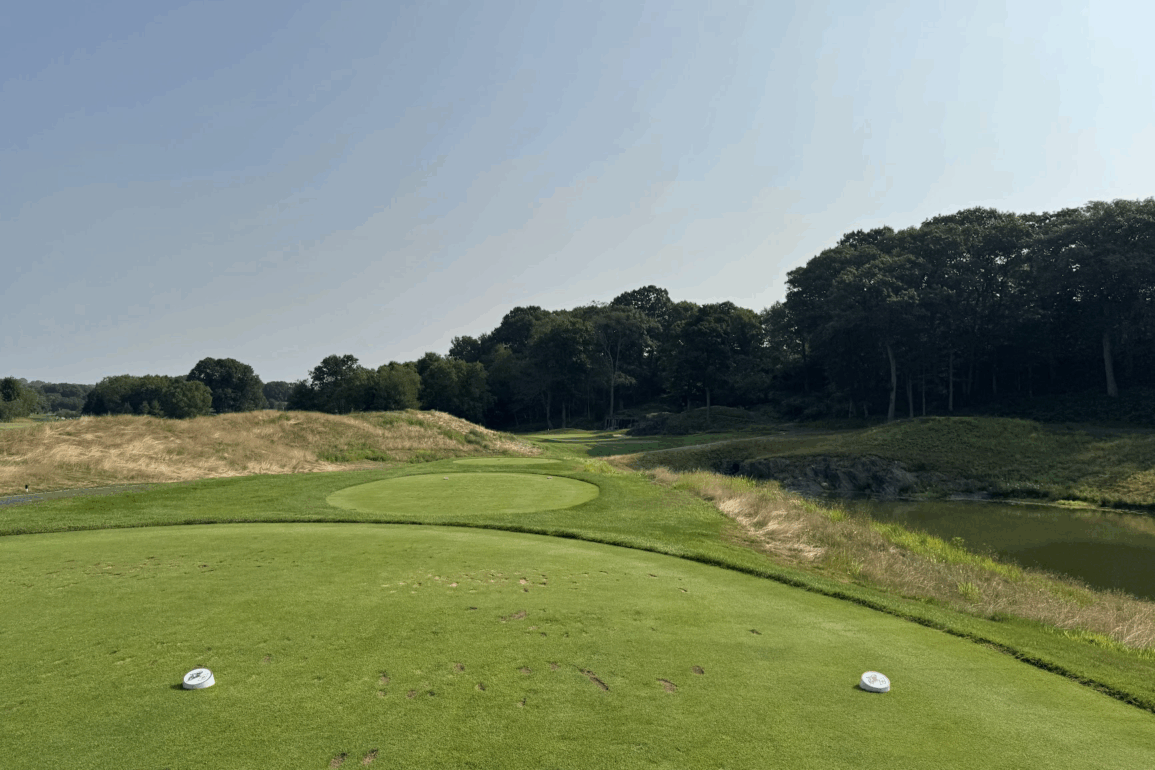
Category: Private

  • Country Club of Waterbury

    Country Club of Waterbury

    [put_wpgm id=”2″ width=”100%” height=”770px” current_post_only=”true”]

    [letsreview]


    Country Club of Waterbury is a private par-69 course measuring approximately 6,301 yards from the tips. The course was originally designed in 1928 by Donald Ross and is located in Waterbury, Connecticut.

    The origins of organized golf in Waterbury date back to 1896 when Arthur Fenn laid out rudimentary holes along the Naugatuck River for the Waterbury Golf Association, though the club was not formally incorporated until 1899. By the turn of the century, membership had grown to 200 golfers playing what became known as the golf lots near present-day Colonial Plaza. In 1906, the club purchased 200 acres on Oronoke Road at fifty dollars per acre and officially became the Country Club of Waterbury. Following a devastating Naugatuck River flood in 1908, the club constructed a nine-hole course, clubhouse, and four tennis courts on the new property. The layout was extended to eighteen holes in 1919, but it was not until 1927 that the club acquired additional acreage and commissioned Donald Ross to design a proper championship layout. Ross dispatched Charles Baskin to supervise construction, and by the end of 1928, the current routing came into play. In recent years, the club has undertaken a thoughtful restoration under the guidance of architect Matt Dusenberry, who has worked with master plan consultant Bradley Klein since 2015 to recapture Ross’s original design intent while sensitively modernizing certain elements for contemporary play.

    Occupying roughly 200 acres of undulating Connecticut terrain, the Country Club of Waterbury navigates a routing that makes intelligent use of the property’s natural topography and rocky outcroppings. The course unfolds across hilly ground with significant elevation change, creating a three-dimensional puzzle that rewards strategic thinking and precise execution. Ross routed the layout to showcase dramatic downhill openers, plateaued greens with false fronts, and corridors framed by specimen hardwoods and native fescue. The design aesthetic reflects Ross’s golden age philosophy of penal yet fair golf, where misses are punished but recovery remains possible for those who manage their angles properly. Players who appreciate cerebral golf will find abundant satisfaction here, as the par-69 format forces difficult decisions about club selection and risk assessment from the first tee to the eighteenth green. The course particularly suits better players who can work the ball both ways and possess the imagination to navigate Ross’s strategic architecture, though recent tree removal has opened sight lines and made the experience more accessible to mid-handicappers willing to play conservatively.

    Strategic Test

    The strategic merit of the Country Club of Waterbury stems from its unusual par-69 configuration, which eliminates the traditional balance of four par-threes, four par-fives, and ten par-fours in favor of five par-threes, one par-five, and twelve par-fours. This composition fundamentally alters tactical calculus throughout the round, as players cannot rely on par-five scoring opportunities to offset mistakes elsewhere. The preponderance of par-fours ranging from 307 yards to 456 yards creates constant variety in approach requirements, demanding everything from wedges to hybrids into greens of wildly different character. Several holes present genuine strategic alternatives off the tee, particularly on the shorter par-fours where aggressive drives can shorten approaches but introduce hazards, while conservative play leaves longer second shots to greens protected by Ross’s characteristic false fronts and pushed-up surfaces. The doglegs turn both directions, rewarding players who can shape drives to match the hole’s geometry rather than relying on a single stock shot. Green complexes feature substantial internal contour and frequent false fronts that reject anything less than committed approaches, creating constant tension about club selection and carry distances. The solitary par-five ninth hole becomes disproportionately important in scoring, as it represents the only realistic birdie opportunity without perfect execution, forcing players to balance aggression with the knowledge that bogeys on the lengthy par-fours will quickly derail rounds. Recent restoration work has reintroduced perpendicular fairway bunkering that had been filled over decades, restoring strategic choices about angles of approach that had been lost to homogenized maintenance practices.

    The course rating and slope provide essential context for understanding how Waterbury’s strategic demands scale across skill levels. Course rating represents the score a scratch golfer would shoot under normal conditions, while slope measures the relative difficulty for bogey golfers compared to scratch players, with 113 representing standard difficulty and higher numbers indicating disproportionate challenges for higher handicappers. Waterbury’s 71.0 rating from 6,301 yards reflects that scratch players would expect to shoot two over par, meaning the par-69 layout plays approximately as difficult as a par-71 course from similar yardage. The 133 slope rating indicates above-average difficulty for higher handicappers, suggesting the course penalizes wayward shots and imprecise distance control more severely than typical layouts. For practical purposes, this means that while accomplished players can navigate the strategic options and occasionally score well, mid-to-high handicappers will find scoring difficult without exceptional ball-striking and sound course management. The elevated slope relative to rating signals that Waterbury’s hazards, green complexes, and forced carries create disproportionate trouble for players who cannot consistently execute precise shots, making strategic restraint more valuable than aggressive play for those without tour-level control.

    HandicapCourse Strategy
    High Handicap (18+)High handicappers should play the forward tees measuring approximately 5,500-5,800 yards with a rating around 68-69 and slope near 125-128, which adjusts expected scores to the low-90s for an 18-handicapper. From these tees, the strategic emphasis shifts entirely to course management rather than aggressive play, as the lengthy par-fours remain formidable and the solitary par-five becomes critical for avoiding catastrophic scores. Laying back off tees to avoid fairway bunkers and forced carries makes mathematical sense even when leaving 180-200 yard approaches, as penalty strokes from hazards cost more than an extra club into greens. The false-front greens require particular attention, as short approaches frequently roll 30-40 yards back down slopes, turning makeable pars into difficult up-and-downs. Playing to the fat of greens rather than attacking pins positioned near hazards or severe slopes preserves realistic par opportunities and prevents the doubles and triples that balloon scores.
    Mid Handicap (8-18)Mid handicappers playing the middle tees at approximately 5,900-6,100 yards face a rating around 69.5-70.5 and slope of 130-132, producing expected scores in the low-to-mid-80s for a 13-handicapper. From this yardage, several shorter par-fours between 300-380 yards come into range for driver followed by wedge, creating legitimate birdie chances that must be exploited to offset inevitable bogeys on the demanding long par-fours. Strategic decisions center on risk-reward calculations at the doglegs, where cutting corners can reduce approach distance by 20-30 yards but introduces fairway bunkers and rough that complicate subsequent shots. The par-three holes require precise club selection given their length and green complexes that reject anything short, making disciplined pre-round yardage assessment essential. Playing away from hole locations tucked behind false fronts or severe slopes becomes increasingly important, as two-putt pars from safe areas score better than aggressive approaches that miss slightly and create impossible up-and-downs.
    Low Handicap (0-8)Low handicappers from the championship tees at 6,301 yards face the full strategic test Ross intended, with the 71.0 rating and 133 slope indicating that even scratch players will struggle to break par without excellent ball-striking and intelligent decision-making. The course rewards shaping drives to match hole geometry, particularly on the doglegs where holding the correct side of the fairway opens preferred angles into greens and avoids cross-hazards. Several par-fours ranging from 410-456 yards demand hybrids or fairway woods into elevated greens with severe false fronts, requiring precise distance control and committed swings to clear the hazards. The pushed-up green complexes create constant tension about spin rates and trajectory, as anything less than optimal contact risks the ball rolling back off putting surfaces. Aggressive players can attack the shorter par-fours with drivers and take advantage of the reachable ninth hole, but the margin for error remains razor-thin given the penal bunkering and OB that frames several holes.

    The second hole epitomizes the strategic architecture that has earned Waterbury its reputation among golden age enthusiasts, with five-time Connecticut State Amateur champion Dick Siderowf calling it the best par-four in the state. At 412 yards from the championship tees, the hole presents as a sweeping dogleg left that climbs approximately 20-30 feet in elevation from tee to green. The tee shot must navigate a right-to-left sloping fairway pinched by mature hardwoods and native fescue along both margins, with the fairway bending decisively left at roughly 270 yards where a fairway bunker guards the inside corner. High handicappers playing from forward tees around 330-360 yards face a genuine dilemma about whether to challenge the dogleg with driver or lay back with a fairway wood to 180-200 yards, leaving a mid-iron approach that plays uphill to an elevated green complex. Mid handicappers from 380-390 yards can reasonably reach the ideal landing area at 240-260 yards with solid drives, but must shape the tee ball right-to-left to match the fairway’s natural cant and avoid the rough that complicates approach angles. Low handicappers from 412 yards need both length and precision, as drives exceeding 280 yards that hold the left-center portion of the fairway provide the shortest and most favorable angle into a green that sits 15-20 feet above fairway level. The approach shot from any distance must contend with a prominent false front that extends 8-10 yards onto the putting surface, combined with greenside bunkers positioned at ground level that catch anything marginally short. The green itself slopes subtly back-to-front, meaning approach shots that carry too far risk rolling off the back edge, while anything short faces the prospect of trickling back down the false front. Strategic merit comes from the hole’s insistence that players earn their pars through two excellent shots rather than relying on recovery skills, as the elevated green and false front make scrambling exceptionally difficult for all skill levels.

    Nearby Course Alternatives

    Shuttle Meadow Country Club in Kensington represents the closest private course alternative, located approximately 25 minutes northeast of Waterbury through rolling central Connecticut terrain. Designed by two-time British Open champion Willie Park Jr. and opened in 1916-1917, Shuttle Meadow occupies nearly 400 acres of dramatically contoured land that creates even more pronounced elevation change than Waterbury. The course measures approximately 6,300 yards from the championship tees to a par of 71, with a slope rating of 127 and course rating of 71.0 that indicates marginally less difficulty for higher handicappers than Waterbury’s 133 slope. Park’s routing showcases his Scottish sensibilities through bold fairway contours, semi-blind shots over natural ridges, and pushed-up greens that demand precise approach play from all angles. The par-three collection proves particularly memorable, with holes playing both dramatically uphill and downhill across natural amphitheaters. Recent work by architect Bruce Hepner in the 1990s updated certain infrastructure elements while preserving Park’s strategic architecture and distinctive green complexes. The course particularly appeals to players who prize dramatic topography over modern shot values, as several holes feature blind or semi-blind elements that require local knowledge or faith in yardage books. Shuttle Meadow’s emphasis on ground game options and rumpled fairways creates a more linksy playing experience than Waterbury’s parkland character, making it ideal for traditionalists who appreciate strategic architecture that predates the modern aerial game.

    Country Club of Farmington in Farmington provides another compelling alternative approximately 26 minutes northwest of Waterbury, representing one of Connecticut’s most historic golfing venues. Founded in 1892 and redesigned in the 1920s by Devereux Emmet, the course measures 6,453 yards from the championship tees to a par of 71, with a slope of 133 and rating of 71.8 that suggests slightly longer and more demanding than Waterbury from the tips. Emmet’s routing unfolds along the Farmington River through less dramatic terrain than Waterbury, though the ground retains sufficient movement to create interesting playing angles and strategic variety. Recent restoration work by architect Matt Dusenberry in collaboration with superintendent Scott Ramsay has gradually recovered Emmet’s idiosyncratic bunkering and expanded several green complexes that had shrunk through decades of conservative mowing practices. The course showcases several drivable par-fours and reachable par-fives that create more traditional scoring opportunities than Waterbury’s par-69 format, making it somewhat more accessible to mid-handicappers who struggle with the relentless par-four examination at Waterbury. Emmet’s green complexes feature severe internal contour and significant back-to-front slopes that demand precise distance control on approaches, with several putting surfaces dropping 13 feet or more from back to front. The property’s riverside setting provides aesthetic appeal through mature specimen trees and water features that frame the beginning of the back nine. Players seeking a more diverse examination that balances strategic par-fours with legitimate scoring opportunities on shorter holes and reachable par-fives will find Farmington’s variety refreshing compared to Waterbury’s singular focus on par-four play, while those who appreciate the subtle genius of early-20th-century architecture will recognize Emmet’s distinctive design philosophy throughout the routing.

    Final Word

    Practice facilities at the Country Club of Waterbury provide adequate but not extensive options for pre-round preparation, with a regulation driving range that accommodates full swings with all clubs and allows players to work on trajectory control and distance gaps. A practice putting green positioned near the first tee offers relatively faithful speed and contour representation of the course’s pushed-up Ross greens, though members should recognize that on-course surfaces often feature more severe slopes than the practice area. Short game facilities include a dedicated chipping area that allows players to rehearse the delicate pitches and bump-and-run shots that prove essential for navigating the false fronts and collection areas surrounding many greens. The fleet of approximately 60 golf carts ensures adequate availability even during busy member play periods, though the club’s traditional walking culture means that many accomplished players still prefer to experience the routing on foot with caddies or pull carts. Beyond golf, the club maintains six tennis courts that receive regular maintenance and host both casual member play and organized league competition during warmer months. The pool complex provides family-oriented recreation throughout the summer season, creating a social gathering point that complements the golf experience. The clubhouse itself reflects the traditional country club aesthetic established when the current facility opened in 1929, featuring comfortable dining areas that accommodate both casual after-round meals and formal evening functions. The property’s compact 200-acre footprint creates an intimate club atmosphere where members frequently encounter one another throughout their rounds, reinforcing the social fabric that has sustained the membership for more than a century.

    The Country Club of Waterbury ultimately distinguishes itself through its uncompromising commitment to Donald Ross’s strategic philosophy and its willingness to preserve an unusual par-69 routing that defies modern scoring expectations. The course rewards players who think carefully about angles, commit to shots with appropriate conviction, and possess the patience to grind out pars on demanding par-fours rather than expecting birdie opportunities at every turn. Recent restoration efforts under Matt Dusenberry’s guidance have sensitively enhanced Ross’s original architecture without fundamentally altering the character that has earned the layout recognition as one of Connecticut’s finest private courses, now ranked eighth in the state by Golf Digest for 2025-2026. The dramatic elevation changes and rocky outcroppings that define the middle portion of the routing create memorable holes that linger in players’ minds long after rounds conclude, while the demanding opening and closing stretches provide proper tests that bookend the experience. For accomplished golfers who appreciate golden age architecture and relish the challenge of scoring on layouts that refuse to yield easy birdies, Waterbury delivers an authentic examination of shot-making skills and strategic thinking. The course proves that compelling golf architecture need not stretch beyond 6,500 yards to challenge even the best players, instead relying on thoughtful routing, creative green complexes, and strategic bunkering to create difficulty through angles and precision rather than simple length. Members and fortunate guests will find that Waterbury’s charms deepen with repeated play, as familiarity with Ross’s strategic demands transforms an initially frustrating examination into an addictive puzzle that rewards patient learning and skillful execution.

  • Country Club of Farmington

    Country Club of Farmington

    [put_wpgm id=”2″ width=”100%” height=”770px” current_post_only=”true”]

    [letsreview]

    Country Club of Farmington is a private par-71 course measuring approximately 6,501 yards from the tips. The course was originally designed in the 1920s by Devereaux Emmet and is located in Farmington, Connecticut.

    The Country Club of Farmington was established in 1892, making it one of the oldest clubs in Connecticut, beginning as a countryside retreat with a rudimentary nine-hole course. In the 1920s, the club acquired additional land and commissioned Devereaux Emmet, a prolific Golden Age architect, to design the course that forms the core of the modern layout. Unfortunately, most records of Emmet’s original work have been lost over time. The course has undergone a significant evolution, shaped by both necessity and thoughtful restoration. The growth of Route 10 from a quiet path to a major road necessitated rerouting in the late 1940s, a task undertaken by Geoffrey Cornish. Cornish’s work included splitting Emmet’s original finishing par-five into the current 17th and 18th holes. Decades later, in 1998, architect Ron Prichard was brought in to conduct a “fine tuning” of the course, respectfully restoring Emmet’s vision by rebuilding deteriorated bunkers, removing trees, and making the challenging 2nd and 18th greens more playable while retaining their character.

    The course is routed over good rolling terrain, a landscape that Emmet used to create a classic parkland test of strategy and precision. The design vibe is one of timeless, strategic golf, evoking a “Scottish links” feel with its undulating, well-bunkered green complexes that demand a thoughtful approach. It is a course that appeals to the thinking golfer, rewarding skilled iron players and creative short-game artists over those who rely solely on power. The routing is notable for being intersected by a public road, a remnant of its long history and adaptation to the surrounding town’s growth. This layout, while not exceptionally long by modern standards, presents a “sporty yet challenging” experience that has been enjoyed by members for generations. The course is a testament to an architectural philosophy where clever design, not sheer distance, provides the primary challenge.

    Strategic Test

    The strategic examination at The Country Club of Farmington is a compelling study in classic design, where modest length is rendered largely irrelevant by the sheer quality of the architectural questions posed. At just over 6,500 yards, the course derives its formidable challenge not from penal water hazards or forced carries, but from the brilliant placement of hazards and the masterful design of its green complexes. Players are consistently presented with meaningful choices. A prime example is the 6th hole, a par-5 where a stream and a copse of trees create a centerline dilemma off the tee. The conservative player can aim left, accepting a three-shot approach, while the aggressive player must challenge a narrow corridor down the right to earn a chance at reaching the elevated, well-protected green in two. This theme repeats throughout the round; fairways offer preferred sides, and approach shots demand precision to find the correct quadrant of the green. The course’s primary defense is its collection of “devilishly small, sloped yet fair greens,” which require a player to “read the greens before chipping,” indicating that the ground game and recovery shots are paramount.

    The course is remarkably accessible to a wide range of players, provided they approach it with the correct mindset. Its lack of extreme length ensures that shorter hitters are not unfairly penalized and can still reach greens in regulation if they play intelligently. The design rewards multiple styles of play, favoring the skilled iron player and creative short-game artist over the one-dimensional power hitter. For the high-handicap player, the course is manageable from the forward tees, with the Red tees measuring a comfortable 5,547 yards. The primary challenge for this player is not length but discipline. The strategic bunkering and contoured greens mean that missed shots are magnified not by lost balls, but by difficult recovery situations. As one reviewer aptly noted, it is a “Great course with a challenging layout but not punishing. Greens are fast and well kept”. This balance of challenge and playability is the hallmark of a well-conceived member’s course.

    To fully appreciate the strategic nuance of Farmington, one must understand the metrics of Course Rating and Slope Rating. The Course Rating represents the expected score for a scratch golfer; Farmington’s Blue tee rating of 72.2 indicates a scratch player will likely shoot just over one stroke above par. The Slope Rating, however, measures the relative difficulty for a bogey golfer compared to a scratch golfer, on a scale of 55 to 155. Farmington’s formidable Blue tee slope of 139 is the quantitative proof of its strategic nature. This high number signifies that the course is disproportionately more difficult for the average player than for the expert. This is a direct consequence of Emmet’s design philosophy. The scratch player’s precision allows them to navigate the small targets and avoid trouble, while the bogey golfer’s wider dispersion of shots brings the penalizing aspects of the sharp-edged bunkers and complex green surrounds into play far more often, causing scores to inflate rapidly.

    HandicapCourse Strategy
    High Handicap (18+)Play from the Red (5,547 yards) or White (6,088 yards) tees. The 132 slope from the White tees is still very high; focus on advancing the ball safely and avoiding greenside bunkers. Your score will be determined by your ability to get up and down. Playing for bogey is a sound strategy.
    Mid Handicap (8-18)The White (6,088 yards, 70.1/132) or Blue (6,501 yards, 72.2/139) tees are viable options. From the White tees, focus on positioning for approach shots. From the Blues, the challenge increases significantly. The high slope means that course management is critical; avoid being aggressive to sucker pins and play to the center of the greens.
    Low Handicap (0-8)The Blue tees (6,501 yards, 72.2/139) present the full architectural test. The challenge is not overpowering the course, but dissecting it. Strategy involves working the ball to create ideal angles into the small, firm greens and using the ground contours. Scoring well requires a masterclass in iron play and short game.

    Perhaps no hole better encapsulates the club’s layered history and strategic character than the 18th. A long, downhill par-3 playing 209 yards from the championship tee, it is a rare and demanding finishing hole that places immense pressure on a player’s long-iron game. The hole’s story is the story of the course in miniature: it was born from a piece of Emmet’s original finishing par-5, then transformed by Geoffrey Cornish into a par-3 that was plagued by drainage issues. After an ill-advised member alteration created an unplayable “toad stool” green, it was finally rescued by Ron Prichard, who rebuilt it into a playable yet formidable challenge. For the low-handicapper, the shot requires a perfectly struck long iron or hybrid, controlling trajectory and spin into the receptive green. The mid-handicapper, facing a 188-yard shot from the White tees, must play intelligently, favoring the side of the green with the most room to avoid a big number. For the high-handicapper, the wisest strategic choice may be to lay up short of the trouble, trusting their short game to secure a bogey and end the round on a positive note.

    Nearby Course Alternatives

    Wampanoag Country Club in West Hartford sits approximately 10 minutes east of Farmington and represents one of the premier Donald Ross designs in Connecticut. This 6610-yard, par-72 layout carries a slope of 133 and rating of 72.5 from the championship tees, establishing it as a worthy strategic counterpart to Farmington’s Emmet design. The course underwent a comprehensive restoration in 2022-23 by architects Tyler Rae and Kyle Franz, working alongside Ross historian Brad Klein, which doubled the bunker square footage and restored the characteristic diagonal hazard positioning that defines Ross’s strategic vocabulary. The property glides gracefully through the wooded suburbs of West Hartford, featuring restored cops and chiseled bunkering rotated at angles into the fairway corridors to establish set-piece strategies on the approach. The 2023 renovation earned fourth place among Golf Digest’s Best Renovations, testament to how thoroughly the restoration recaptured Ross’s original vision from 1924. Golfers who appreciate Golden Age architecture with an emphasis on ground game options and rumpled, strategic bunkering will find Wampanoag particularly rewarding, especially those who value the interplay between diagonal hazards and green complexes that reward both creative thinking and precision execution. The emphasis on elevated greens and skyline ridges, particularly visible on holes like the par-3 11th, creates a different visual and strategic proposition than Farmington’s more linksy ground contours. Players drawn to courses with significant recent restoration work that honor original architectural intent while accommodating modern maintenance practices will recognize Wampanoag as essential Connecticut golf.

    TPC River Highlands in Cromwell lies roughly 20 minutes southeast of Farmington and presents a distinctly contemporary design philosophy shaped by Pete Dye’s 1982 redesign and Bobby Weed’s subsequent 1989 modifications. Measuring 6841 yards with a par of 70, slope of 131, and rating of 73.0, the course spreads across 148 acres of gently rolling terrain above the Connecticut River, framed by mature corridors of maple, oak, sycamore, and eastern white pine. The property’s parkland aesthetic contrasts sharply with Farmington’s links-inspired ground game, instead emphasizing a more aerial test through strategic water positioning, most dramatically evident in the four-acre lake that governs the celebrated finishing stretch from holes 15 through 18. The course’s pedigree as host of the PGA Tour’s Travelers Championship since 1984 speaks to its ability to challenge elite players while remaining accessible to members through multiple tee configurations. Recent bunker renovations in 2016, informed by ShotLink data, further refined the strategic framework to emphasize risk-reward decision-making throughout the round. Players who prefer a more contemporary architectural vocabulary with pronounced water hazards, defined fairway corridors, and tournament-caliber conditioning will gravitate toward River Highlands over Farmington’s more subtle, ground-oriented challenges. The property rewards aggressive play and aerial precision rather than creative ground approaches, making it particularly appealing to stronger ball-strikers who thrive on visual clarity and straightforward strategic demands. Golfers seeking the combination of championship-level design, Tour-quality maintenance standards, and the prestige of playing where professionals compete annually will find River Highlands delivers an experience fundamentally different from the historical, links-adjacent character of Emmet’s work at Farmington.

    Final Word

    The Country Club of Farmington offers members a comprehensive complement of amenities beyond the championship golf course, establishing itself as a full-service private club rather than a golf-only facility. The clubhouse serves as the social and dining hub for the membership, featuring both formal and casual dining options available throughout the year, with the club hosting traditional holiday celebrations including Easter, Mother’s Day, and Father’s Day gatherings that anchor the social calendar. Special events such as patio parties, wine tastings, live music performances, and craft nights provide varied opportunities for member engagement beyond golf, creating a vibrant community atmosphere that extends across generations. The facility functions as both event space and workspace for members, recognizing the evolving needs of contemporary private club life where flexibility and utility matter alongside tradition and leisure. While the course itself receives the lion’s share of architectural attention, these auxiliary amenities ensure that Farmington delivers value across multiple dimensions of membership experience, from family dining to business entertaining to social networking. The club’s position as one of Connecticut’s oldest institutions, established in 1892, creates a sense of historical continuity that permeates both the golf and non-golf aspects of membership, connecting current members to more than a century of tradition. What distinguishes Farmington most profoundly is the ongoing commitment to architectural restoration under Matt Dusenberry’s guidance, evidenced not only in the golf course itself but in thoughtful additions like the new putting course alongside the Farmington River, demonstrating how historical respect and contemporary amenity enhancement can coexist productively. The combination of Devereux Emmet’s distinctive strategic design, characterized by ground contours and green complexes that reward cerebral play, with the breadth of social and recreational programming creates a club that appeals simultaneously to serious students of golf architecture and families seeking a well-rounded private club experience. The restoration work positions Farmington not merely as a historical artifact but as a living, breathing golf course that continues to challenge and delight in equal measure, proving that thoughtful stewardship of Golden Age architecture remains relevant and compelling in the modern era. For those who appreciate strategic subtlety over visual obviousness, ground game options over forced aerial routes, and historical authenticity over manufactured difficulty, Farmington stands as a testament to what makes classic American golf architecture enduringly special.

  • Country Club of New Canaan

    Country Club of New Canaan

    [put_wpgm id=”2″ width=”100%” height=”770px” current_post_only=”true”]

    [letsreview]

    Country Club of New Canaan is a private par-70 course measuring approximately 6,620 yards from the tips. The course was originally designed in 1895 by Willie Park, Jr. and is located in New Canaan, Connecticut.

    The Country Club of New Canaan traces its origins to 1893, when it was first founded as the Oenoke Field Club. By 1897, members migrated to the present property and commissioned Scottish architect Willie Park Jr. to lay out a strategic nine‑hole course across former farmland with push‑up greens and diagonal bunkering. In the early 1920s, the club engaged Walter J. Travis to plan a second nine and modernize the original holes, but the project paused during the economic headwinds of the late 1920s and 1930s. After World War II, Alfred H. Tull oversaw the completion to a full 18 in 1947, blending Travis’s corridor concepts with his own green‑site preferences. Through the 1950s–1970s, the club incrementally updated tees, rebuilt select bunkers, expanded irrigation, and refined mowing lines as equipment advanced. Occasional tree programs opened sightlines and restored original playing widths, while agronomic upgrades improved firmness and green speed. Robert Trent Jones Sr. consulted on targeted safety and playability adjustments, and later maintenance practices emphasized short‑grass surrounds to keep recovery options in play. In the late 2010s, the club adopted a multi‑year golf master plan led by Andrew Green to restore Golden Age intent: recentering fairways, rebuilding and repositioning bunkers with modern liners and drainage, reclaiming green edges, and improving tee variety. The most recent phase addressed the closing corridor and practice grounds to enhance safety, sightlines, and traffic flow while preserving the classic look. Throughout, the club has maintained its identity as a members’ course—walkable, intimate, strategy‑first—where improvements are meant to accentuate Park/Travis/Tull fingerprints rather than overwrite them.

    Situated on approximately 208 acres of rolling Connecticut terrain, the course occupies land characterized by moderate elevation changes and mature tree growth that frames corridors without overwhelming the playing experience. The property sits atop Smith Ridge, providing the course with natural drainage advantages and occasional long-range views across Fairfield County. Park’s routing follows a traditional out-and-back structure that makes efficient use of the available acreage, with holes flowing naturally across the land rather than forcing dramatic elevation changes or artificial earth movement. The design vibe reflects Park’s Scottish heritage filtered through early American golf course development, emphasizing strategic positioning over penal hazards and rewarding thoughtful club selection throughout the round. Players who appreciate classic Golden Age architecture without excessive difficulty will find the course most satisfying, particularly those who value accuracy and course management over pure distance. The layout appeals to members seeking a walkable experience where the strategic interest comes from subtle green contours, well-placed hazards, and holes that offer risk-reward decisions without overwhelming less accomplished players. Unlike more modern designs that feature dramatic visual statements, New Canaan presents its challenges through understated sophistication that reveals itself over repeated play.

    Strategic Test

    The course presents genuine strategic decisions throughout the round, though the architectural vocabulary leans toward positional golf rather than dramatic alternate routes or heroic carries. Park designed during an era when driving distance averaged considerably less than modern standards, meaning his original strategic concepts centered on approach shot angles and green complex defense rather than tee shot intimidation. From the tee, players encounter situations where the direct line may not yield the best approach angle, particularly on holes where green orientations favor approaches from specific sides of the fairway. The green complexes feature subtle undulations and roll-offs that punish approach shots missing to incorrect quadrants, rewarding players who study pin positions and select appropriate angles. Several holes offer width off the tee but then demand precise approach play to access certain pin positions, creating a strategic hierarchy where accuracy trumps distance. The course rewards players who can shape shots both ways, as some approach angles clearly favor draws while others benefit from fades. Course conditions play a significant role in strategic decisions, with firm and fast conditions emphasizing ground game options while softer conditions allow for more aerial assault. The relatively modest overall yardage means that strategic interest derives more from angles, green contours, and hazard placement rather than sheer length, making this a thinking person’s course where club selection and execution matter more than raw power.

    For higher handicappers, the course presents a balanced challenge that remains accessible through intelligent tee placement and reasonable corridor width on most holes. The slope rating represents the relative difficulty for bogey golfers compared to scratch players, calculated through a complex formula that accounts for effective playing length, obstacle factors, and psychological obstacles like forced carries. Course rating indicates the expected score for a scratch golfer playing the course under normal conditions, providing a baseline against which all golfers measure their performance. At Country Club of New Canaan, the Black tees present a slope of 135 and rating of 72.1, suggesting that bogey golfers will find the course approximately 7-8 strokes harder than their handicap would indicate at a course with a slope of 113. The availability of multiple tee options dramatically affects playability for different skill levels, with the spread from 6,620 yards down to 4,948 yards essentially offering different courses for different abilities. Strategic implications of slope and rating become apparent when considering approach shots, as higher handicappers facing longer clubs into greens encounter exponentially greater difficulty holding surfaces designed for shorter irons. The relatively wide fairways and absence of extreme penal hazards keep the course from punishing weaker players excessively, though the green complexes demand reasonably solid short games. Understanding how slope affects expected scoring helps players set realistic goals and make appropriate strategic decisions about when to play aggressively versus conservatively.

    HandicapCourse Strategy
    High Handicap (18+)From the Green tees at 4,948 yards with a slope of 117 and rating of 64.3, the course becomes significantly more manageable for players still developing fundamental skills. These golfers should prioritize finding fairways over distance, willingly using hybrids or long irons off tees on holes where driver introduces unnecessary trouble. The 117 slope indicates approximately 12-13 additional strokes above handicap needed to achieve expected score, making course management and penalty stroke avoidance paramount to posting respectable numbers. Strategic focus should center on avoiding big numbers through conservative play, accepting bogeys rather than chasing difficult pars that often lead to doubles or worse.
    Mid Handicap (8-18)The White tees at 5,847 yards offer a slope of 131 and rating of 68.4, presenting meaningful strategic decisions on longer par 4s where reaching in regulation requires both distance and accuracy. These golfers face roughly 8-10 strokes above handicap to reach expected score, making smart decisions about when to attack pins versus playing to fat parts of greens critically important. This skill level benefits most from studying approach angles and understanding which misses the course forgives versus those that lead to difficult recovery situations. The yardage allows mid-handicappers to reach most par 4s in regulation with solid contact, making green-reading and short game execution the primary scoring differentiators. Strategic emphasis should balance aggressive play on scoring opportunities with conservative approaches on difficult holes where pars represent victories.
    Low Handicap (0-8)From the Blue tees at 6,340 yards with a slope of 133 and rating of 70.9, accomplished players encounter authentic strategic decisions where approach angles and pin positions dictate optimal tee shot positioning. The Black tees stretch to 6,620 yards with a slope of 135 and rating of 72.1, adding meaningful length to already demanding holes without fundamentally altering strategic principles. Low handicappers should focus intensely on approach club selection and green reading, as the subtle putting surfaces separate scores more dramatically than driving distance advantages. The modest overall slope for accomplished players suggests that while the course tests all aspects of the game, it rewards steady play more than spectacular shotmaking. Strategic decisions for scratch golfers often involve weighing birdie opportunities against bogey risks, particularly on shorter par 4s where aggressive driving lines can yield wedges but also introduce trouble.

    The 18th hole exemplifies Park’s strategic philosophy, playing as a 340-yard par 4 from the championship tees with a handicap rating of 12, making it the 12th most difficult hole on the course. This relatively modest length creates immediate strategic questions for all skill levels, as the hole falls into that dangerous middle distance where it plays too short for comfortable two-shot execution yet too long for most players to comfortably reach with driver. High handicappers playing from forward tees around 260-280 yards should treat this as a straightforward two-shot hole, hitting fairway wood or long iron off the tee to a comfortable layup distance, then executing a mid-iron approach without concerning themselves with heroics. Mid handicappers face the most interesting decisions, as many in this range possess sufficient length to reach the green with driver while lacking the consistency to justify the aggressive play, creating tension between conservative strategy and the temptation to finish strong. Low handicappers from 340 yards must evaluate wind, pin position, and personal form to determine whether driver makes sense or whether laying back to a precise yardage yields better birdie opportunities through wedge proximity. The hole’s moderate handicap rating suggests it features hazards or a demanding green complex that punish wayward attempts at reaching the green, making position more valuable than raw distance. Club selection spans the full spectrum from wedge layups to driver attempts depending on conditions, with scratch players potentially hitting anything from 5-iron layup to aggressive driver based on pin position and match situation, while 15-handicappers benefit from conservative fairway wood followed by controlled mid-iron rather than attempting risky drives that introduce penalty strokes.

    Nearby Course Alternatives

    Woodway Country Club in Darien offers a compelling alternative approximately 10 minutes southeast of New Canaan, presenting another Willie Park Jr. design that predates New Canaan by nearly two decades. Opening in 1916, Woodway plays to 6,716 yards from the championship tees with a par of 71, slope of 139, and rating of 72.8, indicating a notably more demanding test than its sister Park course. The property occupies similar rolling wooded terrain on approximately 150 acres, though Woodway features more dramatic elevation changes and tighter corridors through mature tree growth. Recent restoration work by Mark Mungeam and Roger Rulewich has emphasized recovering Park’s original architectural intent, opening playing corridors through selective tree removal while restoring green contours and bunker edges to period-appropriate styling. The course maintains Golf Digest recognition as one of Connecticut’s finest layouts, with the putting surfaces representing its primary defensive mechanism through significant undulation and speed. Strategic interest comes from demanding approach shots into elevated greens with severe fall-offs, creating genuine risk-reward decisions on whether to attack pins or play conservative to accessible portions of putting surfaces. Players who prefer stern challenges and enjoy courses where green complexes dictate strategy will favor Woodway over the more forgiving New Canaan layout. The higher slope rating particularly affects mid-to-high handicappers, making Woodway best suited for accomplished players who relish demanding golf and possess the short game skills to handle quick, contoured greens.

    Brooklawn Country Club in Fairfield represents a different architectural pedigree located approximately 20 minutes southwest of New Canaan, showcasing A.W. Tillinghast’s design genius from his 1930 complete redesign. Measuring 6,617 yards from the tips with a par of 71, slope of 135, and rating of 72.5, Brooklawn presents similar statistical difficulty to New Canaan while offering dramatically different strategic concepts. The club founded in 1895 holds historical significance as one of the earliest USGA member clubs, having hosted both a U.S. Women’s Open and U.S. Senior Open, demonstrating the layout’s championship pedigree. Tillinghast’s characteristic bold bunkering and dramatic green contours create visual intimidation and genuine penal consequences for wayward shots, contrasting with Park’s more understated hazard placement. The course navigates varied terrain with several memorable uphill approaches that enhance strategic interest without creating an exhausting walk, maintaining walkability while incorporating meaningful elevation changes. Recent restoration work by Ron Forse has enhanced Tillinghast’s original design features, removing later modifications that had softened the architect’s intended challenge. Players who appreciate classic American Golden Age architecture with dramatic green complexes and bold visual statements will favor Brooklawn’s personality over New Canaan’s quieter strategic approach. The course particularly rewards accurate ball-strikers who can work shots into specific quadrants of greens, making it ideal for accomplished players who enjoy courses where architectural features clearly communicate strategic intentions.

    Final Word

    Beyond the golf course itself, the Country Club of New Canaan provides comprehensive practice facilities that allow members to work on all aspects of their game throughout the season. The 20-station driving range includes both natural grass hitting surfaces and mat alternatives, accommodating year-round practice even when turf conditions limit grass availability. A dedicated short game practice area features a practice bunker and multiple chipping surfaces, enabling members to refine their scoring shots under realistic course conditions. The putting green offers ample space for stroke work and green-reading practice, maintaining the same bentgrass surfaces and speeds found on the course itself. The club underwent a major facility expansion completed in 2019 that dramatically enhanced the clubhouse experience while respecting the property’s historical character. New dining spaces include an updated bar and informal member dining areas that encourage casual interaction, plus expanded banquet facilities for member events and functions. The pool complex represents a complete reimagining of the aquatic facilities, featuring a main pool, diving well, kiddie pool, changing rooms, and covered snack bar dining area designed to accommodate families throughout the summer season. Seven Har-Tru tennis courts and four pickleball courts round out the athletic amenities, creating a true country club environment where members can pursue multiple recreational interests beyond golf.

    What distinguishes the Country Club of New Canaan is its sustained commitment to preserving Willie Park Jr.’s strategic design principles while thoughtfully modernizing facilities to meet contemporary member expectations without compromising the golf experience. The course rewards intelligent play and steady execution without punishing higher handicappers through excessive difficulty or penal hazards, creating an environment where all skill levels can enjoy the strategic questions Park posed over a century ago. Multiple renovations by distinguished architects including Travis, Tull, Trent Jones, Forse, and Nagle demonstrate the club’s willingness to invest in the golf course while maintaining respect for the original design intent that makes the layout historically significant. For members seeking a traditional private club experience with a walkable championship course that emphasizes strategy and shotmaking over brute force, New Canaan delivers consistent quality in both course conditioning and overall club atmosphere. The combination of Park’s architectural legacy, comprehensive practice facilities, and recently renovated clubhouse amenities creates a compelling member experience that balances golf tradition with modern comfort. Players who value strategic interest over visual intimidation, appreciate classic Golden Age architecture, and enjoy courses that reveal their subtleties through repeated play will find New Canaan particularly satisfying. The layout stands as testament to Park’s enduring design principles, proving that thoughtful routing, strategic hazard placement, and demanding green complexes create lasting golf interest independent of excessive length or artificial difficulty.

  • Country Club of Fairfield

    Country Club of Fairfield

    [put_wpgm id=”2″ width=”100%” height=”770px” current_post_only=”true”]

    [letsreview]

    Country Club of Fairfield is a private par-70 course measuring approximately 6,358 yards from the tips. The course was originally designed in 1914 by Seth Raynor and is located in Fairfield, Connecticut.

    Founded by Oliver Gould Jennings in 1914 on land nicknamed “Mosquito Hill,” the club required an enormous landfill operation to transform onion fields and tidal marshes into playable terrain. Seth Raynor, protégé of Charles Blair Macdonald, created one of his first solo design projects here, implementing his signature template hole philosophy adapted from Scottish and English classics. Construction lasted several years with fill brought by barge from Long Island and through dredging Southport Harbor to overcome the challenging high water table. The course officially opened in 1921 with Hall of Fame golfer Walter Hagen in attendance, though it featured a “topsy-turvy design history” as the clubhouse was never built where Raynor intended. In the mid-1920s, legendary architect A.W. Tillinghast visited and sketched new fourth through sixth holes around the natural lagoon, creating one of golf’s most distinctive three-hole stretches. Robert Trent Jones Sr. was hired in 1960 to install a practice range and accommodate the final clubhouse location on Sasco Hill, sacrificing Raynor’s original par-4 18th. The club’s forward-thinking 1992 Master Plan signaled the need for restoration, making them pioneers in the Golden Age restoration movement. Tom Doak was commissioned in the early 2000s to re-establish Raynor’s original aesthetic, ultimately turning restoration work over to his associate Bruce Hepner. The course has consistently ranked among Connecticut’s top three courses, with Golf Digest previously including it in the nation’s Second 100 Greatest. After three hurricanes hit Connecticut’s shoreline in 1954, the club finalized keeping the clubhouse on higher Sasco Hill ground rather than the original beachside location. Recent decades have seen over 100 trees removed to restore original seaside views and wind exposure critical to Raynor’s strategic design philosophy. The challenging 133 slope rating and 71.6 course rating reflect how coastal winds and strategic bunkering create difficulty that transcends pure yardage. As Dan Jenkins observed: “Seth Raynor’s best work is the Country Club of Fairfield in Connecticut… It’s short but covered up with charm.” The course represents an irreplaceable opportunity to experience authentic template hole strategy in a spectacular seaside setting.

    The course spans approximately 158 acres of flat coastal terrain at sea level along Long Island Sound, creating authentic links-style conditions rarely found in American golf. Raynor’s routing brilliantly maximizes wind variability with the front nine running counter-clockwise around the property perimeter and the back nine clockwise within that loop, similar to renowned links courses like Muirfield. The design philosophy emphasizes strategic positioning over pure length, with wide fairways typically measuring 40-50 yards combined with centerline hazards that create narrowed landing zones demanding precise positioning. Template holes including the Redan (9th), Cape (6th), Bottle (3rd), Eden (14th), and Double Plateau (15th) showcase Raynor’s mastery of adapting British Isles strategic concepts to American terrain. Green complexes range from 7,000-9,000 square feet with subtle internal contours maintained in firm, fast conditions that promote traditional ground game approaches. The nine-acre tidal lagoon integrated into holes 4-6 represents Tillinghast’s masterful adaptation, creating what experts describe as “unlike anything else you’ll see anywhere.” Geometric rectangular bunkering and push-up green complexes demonstrate Raynor’s engineering background and strategic principles throughout the layout. The course appeals to thinking players who appreciate strategic depth, architectural history, and links-style conditions where wind reading and course management trump pure power. Recent tree removal has restored original coastal exposure, while bunker restoration has re-established Raynor’s geometric aesthetic and strategic positioning principles. The “shepherds approach” maintenance philosophy maintains randomness in rough areas and firm conditions that reward traditional strategic approaches. Players seeking authentic Golden Age architecture combined with spectacular coastal views will find this course unmatched in the Connecticut region. The design rewards intelligent course management and precise execution while remaining accessible to players who understand strategic positioning principles. Members consistently praise the course’s ability to challenge without relying on tricks or excessive length, embodying Raynor’s philosophy of strategic excellence. The links character becomes more pronounced in windy conditions, when the course reveals its true strategic demands and architectural brilliance.

    Strategic Test

    The strategic architecture at Country Club of Fairfield rewards thoughtful decision-making across the spectrum of handicaps, though the course presents different challenges depending on player skill level. From the championship tees, length proves less important than accuracy and positioning, as the 6,442-yard measurement belies a layout where angles of approach and understanding green complexes determine scoring. The template holes demand recognition of proper entry points, while the flat terrain eliminates elevation as a mitigating factor, placing premium value on club selection and trajectory control. Wind variability introduces an additional strategic layer, as prevailing breezes off the Sound can transform club selections by multiple clubs and fundamentally alter hole strategy from round to round.

    The course rating of 71.0 against par 70 indicates that scratch golfers face roughly one stroke of difficulty beyond par, while the slope of 132 signals above-average challenge for bogey golfers when measured against courses of similar rating. Slope quantifies the relative difficulty difference between scratch and bogey players, with 113 representing average and each point roughly corresponding to one stroke for higher handicaps. A slope of 132 suggests that bogey-level players will find this course approximately two strokes more difficult than an average course with the same rating, primarily due to the penal nature of water hazards, the precision required for approach shots into Raynor’s template greens, and the premium placed on avoiding the strategic bunkering complexes that guard optimal angles.

    HandicapCourse Strategy
    High Handicap (18+)Forward tees measuring 5,405 yards (Green) provide manageable length with a slope of 129 and rating of 71.1, though the differential still indicates roughly 18-20 strokes above par for the typical 18-handicapper. The strategic imperative centers on course management rather than aggressive play, as the water hazards on holes 4-6 and the lagoon crossings require conservative club selection to avoid penalty strokes. The firm, fast greens demand running approaches for players without consistent ability to control trajectory, and the template green complexes reward those who study breaks and play to safe portions rather than attacking pins.
    Mid Handicap (8-18)The White tees at 5,760 yards offer appropriate challenge with a slope of 126 and rating of 69.0, suggesting rounds typically ranging from 85-95 for this player category. These golfers possess sufficient length to reach most greens in regulation but must recognize that the course demands precision over power. Strategic decisions emerge on holes like the par-4 sixth, where position off the tee determines whether the approach can safely challenge the pin or must play to the fat portion of the green. The drivable par-4 seventh presents a genuine risk-reward proposition, while the short par-3 fourth over water requires committed swings with mid-irons.
    Low Handicap (0-8)Championship tees at 6,442 yards present authentic challenge despite modest length, as evidenced by the 71.0 rating and 132 slope. Scratch golfers should expect to shoot around par, with scoring opportunities balanced by demanding two-shot holes requiring precise approaches. The strategic emphasis shifts to angle management, as understanding optimal approach corridors into the template greens proves essential for birdie opportunities. The water-influenced stretch from holes 4-6 demands aggressive yet controlled play, and the three-hole finishing stretch beginning at 16 requires precise iron play and steady putting to protect scores. Wind introduces significant variability, potentially adding 5-8 strokes to expected scoring on blustery days.

    The sixth hole exemplifies the course’s strategic architecture and stands as arguably the finest in Connecticut. This 429-yard par-4 Cape hole plays as the number one handicap, requiring an accurate drive to a blind landing zone along the lagoon’s edge. From this position, approximately 150-180 yards remain to a narrow, severely sloped green that falls left-to-right toward the water. High handicappers playing from forward tees at 350-370 yards should play conservatively off the tee with fairway wood or long iron to ensure finding the fairway, then accept bogey as a solid score by playing their approach to the green’s right portion away from the water hazard. Mid-handicappers from the White tees at 375-390 yards face the strategic choice of challenging the inside corner bunker to shorten the approach or playing safely left, accepting a longer second shot but from a superior angle. The green’s severe contouring penalizes misses left and short, making the percentage play a controlled mid-to-long iron aimed at the green’s center. Low handicappers from 429 yards must execute a precise drive favoring the left center of the fairway to open the ideal approach angle, then flight a controlled mid-iron that accounts for the wind and the green’s firm surface, potentially using the slope to feed shots toward back-left pins while avoiding the severe falloffs that make recovery nearly impossible.

    Nearby Course Alternatives

    Brooklawn Country Club in Fairfield sits approximately five minutes south of the Country Club of Fairfield along Algonquin Road. This A.W. Tillinghast design measuring 6,617-6,711 yards to a par 71 features a course rating of 72.5-73.3 and slope of 135-138 on approximately 120 acres of rolling parkland terrain. Tillinghast completed the full redesign in 1930, and recent restoration work by Ron Forse has emphasized the architect’s characteristic undulating greens and strategic bunkering. Unlike Fairfield’s flat, links-influenced layout, Brooklawn presents significant elevation changes throughout the routing, with uphill par-4s like the third and sixth that showcase Tillinghast’s skill in working with challenging topography without making holes feel like a physical grind. The club hosted the U.S. Women’s Open and U.S. Senior Open, establishing its pedigree as a championship venue, and Gene Sarazen holds the course record of 63. The design philosophy emphasizes approach shot precision into severely contoured greens, with the long par-4 fourth featuring one of Tillinghast’s finest putting surfaces in the region. Players who prefer variety in elevation and enjoy the challenge of uphill and downhill lies will find Brooklawn more engaging than the flatter terrain at Country Club of Fairfield, while those seeking less walking and greater emphasis on wind and angles would favor the latter.

    The Patterson Club in Fairfield’s Greenfield Hill section lies approximately ten minutes north along Cross Highway. Robert Trent Jones Sr. designed this 6,795-6,824 yard par-71 layout in 1947, with subsequent work by Stephen Kay, Roger Rulewich, Greg Muirhead, and Rees Jones refining the design across its 170-acre property. The course features a rating of 72.8-73.0 and slope of 132-134 on rolling terrain that makes captivating use of elevation changes, including a distinctive up-and-over finishing hole where a speed slot can add 40 yards to well-positioned drives. Recent tree removal programs have opened sight lines and enhanced dramatic vistas across the property, while updated par-3 complexes now represent particular design highlights. The routing style differs fundamentally from Country Club of Fairfield, as Patterson emphasizes elevation changes, varied hole corridors, and the characteristic length associated with Robert Trent Jones Sr. courses. Having hosted Connecticut State Open and Amateur championships along with Metropolitan Golf Association events, Patterson offers championship credentials similar to Fairfield but in a parkland rather than links setting. Players who appreciate longer courses with significant elevation changes and enjoy testing their games on uphill and downhill lies would prefer Patterson, while those seeking a links experience with greater emphasis on wind, firm conditions, and template holes would gravitate toward Country Club of Fairfield.

    Final Word

    Practice facilities include a driving range that Robert Trent Jones Sr. installed during his 1960 renovation, along with putting greens that allow members to refine their touch on surfaces mirroring the firm, fast conditions found on the course proper. The clubhouse occupies a commanding position overlooking Long Island Sound, providing panoramic views across Southport Harbor and the Connecticut coastline. Dining facilities offer refined service for members and guests, while the club maintains a traditional private club atmosphere emphasizing golf as the primary recreational focus. The property’s location adjacent to Sasco Beach provides a unique coastal setting that few clubs in the region can match.

    What distinguishes Country Club of Fairfield is the convergence of architectural pedigree, strategic design, and dramatic seaside setting that creates an experience unlike any other Connecticut course. The layered history featuring Raynor, Tillinghast, and Robert Trent Jones Sr. provides architectural credibility, while recent restoration work has ensured the design philosophy remains coherent despite the various contributors. The course challenges better players through strategic complexity rather than excessive length, rewards thoughtful course management across all skill levels, and provides an authentic links experience rare in American golf. For those fortunate enough to receive an invitation, the combination of firm, fast playing conditions, coastal winds, template hole designs, and spectacular water views creates a golfing experience that validates the club’s position among Connecticut’s elite courses.

  • Country Club of Darien

    Country Club of Darien

    [put_wpgm id=”2″ width=”100%” height=”770px” current_post_only=”true”]

    [letsreview]

    Country Club of Darien is a private par-71 course measuring approximately 6,800 yards from the tips. The course was originally designed in 1958 by Alfred H. Tull and is located in Darien, Connecticut.

    The Country Club of Darien emerged from Edgar S. Auchincloss’ vision to transform his family’s 200-acre gentleman’s farm, known as Keewaydin after a reference from Longfellow’s “The Song of Hiawatha,” into a membership club. The Auchincloss family acquired the property in 1905 as a vacation retreat, and by 1956, Edgar and his widowed mother Catherine Agnew Auchincloss converted the land into club grounds. Alfred H. Tull, a design partner of Devereux Emmet and construction engineer for legendary architect A.W. Tillinghast, laid out the original routing that opened with nine holes in 1957 and expanded to eighteen by spring 1958. In 2007, Dr. Michael Hurdzan, architect of U.S. Open host Erin Hills, undertook a comprehensive modernization that earned the Renovation of the Year award in 2010 from Golf, Inc. Hurdzan’s work over nearly two decades included routing adjustments, new tees, expanded greens, fescue introduction, and improved drainage, essentially rebuilding the course while respecting Tull’s original structure and creating a championship test capable of hosting premier amateur and professional tournaments.

    Occupying approximately 200 acres of relatively level terrain in lower Fairfield County, the course benefits from Hurdzan’s modern strategic principles applied to suburban Connecticut topography. The routing style reflects both practical constraints of the landlocked property and intentional design choices that create variety through green complex architecture rather than dramatic elevation changes. The front nine features a more straightforward corridor style with tree-lined fairways playing in alternating directions, while the back nine introduces greater strategic diversity through more varied green complexes, collection areas, and undulation. The design philosophy emphasizes precision and course management over raw distance, with fast bent grass greens featuring significant internal contours that reward proper approach angles and punish wayward positioning. Players who value tournament-caliber conditioning, strategic decision-making, and modern green complexes with collection areas will find the course particularly appealing, while those seeking dramatic elevation changes or classic Golden Age architectural features might find the routing more workmanlike than inspiring. The course suits players who think their way around a layout and appreciate subtle strategic elements over visual intimidation, making it ideal for students of the modern game who value shot execution and green reading over power.

    Strategic Test

    The strategic examination at Country Club of Darien centers on green complex navigation and approach angle selection rather than dramatic risk-reward scenarios off the tee. Hurdzan’s renovation work created varied green surfaces with collection areas and false fronts that demand precise distance control and proper angle selection, rewarding players who think ahead to back-pin locations or avoid short-sided positions. The tree-lined corridors provide clear definition but limit alternate angles on most holes, meaning strategic decisions manifest primarily in club selection and target selection rather than aggressive lines off the tee. The course rewards consistency and accuracy over length, with several holes featuring forced carries or tight driving corridors where position trumps distance, creating a test that emphasizes iron play and wedge precision. High-handicap players will find the course accessible from forward tees but challenging when attempting to play beyond their capabilities, as the penal rough and greenside collection areas penalize mis-hits more severely than wider, more forgiving designs. The layout provides sufficient width for developing players while maintaining teeth through green speed and contour rather than oppressive length or centerline hazards.

    Understanding slope and rating proves essential for strategic planning at Country Club of Darien. The course rating measures the difficulty for a scratch golfer, with the 73.4 rating indicating a layout playing approximately 2.4 strokes over par for elite players from the back tees. The slope rating of 137 measures relative difficulty for bogey golfers compared to scratch players, with the scale ranging from 55 to 155, where 113 represents standard difficulty. A slope of 137 sits firmly in the challenging category, meaning the course plays significantly harder for higher handicappers relative to low handicappers due to factors like green speed, rough severity, green contours, and limited recovery areas. This elevated slope suggests that while skilled players can score through precise ball-striking, recreational players will struggle with the demanding green complexes and tight margins for error, making proper tee selection and course management paramount for maximizing enjoyment and minimizing frustration.

    HandicapCourse Strategy
    High Handicap (18+)Forward tees measure approximately 5,800-6,200 yards with rating around 70.0 and slope near 125, creating a more manageable examination that still demands accuracy. Strategic focus should emphasize keeping the ball in play off the tee with fairway woods or hybrids, laying up short of trouble rather than attempting heroic carries, and prioritizing two-putt approaches on the undulating greens. The slope of 125 means these players will typically shoot 18-25 strokes over their course handicap, so accepting bogeys and occasional doubles while capitalizing on shorter par-5s proves crucial. Avoid short-siding approaches into collection areas, favor center-green targets, and recognize that scrambling from tight lies around these greens requires skills beyond most recreational players.
    Mid Handicap (8-18)Middle tees stretch approximately 6,200-6,500 yards with rating around 71.5 and slope near 130, presenting a balanced test that rewards good decision-making. Strategic decisions center on knowing when to attack pins versus playing to fat portions of greens, understanding which holes demand driver versus which favor position with long irons, and managing expectations around fast, contoured putting surfaces. The slope of 130 indicates these players typically shoot 15-20 strokes over their handicap, meaning pars require well-executed shots while bogeys remain acceptable scores on demanding holes. Focus on approach angle selection rather than always attacking flags, recognize that some back-pin locations require bump-and-run approaches, and develop a reliable miss pattern that avoids collection areas.
    Low Handicap (0-8)Championship tees measure 6,800-6,900 yards with rating 73.4 and slope 137, creating a stern examination where par represents good scoring. Strategic elements include understanding subtle green contours that affect both approach shots and putts, recognizing which holes offer genuine birdie opportunities versus requiring defensive pars, and managing the faster green speeds that punish aggressive play. The slope of 137 means even accomplished players will find scoring difficult when missing greens, as recovery shots from collection areas demand touch and creativity. Attack par-5s that yield to well-placed drives, respect long par-4s where bogey isn’t disastrous, and invest time understanding green speeds and break patterns that separate good rounds from great ones.

    The 18th hole serves as an appropriate finishing examination that encapsulates the course’s strategic principles and demands both power and precision under competitive pressure. Measuring approximately 440 yards from the championship tees as a par-4, the closer plays as one of the more demanding tests on the property, requiring a well-positioned drive that avoids trees pinching the landing area from both sides. The drive must favor the right side of the fairway to open the optimal angle into a green complex that features significant undulation and collection areas short and left, punishing approaches that come up short or miss to the wrong side. The green slopes from back to front with subtle breaks that become increasingly difficult to read as the round progresses and green speeds accelerate, meaning even well-struck approach shots can leave challenging two-putt scenarios if positioned on the wrong tier. Low handicappers must commit to an aggressive line off the tee that challenges the right-side trees to open the best angle, then execute a mid-iron approach that accounts for green firmness and pin position, with back-left pins proving particularly difficult due to the false front that feeds balls into the collection area. Mid handicappers should favor the center-left of the fairway with their tee shot, accepting a slightly longer approach in exchange for avoiding the tighter right side, then play for the center-right portion of the green to avoid short-siding themselves and creating recovery situations their short game might not handle. High handicappers benefit from using a fairway wood or hybrid off the tee to ensure finding the short grass, then focusing on a two-shot strategy that prioritizes getting the ball somewhere on the putting surface rather than forcing a heroic approach that risks finding collection areas and turning a potential bogey into a double or worse.

    Nearby Course Alternatives

    Wee Burn Country Club in Darien offers one of Connecticut’s finest and most historically significant golf experiences just five minutes north of the Country Club of Darien. The 7,040-yard, par-72 layout presents a rating of 75.1 with a slope of 146 from the championship tees, making it among the more demanding tests of golf in the region. Devereux Emmet routed the course in 1925 across 230 acres of rolling terrain, artfully weaving the layout around Stony Brook, which Andrew Carnegie himself suggested be called a wee burn in homage to Scottish nomenclature. The club’s storied tournament pedigree includes hosting three USGA Women’s Amateur Championships, and recent tree removal combined with Tom Fazio’s renovations have allowed the course to breathe and play closer to Emmet’s original vision. The property features pronounced elevation changes throughout, particularly on the closing stretch where holes 9, 10, and 18 play toward, away from, and back to the clubhouse on significant slopes. Strategic positioning off the tee proves paramount given the narrow approach corridors and well-protected greens, with many holes rewarding placement over pure distance. Players who value shot variety, classical Golden Age architecture, and terrain that demands precise distance control will find Wee Burn’s challenges more appealing than the Country Club of Darien’s relatively flatter topography and modern strategic principles.

    Tamarack Country Club in Greenwich presents a markedly different architectural philosophy fifteen minutes south of the Country Club of Darien, sprawling across 170 acres of northwest Greenwich property. The 6,841-yard, par-70 course carries a rating of 72.9 and slope of 126, offering a slightly more approachable examination from the scorecard perspective. Charles Banks designed the layout in 1929, earning his moniker Steam Shovel Charley through his affinity for using machinery to create the massive, undulating push-up greens protected by steep-faced bunkers that remain his calling card. The course features a comprehensive collection of template holes inherited from Banks’ mentors Seth Raynor and Charles Blair Macdonald, including a Redan at the 7th, Eden at the 3rd, Biarritz at the 12th, Alps at the 6th, Road Hole at the 14th, and Cape at the 2nd, all executed at scale befitting the property’s generous acreage. Recent restoration work by Ron Forse, Mike DeVries, and Brian Silva has emphasized tree removal to restore corridor width and enhance the visual connectivity across the property, allowing players to appreciate the architectural theater from the elevated clubhouse. The template holes provide variety and strategic interest through their geometric precision and studied angles, contrasting with the Country Club of Darien’s emphasis on contemporary shot values and hazard placement. Golfers who appreciate architectural history, enjoy decoding classic template strategies, and prefer brawny, wide-open playing corridors where recovery remains possible despite wayward strikes will gravitate toward Tamarack over more tightly-framed modern designs.

    Final Word

    The practice facilities at Country Club of Darien reflect the club’s commitment to player development and year-round improvement, anchored by dual practice ranges that accommodate varying shot shapes and practice needs. Two dedicated chipping greens allow members to refine their short game with multiple pin positions and varying green speeds, while the main putting surface provides an accurate simulation of the course’s green complexes for pre-round preparation. The crown jewel of the practice area remains the indoor Golf Performance Studio, which ensures members can maintain their games through Connecticut’s challenging winters with climate-controlled hitting bays, comprehensive swing analysis technology, and professional instruction regardless of weather conditions. Beyond golf, the club delivers a comprehensive country club experience with eight pristine Har-Tru tennis courts that host competitive play and social round-robins, complemented by five platform tennis courts with a dedicated paddle hut that transforms the facility into a winter sports destination. The aquatics program centers on a six-lane competition pool designed for serious lap swimming alongside a protected baby pool for young families, creating multigenerational appeal throughout the summer months. Two distinct restaurant venues provide dining options ranging from casual post-round meals to formal event settings, while the fitness center rounds out the amenities with modern equipment and programming. The club’s ability to host significant tournaments including the 2018 PGA Met Match Play Championship, 2019 Westchester Open, 2021 Connecticut State Open, and 2022 Ladies MET Open speaks to the course’s competitive caliber and conditioning standards that extend well beyond member play. What distinguishes the Country Club of Darien within the crowded landscape of lower Fairfield County private clubs is its successful marriage of Dr. Michael Hurdzan’s strategic design excellence with comprehensive family-oriented amenities, creating a destination where serious golfers can test themselves on a demanding, tournament-proven layout while their families enjoy world-class tennis, paddle, swimming, and dining experiences under one membership umbrella.

  • Clinton Country Club

    Clinton Country Club

    [put_wpgm id=”2″ width=”100%” height=”770px” current_post_only=”true”]

    [letsreview]

    Clinton Country Club is a private par-72 course measuring approximately 6,518 yards from the tips. The course was originally designed in 1968 by Geoffrey S. Cornish and is located in Clinton, Connecticut.

    Established in 1895, Clinton Country Club has a rich history, relocating to its current 110-acre property, a former dairy farm, in 1957. Architect Geoffrey S. Cornish was tasked with crafting the course, first designing nine holes in 1958 and completing the full 18-hole layout in 1968. The result is a classic parkland design that embodies the Cornish philosophy of creating strategic, engaging, and enjoyable tests of golf that are playable for a diverse membership. The routing makes excellent use of the gently rolling terrain, presenting a course that favors the thinking golfer who values precision and course management over sheer power. It is a true “Gem of the Shoreline,” known for its consistently excellent conditioning and a welcoming, unpretentious atmosphere dedicated to the game.

    Strategic Test

    The strategic examination of Clinton Country Club begins with a compelling question: how does a course measuring a modest 6,518 yards from its championship tees command a slope rating of 135? The answer lies not in brute strength but in the sophisticated and layered challenges presented by its architecture. This is a course where the scorecard’s yardage is a poor indicator of its true difficulty. The primary defense is not length but the demand for precision from tee to green. Cornish’s design consistently asks the player to make strategic decisions, often presenting a wide fairway that subtly favors one side over the other to create the optimal angle of approach into the green. The recent bunker renovation project has undoubtedly amplified this characteristic, creating what one architect described as more “visual drama and enhanced play”. These hazards are not merely penal; they are strategically positioned to dictate play, functioning as centerline hazards or guarding the ideal line into a putting surface. As one reviewer noted, it is a “Challenging course that always is in superior condition”.

    To fully appreciate the strategic test, one must understand the language of the USGA Course and Slope Rating system. The Course Rating, 71.6 from the Black tees, predicts the average score of a scratch golfer on a par-72 layout; in this case, it suggests the course is slightly less difficult than par for an elite player under normal conditions. The Slope Rating, however, tells a more revealing story. This number reflects the relative difficulty for a bogey golfer (an 18-handicap) compared to a scratch player. With a national average of 113, Clinton’s 135 slope is exceptionally high for its length, indicating that mistakes are magnified and the scoring gap between the skilled and average player will be significant. The course effectively mitigates this challenge and ensures playability for all skill levels through a well-conceived system of five distinct teeing grounds, ranging from 4,967 to 6,518 yards. This allows players to select a yardage appropriate to their ability, yet the core strategic questions posed by the architecture remain relevant from every tee.

    The design at Clinton is a testament to the principle that a great course should reward all styles of play, not just the power game. A player who relies on length alone will find themselves frequently out of position, facing awkward angles into well-protected greens. The course instead favors the tactician who can shape shots, manage distances, and think one or two strokes ahead. The corridors, while not overly narrow, demand that the player select the correct line from the tee to set up the approach. The green complexes, some of which are classic push-up designs, require a deft touch and a creative short game. A feature like the original Geoffrey Cornish double-green serving the 6th and 8th holes, which was recently enlarged, underscores the club’s commitment to preserving and enhancing these unique strategic elements that reward thoughtful play over brute force.

    HandicapCourse Strategy
    High Handicap (18+)The primary goal is hazard avoidance. Playing from the White (5,761 yards, 125 slope) or Gold (5,212 yards, 122 slope) tees is recommended. The slope indicates that errant shots will be punished, so the focus should be on keeping the ball in play with conservative club selection off the tee, accepting that bogey is a good score on most holes.
    Mid Handicap (8-18)The focus shifts to strategic positioning and course management. The Blue tees (6,156 yards, 132 slope) offer a robust challenge. Success requires playing to specific sides of fairways to open up better angles into greens and avoiding the three-putt by leaving approach shots on the correct side of the hole.
    Low Handicap (0-8)The game becomes a chess match of creating scoring opportunities. From the Black tees (6,518 yards, 135 slope), players must challenge fairway bunkers to gain optimal lines of play. Trajectory control and spin are critical for attacking specific pin locations on the contoured and well-guarded greens.

    The par-5 11th hole serves as a superb microcosm of the course’s overall strategic character. Playing to 482 yards from the Black tees and 437 from the White, its challenge is derived from thoughtful design rather than sheer length. The hole is visually distinguished by a handcrafted stone wall on the tee, a 2011 addition that lends a sense of place and permanence. For the low-handicap player, the hole is reachable in two, presenting a clear risk-reward decision. An aggressive tee shot must be placed perfectly to set up a long-iron or hybrid into a renovated green complex that is likely well-defended. For the mid-handicap player, it becomes a classic three-shot hole where the second shot is paramount. The player must strategically lay up to a specific yardage, leaving a full swing with a preferred wedge into the green while navigating any fairway hazards. For the high-handicap player playing from the 394-yard forward tees, the hole is about control and discipline. The optimal strategy is to break the hole into three distinct and manageable shots—perhaps a hybrid, a mid-iron, and a wedge—focusing solely on finding the fairway to set up a simple approach and a potential par.

    Nearby Course Alternatives

    Madison Country Club in Madison occupies a flat, compact property along the Long Island Sound just four minutes to the west of Clinton. The Willie Park Jr. original design from 1900 stretches to 6,069 yards from the tips with a par of 70, carrying a 70.3 rating and 123 slope that belies the strategic demands of the layout. Orrin Smith added nine holes in 1930, and Brian Silva completed a comprehensive renovation in 2015 that introduced three new holes while preserving Park’s architectural intentions. The property threads through forested lands punctuated by ponds, streams, and salt-fresh water marshes that create both visual interest and strategic complications. The routing demonstrates remarkable efficiency given the limited acreage, with the front nine playing tighter and quirkier while the back nine opens up with more pronounced elevation changes and coastal exposures. Madison earned recognition as the 25th-ranked course in Connecticut for its clever use of well-placed bunkers and tricky elevated greens that defend par despite the modest yardage. This golf-only facility maintains a traditional members’ club atmosphere and particularly suits players who value precision over power, as angles of approach into shallow, diagonal greens matter far more than brute distance. The ever-present coastal wind adds another strategic layer that rewards the thinking player who understands how to work the ball in varying conditions and use the firmness of the playing surfaces to their advantage.

    Black Hall Club in Old Lyme presents a contrasting architectural philosophy approximately twelve minutes to the east of Clinton. Robert Trent Jones Sr. carved this 6,625-yard par 71 layout through 160 acres of heavily wooded terrain in 1967, creating the first championship-caliber course in the lower Connecticut Valley. The tips play to a formidable 73.2 rating with a 141 slope that reflects both the demanding shot values and the premium Jones placed on accuracy through tree-lined corridors. The routing showcases classic Jones characteristics with elevated greens flanked by bunkers, numerous doglegs that force careful positioning off the tee, and fast undulating putting surfaces that require exceptional green reading skills. Despite playing shorter than modern championship layouts, Black Hall compensates through tightness and the strategic necessity of managing angles around mature tree lines that define playing corridors and limit recovery options. The club has maintained its golf-first mentality and regularly hosts Connecticut state championships, with membership drawn from serious players who appreciate target golf and the mental demands of navigating a layout where the driver often stays in the bag. Black Hall earned ranking as the 16th-best course in Connecticut and appeals most to players who favor accuracy and finesse over distance, particularly those who enjoy the challenge of working approach shots into well-protected greens where short irons and wedge play determine scoring outcomes more than any other aspect of the game.

    Final Word

    The practice facilities at Clinton Country Club provide members with comprehensive resources for game improvement and pre-round preparation. The driving range offers ample space for full swings and distance work, while the putting green allows players to dial in speed and read before heading to the first tee. The pro shop operates under the direction of award-winning PGA Professional Sean Busca, who delivers personalized instruction alongside top-tier equipment services including club repair and custom fitting. Beyond golf, the facility maintains a pool that serves as a central gathering point during summer months, particularly for families seeking relief from the Connecticut heat. The tennis courts have been thoughtfully converted to pickle ball courts, reflecting member preferences and the growing popularity of the sport while maximizing the utility of existing amenities. The clubhouse anchors the entire operation with a full bar and dining spaces that accommodate both casual rounds and formal occasions, with all rooms oriented to provide unobstructed views across the golf course. The club maintains two substantial cart sheds that protect member equipment and rental fleets from the elements, a practical consideration given the extended playing season along the Connecticut shoreline. What distinguishes Clinton Country Club within the competitive southeastern Connecticut market stems from the careful balance between tradition and accessibility that pervades the entire operation. The Cornish design heritage connects members to the golden age of American golf architecture while subsequent work by Bill Robinson and A. John Harvey has ensured the course remains relevant for contemporary play without sacrificing the strategic principles that make the routing engaging across skill levels. The location just off Route 1 provides convenient access from surrounding shoreline communities while the property itself feels removed from commercial development, creating the sense of sanctuary that defines successful private clubs. For players seeking a complete club experience with strong practice amenities, varied social opportunities beyond golf, and an architecturally sound course that rewards strategic thinking over raw power, Clinton Country Club delivers consistent value within a welcoming membership culture that has sustained the club through multiple generations of Connecticut golfers.

  • Connecticut Golf Club

    Connecticut Golf Club

    [put_wpgm id=”2″ width=”100%” height=”770px” current_post_only=”true”]

    [letsreview]

    Connecticut Golf Club is a private par-72 course measuring approximately 7,150 yards from the tips. The course was originally designed in 1966 by Geoffrey Cornish and is located in Easton, Connecticut.

    Conceived by Lawrence A. Wien as a golf-only sanctuary, the club was built on a rugged site of ledge, dense woodland, and elevation changes that many thought unfit for golf. Cornish and Robinson reshaped the landscape through blasting, rerouting streams, and careful routing, producing one of Cornish’s most acclaimed designs. From the beginning, the course distinguished itself by greens of exceptional variety and boldness: small push-up surfaces on certain holes contrast with sprawling, multi-tiered complexes, none more dramatic than the par-4 16th, whose green stretches nearly 70 yards deep across four distinct levels. The layout emphasizes strategy and shot placement over brute force, a theme that has helped cement the club’s reputation as a stern but fair examination. In the early 2000s, Brian Silva introduced selective enhancements, lengthening holes and refining bunkering while retaining Cornish’s essential rhythm. More recently, in the late 2010s and early 2020s, Joel Weiman directed a comprehensive modernization that rebuilt bunkers with the Better Billy system, added new tees to scale the course for varying abilities, expanded approaches and fairways to restore ground-game options, and removed trees to reveal rock outcrops and interior vistas. The result is a course that remains faithful to its 1966 vision yet is sharpened for modern play—an uncompromising New England test with world-class conditioning and strategic depth.

    The routing unfolds across hundreds of wooded acres in rolling Easton countryside. Elevation is a defining motif: nearly every par 3 plays from a raised tee, while several par 4s and par 5s climb or descend dramatically, shifting effective yardages and placing a premium on trajectory control. Doglegs appear often, bending around trees or outcroppings that require players to choose between bold carries and conservative lines. Streams and ponds, some natural and others constructed during development, provide forced carries at key junctures, amplifying the risk-reward character. Despite being conceived in the cart era, the routing remains reasonably walkable, with nines returning near the clubhouse and shaded corridors connecting holes. Isolation is another hallmark: fairways are separated by thick woodland, giving each hole its own stage. The par set is balanced and varied—short par 4s that tempt aggression, long par 4s that demand discipline, par 5s mixing reachable opportunities with genuine three-shotters, and par 3s spanning from wedge finesse to long-iron fortitude. Throughout, accuracy and shot-shaping are rewarded, while misjudgments are magnified by sloping fairways, angled approaches, and firm, tiered greens. It is a layout that never feels repetitive, constantly challenging players to think their way through the terrain. In sum, Connecticut Golf Club delivers a pure, strategic, and visually striking golf experience—an archetype of New England private golf at its most uncompromising.

    Strategic Test

    Connecticut Golf Club is one of the sternest strategic tests in Connecticut, demanding both execution and decision-making. From the Wien championship tees, it stretches to 7,150 yards with a rating of 76.2 and slope of 149, making it a formidable challenge even for scratch players. Low handicaps must not only hit precise drives to secure the correct angle into greens but also manage their putting on multi-tiered surfaces where leaving the ball on the wrong tier often means three putts. Mid handicaps face a different balance: the course is playable from intermediate tees of about 6,200 yards, but the slope of ~140 ensures inflated scores. Strategy for this group revolves around taking the conservative route, laying back from bunkers, and aiming for the wider landing zones. Smart course management, such as accepting bogey on longer par 4s, is often the key to keeping the round enjoyable and avoiding disaster.High handicaps will find the forward tees, between 5,400 and 5,800 yards, still present a daunting experience. The slope remains near 129, meaning bogey golfers will add strokes quickly if they attempt aggressive carries or fail to use bailouts. For this group, the best strategy is survival: keeping the ball in play, advancing steadily, and playing every par 5 as a three-shot hole. Patience and conservative choices are essential to finishing the round confidently.

    HandicapCourse Strategy
    Low (0–8)Play ~7,100 yards. Requires precision into multi-tiered greens, slope 149 magnifies mistakes, par 5s offer risk-reward eagle chances.
    Mid (8–18)Play ~6,200 yards. Strategy focuses on safe lines, slope ~140 inflates scores, aiming for bogey is often smart golf.
    High (18+)Play ~5,400–5,800 yards. Forced carries remain challenging, slope ~129 still difficult, conservative play and avoiding hazards are essential.

    The 15th hole, known as Consequence, epitomizes the course’s philosophy. At 360 yards from the Wien tees, it dares low handicaps to attempt driving the green, a heroic play that can yield eagle or double bogey depending on execution. Mid handicaps often choose a long iron or hybrid layup of about 200 yards, leaving a wedge into the green and avoiding the creek and trees that punish misses. High handicaps should always play the layup, advancing safely and relying on a short approach for bogey or par. The green itself is well bunkered and subtly contoured, rewarding thoughtful approaches and penalizing recklessness. This hole illustrates Cornish’s genius in offering multiple strategic routes that adapt to each golfer’s ability.

    Nearby Course Alternatives

    Aspetuck Valley Country Club in Weston presents an intriguing contrast just 19 minutes northwest of Connecticut Golf Club. The layout stretches 6,611 yards from the tips with a par of 71, carrying a course rating of 72.5 and slope of 132. Hal Purdy designed the course in 1966, the same year Connecticut Golf Club opened, creating a fascinating contemporary comparison between two Mid-Atlantic parkland designs. The property encompasses rolling, wooded acreage along the picturesque Aspetuck River, establishing a more naturalistic corridor environment than Connecticut Golf Club’s blasted terrain. Where Connecticut Golf Club leverages dramatic elevation changes created through extensive rock removal and earth movement, Aspetuck Valley works with the natural river valley topography to create a layout that emphasizes pronounced uphill and downhill approaches rather than the manufactured severity found at Connecticut Golf Club. The course presents as notably hilly throughout, requiring strategic club selection on approaches where elevation masks true distances. Family-oriented amenities extend beyond golf to include tennis courts, pool facilities, and restaurant services, positioning the club as a comprehensive recreational destination. A player who prefers gentler, more organic routing principles and values traditional river valley golf architecture over manufactured terrain would find Aspetuck Valley more appealing, particularly those who appreciate multiple recreational options beyond the course itself. The layout rewards course management and precise distance control on elevation-influenced approach shots, making it well-suited to players who prioritize strategic positioning over power.

    The Patterson Club in Fairfield offers blue-chip architectural pedigree 15 minutes south of Connecticut Golf Club. Robert Trent Jones Sr. designed the course in 1947, routing the layout across 170 acres of former farm property, and his son Rees Jones completed a comprehensive renovation in 2009 that modernized the design while preserving the original strategic intent. The course measures 6,824 yards from the championship tees with a par of 71, posting a rating of 73.0 and slope of 132. Jones Sr. incorporated five man-made lakes throughout the routing, creating strategic hazard placement that influenced both tee shot positioning and approach angle selection. The property features rolling, wooded terrain that provides natural corridor definition, though the elevation changes prove less severe than those at Connecticut Golf Club. Patterson Club has hosted the Connecticut State Open and Amateur championships, establishing its reputation as a tournament-caliber test. The course’s historical significance includes an inaugural foursome featuring Bobby Jones and Gene Sarazen, connecting the layout to golf’s golden age despite its post-war construction date. The 2009 renovation addressed contemporary distance demands while refining bunker complexes and green contours to enhance strategic interest. A player who values established tournament pedigree, classic Robert Trent Jones strategic principles, and preference for water hazards over manufactured rock features would favor Patterson Club. The layout particularly appeals to those who appreciate architectural lineage and courses that have proven themselves through competitive championship play, offering a more traditional country club test than Connecticut Golf Club’s engineered severity.

    Final Word

    Connecticut Golf Club provides standard practice facilities that support member development beyond the eighteen holes. The driving range includes dedicated short game practice areas for approach shots, pitch work, and bunker play. A putting green offers varied contours and multiple hole locations for preparation on the complex multi-tiered greens found throughout the layout. A limited membership of fewer than 250 maintains uncrowded conditions on both the course and practice areas. Yet a profound negative tempers the value: the club maintains a men-only membership and limits women’s access to a designated day each week. In 2025, this stands starkly apart from most clubs in Connecticut and America. Connecticut law (Conn. Gen. Stat. § 52-571d) explicitly prohibits sex-based discrimination at country clubs and allows legal action against violators, so while the club’s private status has insulated it to date, the policy places it in cultural conflict with state standards. By contrast, elite peers have modernized; Pine Valley, long considered the top course in the world, voted in April 2021 to admit women and end gender-restricted tee blocks. Augusta National admitted its first female members in 2012, and Portmarnock in Ireland followed suit in 2021. The overwhelming trend has been toward inclusion, making Connecticut Golf Club’s position anachronistic. While the golf itself is superb, prospective members must reconcile whether an outdated cultural policy is worth the trade.

  • Chippanee Country Club

    Chippanee Country Club

    [put_wpgm id=”2″ width=”100%” height=”770px” current_post_only=”true”]

    [letsreview]

    Chippanee Country Club is a private par-70 course measuring approximately 6,310 yards from the tips. The course was originally designed in 1923 and is located in Bristol, Connecticut.

    Chippanee was founded in the early 1920s by a group of local enthusiasts who converted a hilltop estate into a golf course and clubhouse. It began as a 9-hole layout before expanding to a full 18 in the mid-century, with much of the shaping and construction completed by members themselves. This unusual development story gives the course a distinctive, almost hand-crafted feel that remains today. The site’s elevation, nearly 900 feet above sea level, provides a commanding position over the surrounding landscape. Over time, the course has become a hub of community life, blending golf with swimming, tennis, and dining. Its greens are small and fast, its fairways tree-lined, and its layout designed to reward thoughtful play rather than sheer length. Generations of golfers have found the course to be an intimate, challenging, and rewarding experience, combining traditional charm with a competitive edge.

    The course is laid out over approximately 150 acres of rolling Connecticut countryside. It follows a two-loop routing that returns to the clubhouse after each nine, a classic feature of Golden Age designs. The terrain consists of moderate elevation changes, creating a rhythm of uphill, downhill, and sidehill lies that influence club selection and stance. Mature corridors of trees frame most holes, giving each fairway a defined target zone. The design is compact but highly strategic, with push-up greens that repel indifferent approaches. It embodies a classic New England parkland style: shorter in length than modern resort layouts, but demanding in precision and decision-making. Players who enjoy accuracy, placement, and short game creativity will thrive here. Those who rely on raw distance may find themselves constrained, while those who embrace shot-making will find the course deeply satisfying.

    Strategic Test

    Chippanee emphasizes placement over power. Off the tee, players face repeated choices between playing conservatively for position or trying to cut corners for a shorter approach. Several holes allow for aggressive driver lines, but risk comes in the form of tree-lined rough, fairway bunkers, and narrowing corridors. Into the greens, the challenge heightens. Small, slightly elevated putting surfaces require accurate iron play; approaches must be judged not only for line but also for trajectory, since a ball arriving on the wrong angle often fails to hold. While the course rewards creativity and shot-shaping, it remains forgiving enough that players can find playable lies if they opt for safer lines.

    High-handicap golfers will find the course accessible provided they choose the forward tees. The relatively modest yardage helps, but the tree corridors demand straight hitting. The greens, while quick, are fair and can be navigated with good lag putting. Mid-handicaps will enjoy the balance of reward and punishment: there are opportunities to gamble on tighter lines, but the course rarely requires brute force. Low-handicap players will find a subtle but engaging challenge. To score well, they must manage angles, use controlled tee shots rather than simply hitting driver, and display precision with wedges and short irons.

    The course rating of approximately 70.5 and slope of 129 illustrate the test. A scratch golfer can expect to shoot near level par, but bogey golfers will struggle to keep pace. The higher slope indicates that misses are punished more severely than at an average course, which makes smart course management essential.

    HandicapCourse Strategy
    High Handicap (18+)Play the forward tees around 5,600 yards. Focus on keeping the ball in play by favoring hybrids or fairway woods. Aim for the widest fairway zones and play to the center of greens. Expect a score above your handicap due to narrow corridors and small targets.
    Mid Handicap (8–18)Middle tees around 6,000 yards provide balance. Choose driver carefully; laying up to comfortable yardages is often smarter than overextending. Use strategy to avoid blow-up holes and accept that bogeys will come. A solid short game keeps scores near handicap.
    Low Handicap (0–8)Back tees at 6,310 yards reveal the full design intent. Use three-wood or long iron off tees where accuracy trumps distance. Attack when safe but play conservatively when angles are poor. To beat the course rating, low handicaps must excel in placement and wedge control.

    A standout hole is the par-5 4th, stretching to about 540 yards from the back tees. Off the tee, accuracy is paramount, as the fairway pinches between trees. High handicaps should lay up short and play the hole in three shots, using a wedge to carry the water in front of the green. Mid handicaps face a choice: lay up to 100 yards or attempt to carry in two. The lay-up is usually wiser unless conditions are perfect. Low handicaps may attempt the heroic second shot with a fairway wood, but only with an ideal lie. The green is small and slightly raised, so even those who succeed in reaching must execute a precise approach. This hole embodies Chippanee’s philosophy: options for every level, but no easy birdies without risk.

    Nearby Course Alternatives

    Shuttle Meadow Country Club in Kensington offers members a distinguished alternative approximately 15 minutes southeast of Chippanee. Willie Park Jr designed this 6,329-yard par 71 layout in 1917, bringing his renowned strategic sensibility to 400 acres of dramatically rolling terrain. The two-time Open champion famously declared that a man who can putt is a match for anyone, and his design philosophy here reflects that conviction through boldly contoured greens and thoughtfully positioned hazards. The slope rating of 127-130 and 71.0 course rating suggest a layout that demands precision over pure length, with the famed 18th green rising six feet across three distinct tiers. Bruce Hepner’s 1996 renovation work preserved Park’s original strategic intent while modernizing playing surfaces. The property showcases significant elevation changes across its expansive acreage, creating a sense of scale that surpasses Chippanee’s more intimate 150-acre footprint. The course has earned recognition as one of Connecticut’s finest private layouts, having hosted numerous Connecticut State Golf Association championships and U.S. Amateur qualifying rounds. Players who appreciate strategic complexity and dramatic topographical variety will find Shuttle Meadow particularly compelling, as the routing exploits natural elevation shifts that create blind approach shots and require careful course management rather than relying solely on distance. The golfer seeking a more cerebral test with bolder green complexes and greater vertical movement will find this Willie Park Jr design offers distinct character from Chippanee’s traditional members layout.

    Farmington Woods Golf Club in Avon presents another private alternative roughly 23 minutes northeast of Chippanee. Desmond Muirhead crafted this 6,577-yard par 72 course in 1970 during his period of traditional design work, before his later ventures into symbolic architecture. The layout plays approximately 270 yards longer than Chippanee from the tips, with a slope rating of 134 and course rating of 72.4 indicating a stern examination of ball-striking ability. Muirhead’s background in master-planned communities informed his thoughtful routing through the residential development, creating distinct playing corridors that maintain strategic integrity despite surrounding homes. The bent grass surfaces throughout reward precision off the tee and on approach shots, with accuracy proving more valuable than length across most holes. Several holes incorporate out-of-bounds markers and elevation changes that require strategic course management, though the property lacks the extreme vertical movement found at other regional layouts. Reviews consistently note that the course favors the accurate player who can shape shots and find specific landing areas rather than the long hitter who relies on distance. The golfer who prioritizes a longer test with modern conditioning and demands for positional play will appreciate Farmington Woods’ challenge, particularly those who enjoy Muirhead’s methodical approach to integrating golf architecture with residential settings. Players seeking a more substantial yardage examination with emphasis on course management over the tight, traditional character of Chippanee’s golden-age inspired design will find Farmington Woods delivers a distinctly different strategic proposition within convenient driving distance.

    Final Word

    Beyond the golf course itself, Chippanee Country Club maintains comprehensive practice facilities that allow members to refine their skills before venturing onto the layout. The driving range provides ample space for working through the bag, while a dedicated practice putting green enables members to dial in their speed control on surfaces similar to those they will encounter during their round. The Olympic-size swimming pool stands as a centerpiece of warm-weather recreation, complemented by a separate kiddie pool that makes the facility genuinely multigenerational in its appeal. Tennis enthusiasts benefit from Har-Tru courts, the distinctive green-colored crushed stone surface that plays similarly to clay and offers a unique alternative to standard hard courts. The full-service restaurant and dining facilities accommodate up to 200 guests for both casual meals and special events, providing members with quality culinary options and banquet capabilities. These amenities collectively transform Chippanee from merely a golf destination into a complete country club experience where families can spend entire days without exhausting the available activities. The elevated location at 900 feet above sea level contributes to the property’s distinctive character, offering views and climate conditions that set it apart from lower-elevation facilities in the region.

    What ultimately distinguishes Chippanee is its commitment to maintaining the intimate, traditional character of a members course while steadily enhancing the overall experience. The relatively compact 150-acre footprint creates a walkable layout where members frequently encounter one another across the round, fostering the social connections that form the foundation of private club life. The modest 6,310-yard playing length from the tips might suggest an easy afternoon, yet the combination of small greens, strategic bunkering, and tight fairways ensures that scoring requires thoughtful execution rather than simply overpowering the course. This design philosophy aligns perfectly with members who appreciate golf as a game of angles and strategy rather than a pure test of athleticism. The 1923 vintage of the original nine holes places Chippanee firmly within the golden age of golf architecture, even if architect Herb Lagerblade remains less celebrated than contemporaries working during that era. By preserving these fundamental design principles across both the original front nine and the 1950 addition on the back, the club delivers consistency of character that rewards repeated play and intimate course knowledge. For members seeking a private club experience emphasizing tradition, walkability, and strategic interest over championship length and modern flash, Chippanee Country Club provides exactly that combination in a setting that has served Bristol families for over a century.

  • Candlewood Lake Club

    Candlewood Lake Club

    [put_wpgm id=”2″ width=”100%” height=”770px” current_post_only=”true”]

    [letsreview]

    Candlewood Lake Club is a private par-30 course measuring approximately 1,775 yards from the tips. The course was originally designed in 1935 by Ted Farley and is located in Brookfield, Connecticut.

    The origins of Candlewood Lake Club trace back to 1929 when the Farley Organization, led by Robert Farley and his sons Calvin and Theodore, purchased the White Farmhouse overlooking the newly created Candlewood Lake. The golf course evolved in phases across two decades, with the first five holes along the flats completed in 1937 during the Depression era when funding constraints limited the original vision. Two additional holes followed in 1948, and the course reached its current configuration in 1950 with the completion of the final two holes. Ted Farley, the principal architect and driving force behind the club’s development, devoted most of his life to the property before retiring to Florida in 1978. The club has since maintained the course’s original character while making incremental improvements to the playing surfaces and adding practice facilities including a driving range.

    The course occupies an estimated 40 to 50 acres of rolling terrain along the eastern shore of Candlewood Lake, Connecticut’s largest lake. The routing takes advantage of natural elevation changes and lakeside vistas, with the early holes nicknamed the flats playing across more level ground before the layout transitions into hillier topography. The design philosophy reflects a compact, efficient use of land that prioritizes strategic shot values over distance, featuring bent grass greens and fairways that demand precision over power. Players who appreciate thinking their way around a course rather than overpowering it will find considerable merit in this layout, particularly those comfortable with a more intimate scale where course management and accurate iron play determine scoring. The lakeside setting and mature tree-lined corridors create a peaceful environment well-suited to members seeking a relaxed pace of play without the time commitment of longer layouts.

    Strategic Test

    The strategic depth at Candlewood Lake Club reveals itself through green complexes and approach angles rather than tee shot decisions, given the abbreviated yardages that place most holes within mid-iron or wedge range off the tee. With an average hole length under 200 yards, the premium sits squarely on precision approach play and green reading, where undulating putting surfaces penalize wayward iron shots more severely than the scorecard might suggest. The course lacks an official USGA rating in many databases, though one source indicates a rating of 29.8 with a slope of 96 from the white tees, numbers that reflect the abbreviated distance while acknowledging the challenge of navigating small, contoured greens. Course rating measures the expected score for a scratch golfer under normal conditions, while slope rating assesses the relative difficulty for bogey golfers compared to scratch players on a scale from 55 to 155, with 113 representing standard difficulty. When played twice to constitute 18 holes, these figures translate to approximately 59.6/96, positioning the layout as highly accessible for mid-to-high handicappers while still requiring low handicappers to execute precise iron play to score well.

    The absence of significant length democratizes play across skill levels, though the course rewards different abilities in distinct ways. High handicappers benefit from forgiving tee shots that eliminate the driver and reduce opportunities for wild misses, allowing them to focus on consistent contact and green-finding rather than distance management. Mid-handicappers face an interesting test where bogey-free golf becomes an achievable target if approach distances are well-managed, yet the short yardages remove the advantage typically held by longer hitters, placing greater emphasis on wedge play and putting touch. Low handicappers must demonstrate exceptional precision to separate themselves from the field, as birdie opportunities abound but only for those who can consistently attack pins on greens where subtle breaks and firmness dictate scoring outcomes.

    HandicapCourse Strategy
    High Handicap (18+)Playing from forward tees around 1,400 to 1,500 yards removes intimidation factor and allows focus on contact quality and green-finding percentage without distance pressure, with the modest slope suggesting enough green complexity to prevent easy scoring
    Mid Handicap (8-18)Middle tees from 1,600 to 1,700 yards emphasize precision iron play where course management becomes critical in club selection to avoid running through greens, with slope indicating enough defense to challenge but not overwhelm this skill level
    Low Handicap (0-8)Championship tees at 1,775 yards demand surgical iron accuracy to generate birdies on a layout where par represents solid execution, with the relatively modest slope suggesting scoring opportunities exist for those who consistently hit small targets

    The ninth hole encapsulates the course’s strategic philosophy through its role as a closer that demands both distance control and accuracy. While specific championship yardages remain difficult to confirm across sources, this par-3 finishing hole appears to play in the range of 170 to 190 yards to an elevated green with pronounced fall-offs that reject anything but pure strikes. High handicappers should consider club-up and aim for the center of the putting surface, accepting a two-putt par as a solid finish rather than flirting with trouble by attacking pins near edges. Mid handicappers face a genuine decision about aggression level based on wind direction and pin position, where a well-struck mid-iron can set up birdie but a slight miss leaves a challenging up-and-down from slopes around the green. Low handicappers must execute a precise iron to a specific quadrant of the green based on pin location, as the hole rewards those who can flight their ball to the correct tier and avoid the three-putt possibilities created by the green’s internal contours.

    Nearby Course Alternatives

    Ridgewood Country Club in Danbury offers an 18-hole private alternative approximately 10 minutes west that provides a dramatically different experience through its 6,570-yard, par-71 layout with a course rating of 72.5 and slope of 138 from the championship tees. Originally designed by Devereaux Emmet in 1920 with later renovations by Roger Rulewich, this course unfolds across approximately 120 to 140 acres of rolling terrain marked by significant elevation changes and tree-lined corridors that demand accuracy off the tee. The higher slope rating and greater yardage create strategic complexity absent at Candlewood Lake Club, with Ridgewood’s design pedigree and larger scale appealing most to accomplished players seeking a traditional parkland test where length management and shot shaping separate quality scores from mediocre rounds. Players who value dramatic elevation transitions and prefer to work their driver throughout a round will find Ridgewood’s demands more aligned with championship-style golf than the precision iron focus at Candlewood.

    Brooklawn Country Club in Fairfield presents a compelling alternative 25 minutes southeast that represents Connecticut private club golf at its most prestigious, featuring an A.W. Tillinghast design from 1930 across 18 holes measuring 6,711 yards with a course rating of 73.3 and slope of 138 from the championship tees. Occupying approximately 150 acres in one of the state’s most established communities, Brooklawn’s championship pedigree includes hosting five USGA championships and traces its lineage to 1895, making it one of the earliest USGA members. The course showcases Tillinghast’s signature undulating greens and strategic bunkering, recently refined by architect Ron Forse to restore classic design elements while maintaining tournament-caliber conditioning. Members seeking the most complete traditional country club experience with deep golf heritage, championship tournament history, and Tillinghast’s architectural brilliance would find Brooklawn’s combination of prestige and playability particularly compelling. Players who appreciate Golden Age architecture and the cachet of club membership at a facility where Gene Sarazen once served as assistant professional will value Brooklawn’s historical significance and architectural merit over Candlewood’s more modest scale.

    Final Word

    Beyond the golf course, Candlewood Lake Club provides members with practice facilities including a driving range and putting green that support game development, alongside a fully stocked pro shop under the direction of Head PGA Professional Alex Bardani who oversees a comprehensive junior golf program for members’ children starting at age five. The historic clubhouse, originally the White Farmhouse purchased in 1929, serves as the social hub for the residential community and offers dining options that transition from formal dinners to casual gatherings, creating spaces where members gather beyond golf rounds. Tennis courts with organized ladies and mens play, a private beach accessible to all community residents, marina access on Candlewood Lake, and recreational fields round out the amenities, positioning the property as a comprehensive residential country club environment where golf represents one component of a broader lakeside lifestyle. The integrated nature of the golf course within this residential community creates a distinctive dynamic where the layout serves members who reside on property and value convenient access to familiar holes over constantly changing playing experiences.

    What distinguishes Candlewood Lake Club within Connecticut’s golf landscape lies not in architectural innovation or championship credentials but in its unpretentious execution of a compact layout that delivers genuine shot values despite abbreviated yardages. Ted Farley’s design, developed across two decades as resources permitted, reflects a pragmatic approach to routing that maximizes the available terrain while maintaining strategic integrity through green complexes that demand respect regardless of approach distances. The course proves its value through consistent conditioning of bent grass surfaces, efficient pace of play that respects members’ time commitments, and a scale that encourages frequent play without the physical or temporal investment required by longer layouts. For members seeking a walking-friendly course where precision iron play and putting touch determine scores more than driving distance, Candlewood Lake Club delivers a distinctly New England golf experience that prioritizes accessibility and playability without sacrificing the strategic elements that make repeated rounds continually engaging.

  • Burning Tree Country Club

    Burning Tree Country Club

    [put_wpgm id=”2″ width=”100%” height=”770px” current_post_only=”true”]

    [letsreview]

    Burning Tree Country Club is a private par-72 course measuring approximately 6,902 yards from the tips. The course was originally designed in 1962 by Hal Purdy and is located in Greenwich, Connecticut.

    Burning Tree was founded in 1962 when prospective members were interviewed in the old Showboat Hotel, now the Delamar at Greenwich Harbor, and the front nine opened in 1963 with the back nine completed in 1965. Hal Purdy, who had previously worked with Robert Trent Jones, brought his practical construction experience to shape the routing across tight acreage. Over time, architects Robert McNeil and Tripp Davis refined the course through bunker renovations, practice area enhancements, and complete green rebuilds while preserving Purdy’s strategic intent. Unlike many older clubs in the region, Burning Tree emphasized family and inclusivity from its inception, layering in tennis, paddle, and swimming to match the golf experience. A major clubhouse rebuild in 2005 and upgrades to racquet and aquatic facilities deepened the family-oriented identity. The club has since hosted U.S. Open qualifying and regional amateur events, underscoring both its architectural credibility and its role as a community hub.

    The course stretches across approximately 160 acres, divided into two distinct halves. The front nine moves across open corridors with ponds and streams influencing play, giving a feeling of breadth but demanding precise placement near water edges. The back nine tightens considerably into dense hardwood forest, routed along Rockwood Lake Brook, where fairways narrow and doglegs turn sharply. This dual character ensures variety: the outward nine rewards strategic line selection around water, while the inward nine tests accuracy and shot-shaping through wooded corridors. The greens, once modest push-up surfaces, are now rebuilt to USGA specifications, providing more pinnable zones yet retaining quick speeds and subtle tilts. Players who enjoy precision, thoughtful angles, and alternate routes will find the design ethos rich and layered, while those relying on raw distance may find the corridors less forgiving. The course appeals to golfers who appreciate strategic nuance and mental challenge, demanding more calculation than brute force.

    Strategic Test

    Burning Tree consistently demands decision-making both off the tee and into the greens. Doglegs require judgment on whether to cut corners or play safe, and water features force a choice between attacking aggressive lines or bailing to wider areas. On par 5s, such as the 7th, length tempts a two-shot green attempt but hazards and slopes make laying up the smarter play for many. Even on shorter par 4s, players must decide whether to use less than driver to secure position. The routing ensures players are rarely on autopilot: each hole poses a fresh question of risk versus reward.

    The design rewards players who can shape shots and manage angles. Many fairways bend, and the ability to play a draw or fade to open approaches is critical. On the back nine, narrow corridors between trees severely punish wayward drives, demanding control over length as well as line. On the front nine, ponds and creeks dictate where tee shots can land to leave clean approaches. The greens, with their expanded pinnable surfaces, require precise trajectories and spin to access tucked flags. Straight ball-strikers can survive, but the golfer with a full shot-making repertoire is the one best positioned to score.

    From the championship tees the course rating of 74.1 and slope of 137 indicate a layout that challenges scratch players and heavily penalizes bogey golfers. The high slope means that high-handicap players will see their scoring differential widen if they play too far back, while a selection of forward tees reduces forced carries and makes the course accessible. Mid-handicap players who manage their game and avoid compounding mistakes can score near their index. Low-handicap players must demonstrate precision throughout the round, as even small errors can lead to bogeys. Burning Tree’s challenge scales well with tee choice, ensuring a fair but demanding test across levels.

    Handicap LevelEffect of Slope and Course Strategy
    High (18+)Must use forward tees to avoid unmakeable carries; scores rise quickly with errant shots; safest to play center of fairways and accept bogeys.
    Mid (8–18)Manageable if club selection is conservative; bogey-par golf possible by avoiding hazards and aiming for safer sections of greens.
    Low (0–8)Rating requires consistent precision; birdie chances exist only through accurate shaping; mistakes are amplified by narrow corridors and water.

    One hole that encapsulates the course’s character is the 18th, a par-3 playing 191 yards from the back tee, with 176 to the front and 203 to the back. A full pond fronts the green, forcing a committed carry, while bunkers left and long add equal peril. The bailout short-left leaves a delicate chip over sand to a green sloping away. Low-handicap players must take a long iron or hybrid directly at the center, trusting spin and distance control. Mid-handicaps should choose a club that easily clears the 176-yard front, playing for the fat of the green even if it leaves a long putt. High-handicaps are best served by using forward tees to minimize carry; if playing back, extra club and a safe aim point to the front-left margin are critical. The hole demands precision under pressure and provides a fittingly dramatic conclusion.

    Nearby Course Alternatives

    Beyond the championship golf experience, Burning Tree Country Club provides members with comprehensive practice facilities including a driving range for honing your long game, multiple putting greens for perfecting your stroke, and a dedicated short game practice area for working on those crucial up-and-down shots. The club’s impressive 158-acre property features a recently renovated aquatics center with a 25-meter competition pool and splash pad, paddle tennis courts, a state-of-the-art fitness center, and an elegant clubhouse offering refined dining experiences in the Grille Room, Founders Bar, and outdoor patio spaces. For Greenwich golfers seeking alternative private club experiences, two distinguished courses within the same community offer their own compelling blend of championship golf and Golden Age architecture.

    Round Hill Club in Greenwich, located approximately 10 minutes northeast in the mid-country area, presents a classic Walter Travis design that opened in 1924 and spans 200 acres of rolling Connecticut countryside. Measuring 6,525 yards from the tips with a par of 71, the course plays to a 71.3 rating and 127 slope, making it slightly more forgiving than Burning Tree’s 135 slope despite its deceptively strategic design. Travis’s original routing, enhanced by Robert Trent Jones Sr. in the 1960s and refined by Kenneth Dye in the late 1990s, showcases significant elevation changes throughout the property and features the architect’s trademark sweeping, undulating green complexes protected by thick rough. The course’s signature 11th hole, a dramatic 178-yard par-3 requiring a carry over a picturesque pond, exemplifies Jones’s enhancement work and stands as one of Greenwich’s most memorable one-shotters. Round Hill’s shorter overall length belies its strategic complexity, with three par-4s on the back nine playing under 350 yards and demanding precision over power. The club complements its historic golf pedigree with tennis and pickleball courts, a modern pool complex with a 25-meter lap pool, bocce courts, and an iconic clubhouse featuring an intimate fire pit seating area. Players who appreciate strategic placement over raw distance, enjoy dramatic topographical variation, and prefer Golden Age architecture with mid-century modern enhancements would find Round Hill a compelling alternative to Burning Tree’s more contemporary shotmaking demands.

    Tamarack Country Club in Greenwich, situated approximately 12 minutes northwest near the New York border, offers one of Charles “Steam Shovel” Banks’s finest solo designs from 1929, recently restored to its original glory through a comprehensive nine-month renovation by architect Brian Schneider. Playing 6,841 yards to a par of 71 with a 72.9 rating and 126 slope, Tamarack stretches slightly longer than Burning Tree while presenting a gentler slope rating, though its celebrated template holes demand thoughtful strategic play. Banks, a protégé of Golden Age masters C.B. MacDonald and Seth Raynor, incorporated dramatic architectural features throughout the routing including faithful renditions of the Eden (3rd), Redan (7th), Biarritz (12th), Cape (2nd), Alps (6th), and Road Hole (14th), creating what Golf Digest ranks among Connecticut’s top five courses. The architect’s signature “steep and deep” bunkering remains intact, most prominently at the sweeping 508-yard 17th where the enormous “Big Bertha” bunker guards an elevated green, and the innovative center-line hazards on the par-4 4th exemplify modern restoration work honoring Golden Age principles. Schneider’s recent work opened up tree-lined corridors and restored dramatic green-to-tee elevation changes, particularly visible on the spectacular run from holes 5 through 8 along the property’s southwestern boundary. The club’s 55,000-square-foot grand clubhouse commands the highest point on the property with panoramic views, while the recently constructed poolside bar and 13,000-square-foot pool deck, along with tennis courts and year-round dining venues, provide a complete country club experience. Architecture enthusiasts who appreciate Golden Age template holes, players seeking dramatic slopes and bold bunkering that reward strategic thinking, and those drawn to courses with championship pedigree and recent professional restoration work would find Tamarack’s cerebral challenges a refreshing contrast to Burning Tree’s more straightforward modern design philosophy.

    Final Word

    Burning Tree Country Club blends strategic golf with a family-focused atmosphere, delivering a course that asks questions of precision and placement while offering full recreational breadth. Its front nine of water and open corridors contrasts with the wooded back nine, creating variety and sustained engagement. With a long-standing tradition of inclusivity and modern amenities, it remains one of Greenwich’s most complete club experiences. Strategically demanding, socially vibrant, and historically rooted, Burning Tree proves its value by combining architectural substance with a welcoming club culture.

  • Brooklawn Country Club

    Brooklawn Country Club

    [put_wpgm id=”2″ width=”100%” height=”770px” current_post_only=”true”]

    [letsreview]

    Brooklawn Country Club is a private par-71 course measuring approximately 6,711 yards from the tips. The course was originally designed in 1930 by A.W. Tillinghast and is located in Fairfield, Connecticut.

    Founded in 1895 by Dr. I. DeVer Warner and Bridgeport’s power elite, Brooklawn Country Club became the USGA’s 15th member club on January 22, 1896, cementing its place among American golf’s founding institutions. The club began as part of an ambitious real estate development called “Brooklawn Park,” one of America’s earliest planned recreational communities, with members designing the original 9-hole layout for just $100. Gene Sarazen launched his legendary career here as assistant professional from 1918-1920, establishing the course record of 63 in 1938 that has been matched only once but never broken despite decades of equipment advances. The club expanded to 18 holes in 1911 before receiving its crown jewel redesign from A.W. Tillinghast in 1930, representing one of the master architect’s final works and showcasing his accumulated design wisdom. Brooklawn has hosted five USGA championships, including the 1979 U.S. Women’s Open won by Jerilyn Britz and the 1987 U.S. Senior Open captured by Gary Player, placing it among just 37 courses nationwide to host more major championships. The club’s tournament pedigree extends beyond USGA events, with historic exhibition matches featuring Willie Anderson, Harry Vardon, Ted Ray, Francis Ouimet, and Walter Hagen drawing hundreds of spectators in golf’s golden age. Notable members have included 1904 U.S. Women’s Amateur champion Georgianna Bishop, honorary member President William Howard Taft, and Fairfield native Julius Boros. Remarkably, only three superintendents have maintained the course since Tillinghast’s redesign opened in 1932, with current superintendent Peter Bly serving since 1980 and preserving the architect’s original drainage systems built on native rock foundations. This continuity of care has enabled Brooklawn to maintain its championship conditions while honoring Tillinghast’s architectural vision across nearly a century.

    Brooklawn’s 120 feet of elevation change creates what players describe as a “constantly shifting feel underfoot,” with the dramatic terrain showcased most memorably on back-to-back par fives where the seventh hole plunges 75 feet from tee to green while the eighth climbs 67 feet in the opposite direction. The course routing demonstrates Tillinghast’s mature understanding of strategic design, with 175,000 square feet of sand across 68 bunkers—53 greenside and 15 fairway hazards averaging 4-6 feet in depth—positioned to punish wayward shots while offering recovery options for skilled players. Tillinghast’s signature green complexes average 5,800 square feet but feature distinctive “narrowness across the waist” that prioritizes accuracy over size, with intensely contoured surfaces containing four high shoulders halfway back and false fronts that create putting challenges Arnold Palmer once described when calling the 119-yard 10th “the shortest par 4 in America.” The bentgrass playing surfaces, maintained at tournament speeds of 10-10.5 on the Stimpmeter, regularly produce putts with 2-3 feet of break on 30-foot attempts, demanding precise green reading throughout the round. Ron Forse’s two-decade restoration project from 1998-2018 has methodically implemented Tillinghast’s original bunker scheme while removing excessive tree plantings from the 1970s that had narrowed the strategic playing corridors. The course’s proximity to Long Island Sound, just three miles south, introduces wind variables that affect club selection and shot shaping, particularly on exposed holes along the property’s elevated sections. Rooster River crosses the seventh fairway, adding both strategic intrigue and natural beauty to Tillinghast’s routing through rolling Connecticut parkland. The restoration has returned the course to its original width while preserving putting surfaces that have remained “untouched” since 1929, creating what Golf Digest describes as “wonderful classic club with difficult greens” that “rewards intelligence and self-restraint.” The design philosophy emphasizes strategic decision-making over raw power, with 16 of 18 holes allowing running approach shots due to the absence of fronting bunkers, accommodating players who prefer ground-game tactics while challenging aggressive aerial approaches with deep greenside protection. This balance of challenge and playability, combined with consistently excellent maintenance and the course’s natural drainage advantages, creates what members and guests describe as “a perfect venue” that stands up to repeated play while revealing new strategic nuances with each round.

    Strategic Test

    Brooklawn Country Club presents exceptional strategic variety through its routing and green complexes, offering multiple decision points throughout the round that reward different playing styles and strategic approaches. Players face legitimate choices off the tee on most holes, with risk-reward opportunities like the aggressive line over fairway bunkers on the opening hole or conservative positioning that accepts longer approaches for safer angles. Tillinghast’s design consistently presents alternate angles of attack, particularly on approach shots where the absence of fronting bunkers on 16 holes allows both aerial and ground-game strategies to succeed. The course rewards precise players who can work the ball both ways, as tree-lined corridors and strategic bunkering often favor shaped shots over straight ball striking. Strategic variety extends to green reading, where Tillinghast’s contoured surfaces demand different putting approaches based on pin position and approach angle, creating tactical decisions that extend well beyond ball striking.

    Brooklawn’s accessibility varies significantly based on skill level, with the course rating of 73.3 and slope rating of 138 from the championship tees indicating substantial difficulty for higher handicappers while remaining fair for accomplished players. The slope rating measures the relative difficulty for bogey golfers compared to scratch players, with 113 representing average difficulty and Brooklawn’s 138 indicating the course plays approximately 25% more difficult for higher handicappers than the rating suggests. Course rating represents the expected score for a scratch golfer under normal conditions, with Brooklawn’s 73.3 rating indicating the layout plays 2.3 shots over par for skilled players. These ratings combine to create strategic implications where higher handicappers benefit significantly from playing forward tees, with the middle tees offering more reasonable approaches at 6,400 yards with a 71.8 rating and 132 slope that reduces the difficulty gap while maintaining strategic interest.

    The strategic examination intensifies throughout the round as Tillinghast’s design philosophy demands increasingly precise execution, particularly on approach shots to elevated green complexes surrounded by deep bunkers and severe slopes. Recovery play becomes a crucial strategic element, as players who miss greens face complex decisions about recovery angles, club selection for various lies, and risk assessment for aggressive recovery attempts versus conservative play back to safe areas. The course’s strategic merit lies in its ability to present different challenges for each skill level while maintaining coherent design principles that reward intelligent course management over raw power, creating what members describe as a layout that “never gets old” due to constantly changing wind conditions, pin positions, and seasonal playing conditions that alter optimal strategic approaches.

    HandicapCourse Strategy
    High Handicap (18+)Play forward tees (6,200 yards, rating 70.1/slope 128) for manageable approaches; emphasize fairway accuracy and avoid aggressive recovery shots from deep bunkers; focus on two-putt strategy on severely contoured greens
    Mid Handicap (8-18)Utilize middle tees (6,400 yards, rating 71.8/slope 132) for optimal balance; develop course management skills by laying up on par 5s and playing conservative lines away from trouble; practice lag putting for speed control on fast greens
    Low Handicap (0-8)Championship tees (6,711 yards, rating 73.3/slope 138) provide full strategic test; attack pins aggressively when approach angles allow but respect greenside bunkers; master green reading for scoring opportunities on this demanding layout

    The challenging 18th hole serves as the ultimate strategic examination, measuring 406 yards to a par 4 with a handicap rating of 8, demanding both physical execution and mental discipline as players navigate the uphill finishing test beneath the imposing clubhouse. The strategic complexity begins with the tee shot to a landing area 203 yards away, requiring precise placement in an extremely narrow, tree-lined corridor where dense forest coverage on both sides punishes even slight misses with unplayable lies or severely blocked recovery shots. The optimal driving zone sits just short of the fairway bunkers visible on the right side, leaving players with a 192-yard uphill approach that plays significantly longer due to elevation gain toward the elevated green complex positioned directly below the clubhouse. Strategic tee shot placement becomes critical as aggressive drives that challenge the right-side bunkers provide better approach angles but leave minimal margin for error, while conservative positioning to the left side of the fairway offers safety but creates longer, more difficult approach shots over the bunkers guarding the green’s front-right quadrant. The approach shot presents multiple strategic challenges, with the uphill trajectory disguising exact pin positions while the elevated green complex features surrounding bunkers that catch anything short or offline, demanding precise distance control and trajectory management. High handicappers benefit from playing conservative drives to the widest part of the fairway and accepting longer approach shots that avoid the greenside bunkers, while skilled players must weigh the risk-reward of aggressive driving lines that provide scoring opportunities against the severe penalty for missing the narrow fairway corridor in this dramatic tree-lined amphitheater setting.

    Nearby Course Alternatives

    Beyond the championship golf course, Brooklawn provides members with comprehensive practice facilities including a practice tee for range work, quality putting greens for speed and break practice, and a dedicated short-game area for honing those crucial scoring shots around the greens. The club’s storied 57,667-square-foot clubhouse, perched on the property’s highest point and opened in 1916, serves as the hub of club life with a well-stocked pro shop, formal dining room, casual grill room, ballroom for special events, and even an eight-lane bowling center for year-round entertainment. Additional recreational amenities include a tennis center with seven Har-Tru courts and its own clubhouse, three platform tennis courts with a warming hut, and a swimming pool complex with casual dining facilities, creating a comprehensive country club lifestyle. For members seeking to experience different architectural styles and design philosophies from the golden age of golf course architecture, Fairfield is uniquely blessed with three of Connecticut’s finest private clubs all situated within the same town, each offering distinct playing experiences shaped by legendary designers.

    Country Club of Fairfield in Fairfield, located just minutes from Brooklawn, presents one of Connecticut’s most unique and captivating golf experiences on an exclusive parcel of Long Island Sound shoreline. Originally designed by Seth Raynor in 1914 with significant modifications by A.W. Tillinghast in the 1930s and later work by Robert Trent Jones Sr., Geoffrey Cornish, and restoration architect Bruce Hepner, this 6,358-yard par 70 layout with a slope rating of 133 and course rating of 71.6 has evolved into what many consider a classic links-style course hidden on some of Connecticut’s most valuable coastal property. The club has undertaken an extensive tree removal program over the years, opening up spectacular vistas of Long Island Sound from nearly every tee shot and creating a more open, wind-influenced playing environment reminiscent of true seaside golf. The routing takes players around the property’s perimeter on the front nine before turning inland on the back, with the three-hole stretch from the fourth through sixth—including holes that play around and over lagoons—ranking among the finest consecutive holes in the state. The sixth hole, a par 4 demanding an accurate drive to a blind landing zone followed by a challenging mid-iron approach into a severely sloping green, exemplifies the strategic shotmaking required throughout the round. Players who appreciate links-style golf with dramatic water features, prefer courses with strong architectural pedigree and waterfront views, or enjoy the challenge of wind-affected shotmaking will find Country Club of Fairfield offers a completely different aesthetic and strategic experience compared to Brooklawn’s tree-lined, parkland design with its emphasis on elevation changes.

    The Patterson Club in Fairfield, also just minutes from Brooklawn in the Greenfield Hill section, delivers a Robert Trent Jones Sr. masterpiece that opened in 1947 with Bobby Jones and Gene Sarazen in the first official foursome. Playing 6,795 yards from the championship tees at par 71 with a slope rating of 134 and course rating of 72.8, this layout spread across 170 acres showcases Jones’s signature philosophy of “hard par but easy bogey” through strategic use of five artificial lakes, extensive bunkering, and dramatic elevation changes that define the routing. The course underwent a comprehensive renovation directed by Rees Jones’s senior design associate Greg Muirhead from 2009-2012, enhancing playability for all skill levels while maintaining Robert Trent Jones Sr.’s original vision through rebuilt tees, reconstructed bunkers, re-grassed greens, and redesigned sixth and eighteenth holes. Patterson has earned recognition as one of New England’s finest conditioned courses and has hosted the Connecticut State Open, Connecticut State Amateur, and numerous Metropolitan Golf Association events, testament to its championship credentials. The course makes captivating use of elevation changes throughout, including at the up-and-over finishing hole where a speed slot can add 40 yards to a well-placed drive, while the recently enhanced par 3s now stand out as particular highlights. Beyond golf, Patterson emphasizes a socially-driven country club lifestyle with exceptional racquet sports facilities including seven tennis courts, five platform tennis courts, and four pickleball courts, along with a neo-classic farmhouse clubhouse opened in 2010. Golfers who prefer Jones’s bold, strategic architecture with risk-reward opportunities, appreciate courses with significant elevation changes and dramatic topographical movement, or seek a more modern, manicured playing experience will find Patterson offers a distinct contrast to both Brooklawn’s golden-age Tillinghast design and Country Club of Fairfield’s links-inspired seaside character.

    Final Word

    Brooklawn Country Club stands as a testament to A.W. Tillinghast’s architectural mastery, offering members and guests a golf experience that has challenged and delighted players for nearly a century while maintaining its strategic relevance in the modern game. The course’s combination of historic pedigree, championship conditioning, and comprehensive club amenities creates exceptional value within Connecticut’s competitive private club landscape, making it an ideal choice for golfers who appreciate strategic design, tournament-tested challenges, and the timeless pleasure of walking a course where legends like Gene Sarazen honed their craft.

  • Blackhawk Country Club

    Blackhawk Country Club

    [put_wpgm id=”2″ width=”100%” height=”770px” current_post_only=”true”]

    [letsreview]

    Blackhawk Country Club is a private par-72 course measuring approximately 6,573 yards from the tips. The course was originally designed in 1973 by Desmond Muirhead and is located in Stratford, Connecticut.

    Blackhawk Country Club carries a fascinating transformation story that reflects both resilience and architectural evolution in Connecticut golf. Previously known as Oronoque Country Club until its 2022 acquisition by Alliance Point, the facility was originally founded in 1972 by prominent local businessmen who envisioned a world-class golf course and social gathering place for their community. They enlisted renowned golf course architect Desmond Muirhead, whose minimalist design philosophy prioritized strategic play over brute force, to bring their ambitious vision to life. Muirhead, known for his unconventional approach to golf architecture and later famous for symbolic hole designs, was still in his more traditional phase when he crafted this Connecticut layout. The course opened in 1973 during a period of unprecedented golf course construction across America, representing one of Muirhead’s early works before his collaboration with Jack Nicklaus at Muirfield Village. The facility weathered various ownership changes and economic challenges over five decades, maintaining its reputation as a challenging test of golf while serving the Oronoque Village residential community. Recent renovations under new ownership have modernized certain features while preserving Muirhead’s original strategic framework. The club’s rebranding as Blackhawk Country Club symbolizes a commitment to revitalizing the atmosphere and welcoming players of all skill levels. Historical tournament play and member championships have established the course’s competitive credentials within Connecticut golf circles. The facility’s survival and recent renaissance demonstrate the enduring appeal of thoughtful golf architecture in an increasingly crowded marketplace. Today’s Blackhawk represents both respect for Muirhead’s original vision and adaptation to contemporary golf expectations.

    The course encompasses approximately 150 acres of gently rolling Connecticut terrain that showcases classic parkland routing principles through residential corridor development. Muirhead utilized the natural topography skillfully, creating moderate elevation changes that enhance strategic interest without overwhelming recreational players. The routing follows traditional returning nines configuration, with the front nine playing through more open terrain while the back nine navigates tighter, tree-lined corridors that demand greater precision. Natural drainage patterns and existing wooded areas influenced the hole corridors, resulting in varied playing angles and diverse shot requirements throughout the round. The design aesthetic reflects Muirhead’s preference for subtle ground movement and strategic hazard placement rather than dramatic visual features or artificial earth moving. Fairway corridors range from generous landing areas that reward aggressive play to narrower passages that emphasize accuracy and course management. The putting surfaces feature significant internal contouring with multiple pin positions, creating three-dimensional challenges that extend beyond simple distance control. Water hazards appear strategically rather than decoratively, primarily affecting specific holes where risk-reward decisions become paramount. Mature tree coverage provides natural corridor definition while allowing sufficient sunlight penetration for healthy turf conditions. The overall terrain character suits players who appreciate strategic architecture and positional golf over purely physical challenges. Course conditioning varies seasonally but generally maintains standards appropriate for serious recreational and competitive play. The routing accommodates various skill levels through thoughtful tee placement and multiple route options on key holes. This design philosophy attracts thinking players who value strategic decision-making and course management skills. The terrain’s moderate difficulty makes it accessible to mid-handicap players while providing sufficient challenge for accomplished golfers.

    Strategic Test

    The strategic architecture at Blackhawk operates through Muirhead’s systematic placement of centerline hazards and corridor-defining features that create genuine decision points throughout the round. Players encounter multiple route options from tee to green, though several holes feature blind or semi-blind approach shots that require local knowledge for optimal execution. The course rewards different playing styles through varied hole lengths and strategic frameworks, from short par-4s that tempt aggressive drives to longer holes demanding careful position play. Green complexes feature significant slope and contour that reward precise approach angles, with false fronts, collection areas, and internal ridges creating multiple pin positions of varying difficulty.

    Course rating and slope ratings provide quantitative measures of strategic difficulty that directly impact scoring expectations across different skill levels. The course rating of 73.7 represents the expected score for a scratch golfer under normal playing conditions, indicating the course plays nearly two strokes above its par-72 designation for accomplished players. The slope rating of 131-133 measures how much more difficult the course becomes for bogey golfers compared to scratch players, with 113 representing a course of standard relative difficulty. Blackhawk’s slope rating significantly exceeds this standard, meaning higher handicap players face disproportionately greater challenges than single-digit golfers when navigating the strategic demands and hazard placements throughout the layout.

    Accessibility varies considerably based on tee selection and individual skill development, with forward tee positions reducing both distance and strategic complexity for developing players. The course provides sufficient challenge for accomplished golfers while remaining playable for higher handicaps who exercise appropriate course management and realistic expectations. Strategic decision-making opportunities occur frequently enough to maintain engagement, though some tactical options require local knowledge to execute effectively.

    HandicapCourse Strategy
    High Handicap (18+)Play forward tees (5,800-6,000 yards) where slope effect adds 8-12 strokes to expected score. Prioritize avoiding penalty areas and playing to largest landing areas rather than challenging strategic angles.
    Mid Handicap (8-18)Middle tees (6,200-6,400 yards) provide balanced challenge where slope adds 4-8 strokes. Strategic tee shot placement becomes critical for manageable approach angles into contoured greens.
    Low Handicap (0-8)Championship tees (6,573 yards) demand precise execution where slope adds minimal penalty. Must utilize optimal angles and distance control to score effectively against demanding pin positions.

    The signature 18th hole exemplifies Muirhead’s strategic design philosophy through a challenging par-4 measuring 391 yards from the black tees with a slight right dogleg that presents multiple playing strategies. The hole features a centerline bunker complex positioned at the 255-yard mark that creates a genuine strategic decision point for all skill levels. High handicappers should play conservatively with fairway wood or hybrid to a 150-yard position, avoiding the bunker system entirely and setting up a comfortable mid-iron approach to the elevated, push-up green complex. Mid handicappers can challenge the corner with driver placement to the 240-yard area, though this aggressive line requires precise execution to maintain the preferred angle for attacking the pin position. Low handicappers must thread driver past fairway bunkers to reach the optimal 80-yard position, where controlled wedge play can access difficult pin placements on the severely contoured putting surface that features false front collection and back-to-front slope of approximately three feet. The green’s internal ridges create four distinct quadrants, making approach angle selection critical for realistic birdie opportunities.

    Nearby Course Alternatives

    Blackhawk Country Club offers members comprehensive practice facilities including a brand new driving range and expanded short game practice area. The club features three PGA and LPGA professionals on staff who provide personalized instruction and custom club fitting. The recently modernized clubhouse includes renovated locker rooms and casual dining options. Strategic course redesigns have been completed to enhance playability for members of all skill levels across the 6,573-yard Desmond Muirhead layout. The facility’s convenient location less than ten minutes from I-95, Route 15, and Route 8 makes it easily accessible throughout Fairfield County. For golfers seeking different playing experiences, two distinguished private clubs within a short drive offer compelling alternatives to Blackhawk’s championship design.

    Brooklawn Country Club in Fairfield delivers one of Connecticut’s premier golden-age architectural experiences just 11 minutes west of Blackhawk. This championship 18-hole layout stretches to 6,711 yards from the tips with a par of 71, slope rating of 138, and course rating of 73.3. Founded in 1895, Brooklawn became one of the earliest members of the United States Golf Association in 1896 and maintains its position among the state’s most prestigious clubs. The course underwent a complete redesign in 1930 by legendary architect A.W. Tillinghast, with ongoing refinements by respected restoration architect Ron Forse preserving Tillinghast’s strategic brilliance while modernizing playing surfaces. Brooklawn’s pedigree is unmatched in the region, having hosted the U.S. Women’s Open, U.S. Senior Open, and three U.S. Senior Women’s Open championships, most recently in 2021. The layout exemplifies Tillinghast’s signature design elements including dramatically undulating greens that slope back to front, strategic bunkering that frames playing corridors, and clever use of elevation changes that challenge without exhausting. Gene Sarazen, inventor of the sand wedge, served as assistant professional at Brooklawn before his rise to prominence and still holds the course record of 63. Beyond the championship course, Brooklawn offers extensive family amenities including a seven-court tennis center, three paddle tennis courts, swimming complex, and eight-lane bowling alley housed in a magnificent 57,667-square-foot clubhouse opened in 1916. Players who appreciate architectural heritage, classic golden-age design principles, and courses with genuine championship pedigree will find Brooklawn’s Tillinghast masterpiece offers substantially more historical significance and strategic sophistication than Blackhawk’s more modern layout, making it ideal for accomplished golfers who value traditional shot values, demanding green complexes, and membership at a club deeply woven into American golf history.

    Mill River Country Club in Stratford provides a scenic alternative within the same town as Blackhawk, located just minutes away along the picturesque Housatonic River overlooking Long Island Sound. This 18-hole layout plays to 6,266 yards from the championship tees with a par of 70, slope rating of 129, and course rating of 70.3. Established in 1923 and designed by Tom Winton, Mill River expanded from nine to 18 holes in 1926 and has served as a beacon of golf and social camaraderie for over a century. The course occupies waterfront property that provides stunning views and a links-like coastal atmosphere rare in inland Connecticut, with holes routed through rolling terrain that takes advantage of natural elevation changes and water features. Mill River’s layout emphasizes strategic positioning over pure length, rewarding thoughtful course management and precise iron play rather than demanding maximum distance off the tee. The club maintains strong family-oriented programming with active social events, multiple recreational amenities beyond golf, and a vibrant membership culture focused on building lasting friendships and community connections. The clubhouse offers upscale dining options with panoramic views of the course and Long Island Sound, creating an ideal setting for both casual meals and special occasions. Golfers who prefer a shorter, more strategic test that emphasizes accuracy and course management over length will appreciate Mill River’s player-friendly design, particularly those who value spectacular water views, a strong sense of tradition and community, and membership at a club where social connections and family activities receive equal emphasis with competitive golf.

    Final Word

    Blackhawk Country Club succeeds as an accessible entry point into Connecticut private club golf that delivers authentic strategic architecture without the prohibitive costs associated with the state’s most exclusive facilities. Muirhead’s thoughtful design philosophy shines through intelligent routing and challenging green complexes that reward strategic thinking and precise execution over pure physical ability. The recent ownership transition and facility improvements demonstrate genuine commitment to competitive playing conditions while preserving the architectural integrity that makes this course intellectually engaging for serious golfers. For players seeking private club membership with legitimate design pedigree, Blackhawk proves its value through strategic substance and welcoming atmosphere rather than ostentatious amenities or social exclusivity.