
Category: Book Reviews

  • Paper Tiger Book Review

    Paper Tiger Book Review

    I consumed Tom Coyne’s “Paper Tiger” as an audiobook during my commutes, and Kyle Tait’s excellent narration brings the story to life in what becomes both an inspiring and sobering examination of the chasm between weekend warrior dreams and professional reality. Coyne’s audacious attempt to transition from golf writer to professional golfer in just one year chronicles a story that every golfer has fantasized about, but his honest account reveals why so few actually attempt it—and fewer still succeed. The most striking revelation comes early: despite carrying a scratch handicap, Coyne routinely shot in the 90s during tournament play. This gap between casual rounds and competitive pressure will resonate with any golfer who’s watched their game crumble when it matters most. I found myself nodding along during his descriptions of first-tee jitters, which are both hilarious and terrifying in their accuracy. Kyle Tait’s narration really brings these moments to life, carrying the emotional weight of both breakthrough moments and crushing disappointments.

    Coyne’s Obsessive Year

    Coyne’s dedication was extraordinary by any measure, and listening to him describe the depths of his obsession made me both admire and worry about his wellbeing. He quit his job as an English professor, relocated to a golf community in Bonita Springs, Florida, and devoted every waking moment to golf improvement. Working with renowned instructor Dr. Jim Suttie, he hit 75,000 range balls in one year while living and breathing golf in an environment designed for serious practice. The financial and emotional toll could make anyone sympathetic to Coyne —$52,000 in credit card debt, multiple missed holidays, and not being present when his fiancé broke her arm.

    I was less sympathetic to Coyne’s indignation at being excluded from Korn Ferry Tour events without any tournament credentials. His expectation that recommendations and force of will should bypass traditional paths felt tone-deaf, especially when compared to the grinding reality most aspiring professionals face. Similarly, his access to premium equipment like Mizuno clubs and Titleist balls hints at advantages most golfers never enjoy, though he never fully explains how these doors opened. The results were simultaneously impressive and disheartening. Despite improving from a 14 handicap to plus handicap—a transformation that places him among the top 2% of all golfers—Coyne fell far short of professional qualification. His most profound insight became what he called the “bulging pyramid of golf talent”: scratch players dominate local clubs but get destroyed by club pros, who in turn struggle against mini-tour players, who themselves rarely reach PGA Tour level. This pyramid concept explains why even extraordinary improvement isn’t enough to bridge certain gaps in golf.

    Golf Improvement Science

    Listening to Coyne’s journey made me curious about the broader patterns of golf improvement, and the research reveals both possibilities and harsh limitations that explain why his intensive year wasn’t enough. The mathematical reality is both encouraging for recreational golfers and sobering for anyone harboring professional dreams. The data shows why Coyne’s quest was so challenging—moving from scratch to professional level requires bridging a gap that less than 0.1% of golfers ever cross. That 58-yard driving distance difference between high and low handicap golfers represents just one of many exponential improvements required, and the difference between scratch and tour level is even more pronounced.

    Skill LevelPerformance Metrics
    High Handicap187-yard drives, 25% fairways hit, 5-8% greens in regulation, 5+ three-putts per round
    Scratch Golfer250-yard drives, 50% fairways hit, 56-59% greens in regulation, 1.3 three-putts per round
    PGA Tour Pro300-yard drives, 60% fairways hit, 66% greens in regulation, 0.4 three-putts per round
    Handicap RangeGolfer Population
    High handicaps (20+)40% of all golfers
    Mid handicaps (10-19)35% of all golfers
    Low handicaps (5-9)15% of all golfers
    Scratch to plus handicapsLess than 2% of all golfers

    Other documented attempts support this reality and provide insight into what intensive improvement efforts can actually achieve. Dylan Dethier spent 2.5 years as a professional after college but earned less than $10,000 over his entire career before transitioning to golf writing. The “Chasing Scratch” podcast hosts have improved from 11 handicap to around 3 handicap over five years—significant progress that still falls short of their stated goal, despite weekly documentation and dedicated practice. The Dan McLaughlin experiment provides perhaps the most relevant case study for extreme improvement efforts. Starting as a complete beginner in 2010, McLaughlin dedicated 6,000+ hours over six years attempting to reach professional golf, following Malcolm Gladwell’s 10,000-hour theory. Despite this extraordinary commitment—far exceeding what most working golfers could sustain—he reached only 5.2 handicap before injuries ended his quest. His experience demonstrates that even unlimited time and professional coaching can’t guarantee the dramatic improvements many golfers fantasize about. Golf fitness trainer Joey Diovisalvi documented a more successful journey from 18 to 4 handicap over three years with intensive practice, professional instruction, and tournament play. However, this required treating golf improvement almost like a second job—6-8 hours of practice weekly plus rounds, with access to elite coaching most recreational golfers can’t afford.

    Dreams Meet Reality

    Paper Tiger ultimately left me frustrated by its lack of closure and Coyne’s inability to grow from his experience. Despite missing his fiancé’s broken arm and still dragging his clubs out on the morning of their engagement, he never seems to recognize how his obsession affected those closest to him—coming across more like a manchild than someone learning valuable life lessons. The audiobook format, with Kyle Tait’s narration carrying the emotional weight of missed cuts and rare breakthrough moments, does enhance the story, but watching Coyne flail through tournaments and post “big numbers” made me question why I decided to spend 20 bucks buying this on Audible instead of just renting it at the library. His tournament results—shooting in the 90s despite claiming scratch handicap—suggest his actual playing ability was higher than advertised, raising questions about how these handicap numbers were calculated. While the book provides insight into the massive gap between amateur dreams and professional reality, and his transformation from 14 to questionable plus handicap does prove dramatic improvement is possible with obsessive dedication, the journey feels incomplete and unsatisfying. Like Tom Coyne’s loss of one year pursuing an impossible dream, this is one Audible purchase I’ll never get back.
  • Golf Course Design Book Review

    Golf Course Design Book Review

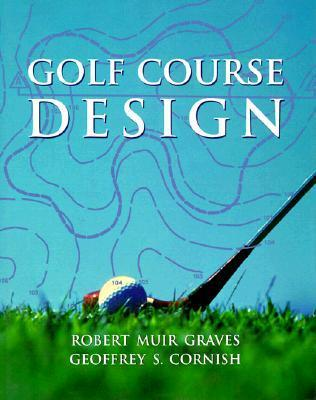
    Golf Course Design by Robert Muir Graves and Geoffrey Cornish is a comprehensive, 445-page reference that explores nearly every facet of building and understanding a golf course. Graves and Cornish, both accomplished golf architects, bring decades of hands-on experience to this work. Graves, who was known for his work in California and the Pacific Northwest, adds West Coast innovation and a builder’s mindset, while Cornish complements with a grounded, research-based approach rooted in New England tradition. Together, they walk readers through routing logic, grading plans, turf selection, irrigation strategy, construction equipment, permitting challenges, and even the financial realities of golf development. The book is methodical and deep—essentially a textbook—and even includes practical exercises for aspiring designers.

    Cornish’s influence is particularly strong in Connecticut, with designs and renovations at Lyman Orchards, Oxford Greens, and contributions to TPC River Highlands, among many others. His emphasis on walkability, land efficiency, and subtle strategy shows up in dozens of courses across the region. Reading this book helped me understand those design philosophies in action. It’s an eye-opener for anyone who wants to understand not just how a course looks, but how and why it works. For Connecticut golfers, it’s a guide to recognizing the architectural DNA of the places we play every week.

    Content

    Graves and Cornish cover everything from routing fundamentals to grading, turfgrass evapotranspiration rates, financing, and even architectural training. The writing balances engineering know-how with conceptual elegance, especially when discussing shot values, elevation change, and land exchange logistics. They manage to walk the line between academic and practical, offering ideas you can apply whether you’re designing a course or just trying to understand why certain holes play better than others.

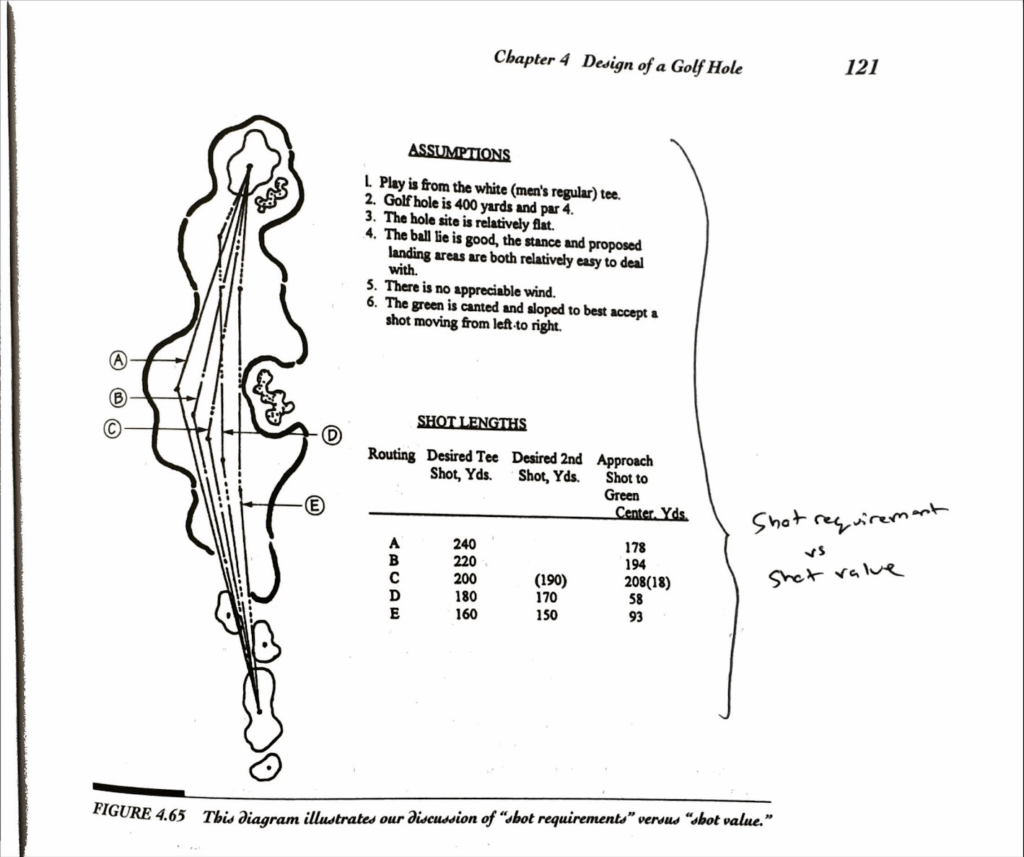
    Pro: The section on designing individual golf holes (Chapter 4) blew my mind. Their shot-length table (Figure 4.65) maps out multiple routings for the same 400-yard hole with different tee shots, second shots, and approach angles. It changed how I approached hole 7 at my home course, where I started playing a low runner off the tee to the left side to open up the green angle—something I never would’ve thought about before. That chart, more than any other single diagram, made me think about decision-making in layers. What felt like a forgettable hole was suddenly full of possibilities.

    Con: The book is entirely architecture-focused. If you’re looking for any swing tips or short game instruction, look elsewhere. It also leans heavily on design theory without always grounding it in real-world case studies for casual readers. While I loved the depth, I could see how a newer golfer might get lost without more applied examples or before-and-after transformations.

    Structure

    The book is divided into three logical parts: “The Game and the Course,” “Construction and Grow-In,” and “The Business of Golf Course Design.” It progresses naturally from theory to practice, though it’s thick enough to double as a reference manual. Chapters can stand alone, which makes revisiting key ideas easy. It doesn’t spoon-feed, but it rewards curiosity—especially if you’re willing to follow cross-references and bounce between chapters like a real-world routing plan.

    Pro: I appreciated how each chapter builds on the last without becoming redundant. The transition from routing theory to grading and then into turf and irrigation felt like walking the land step-by-step as a real architect would. By the time I reached the back third, I was seeing connections I missed on the first read. It’s one of those books that quietly assumes the reader is smart enough to keep up, and I liked that.

    Con: Some chapters, especially those with multi-author contributions, lose a bit of cohesion. There are few subheadings within long chapters, which makes skimming difficult if you’re trying to re-find a specific insight. I wish there were clearer summary sections at the end of major topics, especially in the technical chapters like turfgrass science.

    Visuals

    The visuals are utilitarian but powerful. Diagrams like the starburst routing concept (Figure 2.43) or the turfgrass evapotranspiration table (Table 13.7) do far more than decorate—they explain. Hole sketches, routing plans, drainage schematics, and even lake-liner construction diagrams are sprinkled throughout. These illustrations don’t try to impress—they try to teach. And they succeed.

    Pro: One standout was the land swap map for Minisceongo Golf Club (Figure 16.3). It helped me understand how geography, politics, and design all collide to make a feasible routing. I’ve looked at local GIS maps completely differently ever since. Similarly, the lake lining detail (Figure 8.16) now lives rent-free in my head whenever I play Whitney Farms, and I catch myself scanning for telltale signs of clay banks or buried liners.

    Con: I wish there were more 3D elevation sketches, especially when discussing green contouring or bunker shaping. Without them, some vertical concepts feel abstract. A side-by-side of green profiles or before/after shaping shots would have made a few sections—especially grading and drainage—much more vivid.

    Engagement

    This isn’t beach reading, but it’s not dry either. The tone is practical, knowledgeable, and seasoned. You can feel the authors’ years in the field, especially Cornish, who helped shape much of New England’s golf landscape. It rewards slow, thoughtful reading more than quick skimming. That said, this is absolutely a heavy read—essentially a textbook, and it even includes design exercises. It’s the kind of book you digest in small doses with a pencil in hand.

    Pro: I stayed hooked because every chapter gave me something concrete to apply on my next round. The explanations are clear without being dumbed down. It feels like you’re being coached by someone who’s walked more ground than you ever will. And as someone who plays both new and old tracks across Connecticut, I now have a richer vocabulary for what I’m seeing and feeling out there.

    Con: Some segments on permitting and legalities (especially in Part III) are dense and bureaucratic, best skimmed unless you’re planning to actually build a course. Still, I found it oddly fascinating—and slightly daunting—to see the exhaustive list of permits and environmental considerations that go into even a modest course renovation. It gave me a new respect for what had to happen to make a place like Bandon Dunes possible. Honestly, it makes the green fee easier to stomach when you realize what went on behind the scenes just to get it built.

    Final Thoughts

    Golf Course Design by Graves and Cornish fundamentally changed how I play, watch, and think about golf. I now walk every course with a mental checklist: where are the angles, where is the contour helping or hurting, what is the tee shot really asking me to do? Even televised golf looks different—I notice land movement and pin placements with far more nuance. It also helped me appreciate that some of the quirks I thought were flaws at my home course might be half-finished strategic ideas, victims of budget or land constraints. Compared to modern books like Doak’s Anatomy of a Golf Course, this one offers a more encyclopedic, less poetic approach—but just as much depth. I loved how it helped me see the hidden logic behind the ponds at Whitney Farms, or the elevated tee boxes at Longshore that I used to just take for granted. This book doesn’t just sit on my shelf—it travels with me mentally to every tee box I step on.

  • Anatomy of A Golf Course Book Review

    Anatomy of A Golf Course Book Review

    Tom Doak’s Anatomy of a Golf Course was the book that pulled me into the world of golf architecture. I remember the moment bunker placement clicked for me—how it forces bold players to take on risk while letting cautious players bail out. That insight alone changed how I play. Over time, I kept hearing podcast after podcast where today’s top architects called this book their gateway into the field. I get it. My copy is filled with scribbles, highlights, and folded corners. I keep going back to it. Doak doesn’t just describe design—he makes you see what architects are trying to make you think. If you care about how a golf course challenges your brain as much as your swing, this book delivers.

    Content

    Doak presents architectural concepts with a clarity that cuts through the noise. He breaks down routing principles, green shaping, fairway width, and hazard positioning—not in abstract terms, but in a way that made me immediately think about specific holes I’ve played. When he explains how a diagonal hazard forces you to choose a line based on how aggressive you’re feeling, I thought about the par-5 third at Richter Park or the ninth at Keney Park. His use of real-world examples like The Old Course and Pine Valley reinforces every point. What stood out most was how he treated strategy as a spectrum—never labeling one approach as right, but explaining how design encourages a certain mindset.

    • Pro: Doak’s chapter on the psychology of design completely reframed how I approach every hole. He doesn’t just say, “here’s a bunker”—he shows how its location affects the average, the risk-taker, and the overly cautious player. His examples tie directly into recognizable decisions we all face—laying up short of water, cutting a corner over a bunker, or playing to the fat part of the green. He constantly connects theory to on-course experience. After reading, I found myself questioning why every bunker was placed where it was.
    • Con: There’s zero instruction about how to hit a golf ball. For a newer player or someone expecting tips on swing path, setup, or putting mechanics, the book offers nothing. While that’s clearly not its purpose, it could surprise a reader expecting a broader “how to play better golf” title. Everything is focused on how the course is built—not how you should physically execute shots.

    Structure

    The book follows a clear and deliberate structure that reflects how a golf course itself takes shape. Doak begins with routing, the backbone of any course, then zooms in progressively—first to green complexes, then hazards, then individual shot values. Each chapter builds logically off the last, and that layering made it easy to follow without rereading. I appreciated that there were no wasted detours or unnecessary filler. Even when discussing maintenance or practice facilities, Doak ties the details back to the playing experience.

    • Pro: The progression from macro to micro mirrors how a designer builds and how a serious player learns to see. I loved how routing came first—because it really is the starting point of any great course. The chapters on greens and bunkers don’t just describe features—they show how those features complete the strategic intent introduced by the routing. It all clicks together, like a well-designed hole.
    • Con: The book lacks visual formatting aids like subheadings, callout boxes, or summaries at the end of each chapter. When I wanted to reference something I remembered about green shaping or false fronts, I had to flip and scan instead of spotting it right away. The content rewards careful reading but doesn’t support quick browsing. If Doak ever revises it, adding visual navigation would dramatically improve its usability.

    Visuals

    The visuals are sparse but functional. Most diagrams are black-and-white sketches that highlight hole layouts, green contours, or bunker placements. There’s a small color section in the middle that adds texture to the presentation, but it’s clearly not a photo-driven book. The emphasis is on conceptual clarity rather than artistic impact. I found myself wanting more overhead routings and more examples of green contour maps—not to impress me, but to help visualize what was being described.

    • Pro: The diagrams serve their purpose without overcomplicating things. For instance, when Doak shows how a diagonal hazard increases decision-making, the simple drawing communicates that idea more effectively than a glossy photo ever could. They reinforce strategic principles cleanly and encourage the reader to imagine how they’d play it. I often flipped back to these while reading, using them like a map.
    • Con: The lack of 3D visuals or more dynamic elevation sketches can make it harder to picture complex greens or deep bunkering. When discussing push-up greens or fallaway slopes, I had to mentally translate the description into an image—and sometimes I wasn’t sure I got it right. A few more detailed or shaded renderings would’ve really helped, especially in the chapters on approach shots and short-game areas.

    Engagement

    Doak writes with the confidence of someone who’s walked thousands of fairways and thought deeply about every one. His tone is straightforward, sometimes blunt, but always focused. He rarely strays from the architectural subject matter, which I appreciated—it keeps the book tight and purposeful. I never felt like he was showing off or flexing design credentials; instead, I felt like he genuinely wanted to help readers see through a course’s strategic lens. That said, the book isn’t heavy on personal stories or narrative tangents—this is design talk, not memoir.

    • Pro: I felt smarter after every chapter. Doak doesn’t overcomplicate things, but he makes you think harder about what you already know. His tone has the clarity of a college lecture without the pretension. He challenges assumptions about “hard” holes versus “well-designed” ones. And every time I play now, I find myself silently quoting ideas from this book.
    • Con: Readers who crave a more colorful or anecdotal style might find the prose a bit flat. There’s not much storytelling, no long riffs about travels or quirky designers. It’s not dry, but it is laser-focused. That focus is a strength for people like me who want to learn design—but it might lose readers looking for more personality or charm.

    Final Thoughts

    Anatomy of a Golf Course completely changed how I see golf. I used to just play holes. Now I read them. I look at tee shots and think about the corridor width, the intended landing zone, the angle into the green, and what a poor shot tells me about the architect’s intent. That’s why I rated this book so highly—because it didn’t just inform me; it changed my behavior. The content is precise, the progression makes sense, and I’ve revisited passages dozens of times since my first read.

    It also helped me enjoy watching golf more. When I tuned into the U.S. Open at Oakmont, I found myself understanding the flyover commentary in a way I never could before. I recognized how the bunkers, greens, and fairway contours were shaping each shot and decision. That flyover preview used to just look cool—now I could decode it. And with the Traveler’s Championship right around the corner here in Connecticut, I can’t wait to apply what I’ve learned and see TPC River Highlands with new eyes.

    When I compare it to modern books like Geoff Shackelford’s Grounds for Golf (2003), Doak’s work is sharper in tone and tighter in focus. Shackelford brings more historical sweep and visual punch, but Doak gives you the tools to break down a hole and reconstruct its strategic DNA. Anatomy feels like a blueprint I’ll keep using for years.